


As technology advances, smartphones are becoming more powerful. We use them for payments, to unlock doors, and even to track items. Many people are curious if their smartphones can read RFID tags. This article will answer that question for you and help you understand which RFID tags are compatible with smartphones and how to take advantage of this technology.
Quick Answer
Can smartphones read RFID tags? The short answer is yes—but only in very limited cases. Smartphones can only read certain RFID tags, specifically those that use NFC technology operating at 13.56 MHz.
1. What is RFID and How Does It Work?
RFID (Radio Frequency Identification) is a technology that uses radio waves to identify and exchange data with objects without physical contact.
In a basic RFID system, there are three main components: tags, readers, and antennas.
The tag stores information, the reader captures that information, and the antenna enables communication between them using radio signals.
In simple terms, RFID allows data to be transmitted wirelessly over short or long distances, depending on the type of system being used.
2. Can Smartphones Read RFID Tags?
Smartphones can read RFID tags, but only under specific conditions.
In most cases, smartphones are limited to reading RFID tags that use NFC technology, which operates at 13.56 MHz. This includes common use cases such as contactless payment cards and certain access control cards.
Both Android and iPhone smartphones must support NFC functionality, allowing them to interact with these types of high-frequency RFID tags.
However, smartphones cannot read low-frequency (LF) or ultra-high-frequency (UHF) RFID tags. These types of RFID systems require dedicated readers with specialized hardware and antennas, and are widely used in applications such as logistics, asset tracking, and industrial identification.
This limitation is also why many people confuse RFID with NFC in the first place.
3. Differences Between RFID, NFC, and Bluetooth
Since most smartphones already support NFC and are widely used for reading NFC tags, many people naturally assume that smartphones may also be able to read all RFID tags.
However, NFC is actually a subset of RFID technology. It operates at 13.56 MHz and is designed specifically for very short-range communication, which is why it is commonly supported by smartphones.
RFID, on the other hand, is a much broader technology category that includes multiple frequency types, such as low-frequency (LF), high-frequency (HF), and ultra-high-frequency (UHF) systems. These different RFID types are used in very different applications and are not all compatible with smartphones.
In simple terms, NFC is the part of RFID that smartphones can use, while RFID itself covers a much wider range of technologies beyond smartphone capability.
Bluetooth is a short-range transmission technology based on radio waves, primarily used for data synchronization between devices. Therefore, although NFC and RFID share many similarities, their application scenarios and technical architectures differ.
4. What Type of RFID Tags Can Smartphones Read?
To understand which RFID tags smartphones can read, we first need to grasp the different types of RFID tags and how they operate.
NFC Tags
Most modern smartphones support NFC (Near Field Communication) capabilities, allowing them to interact with certain types of RFID tags. NFC operates at a frequency of 13.56 MHz, which falls under the category of high-frequency (HF) RFID. NFC is widely used in close-range applications like contactless payments and keyless access. If you’ve ever used your phone to “swipe” a card to pay at a store, you’ve experienced how NFC works.
High-Frequency RFID Tags (13.56 MHz)
In addition to NFC, smartphones can also read standard high-frequency (HF) RFID tags that also operate at 13.56 MHz. These tags are typically used in scenarios where short-range communication is sufficient, such as inventory management, product tracking, or identity verification. NFC-enabled smartphones can read these tags for various commercial and industrial applications that require short-range data transmission.
Low-Frequency and Ultra-High-Frequency RFID Tags
At this point, smartphones have some limitations. Low-frequency (LF) RFID tags typically operate at 125-134 kHz, while ultra-high-frequency (UHF) RFID tags operate between 860 MHz and 960 MHz. Smartphones cannot read these tags. These RFID tags are usually used in specialized scenarios like animal tracking, vehicle identification, and long-distance data transmission in supply chain management. Smartphones cannot directly read these types of RFID tags due to the different frequencies and the need for more powerful antennas and specialized RFID readers to process the signals.

5. How to Read RFID Tags with a Smartphone
Now, let’s take a look at how iPhone and Android phones read RFID tags respectively.
iPhone and NFC: How to Read RFID Tags
For iPhone users, Apple has built-in NFC chips starting from the iPhone 7 and later models. However, the NFC function in earlier iPhone versions (like the iPhone 7 and iPhone 8) was mainly used for payment services such as Apple Pay, and users could not directly read regular NFC tags. Starting with the iPhone XS and later models, Apple opened up the NFC functionality, allowing users to read NFC tags directly without third-party applications.
However, if more advanced functions are required, such as reading specific tag information or writing new data to the tag, users can still achieve this by downloading third-party applications (like NFC Tools, TagInfo). The specific steps are as follows:
Download and install NFC applications: Search for and download applications that support NFC reading and writing from the App Store.
Open the application and approach the NFC tag: After launching the application, follow the prompts to bring the iPhone close to the NFC tag.
Read or write information: Read the information on the tag or write new content to the tag according to the instructions on the application interface.
This way, iPhone users can use NFC more flexibly to meet various daily or business needs.
Android and NFC: How to Read RFID Tags
Android phones are more open when it comes to NFC support. Most Android devices come with built-in NFC capabilities, allowing users to read and write NFC tags through system settings or third-party applications.
Enable NFC: Locate the “NFC” or “Wireless & Networks” option in your phone’s settings and ensure the NFC function is turned on.
Download NFC apps (optional): While many Android phones have built-in NFC capabilities, downloading third-party apps can offer additional features and convenience.
Approach NFC tags: Place the back of your phone close to the NFC tag, and the phone will typically recognize it automatically and pop up relevant options.
Perform actions: Read the tag information or carry out other operations according to the prompts on your phone.
6. Comparison Between Smartphones and Professional RFID Readers
While smartphones are very convenient for reading NFC and high-frequency RFID tags, their performance still lags significantly behind that of professional RFID readers. Here’s a comparison between the two in several aspects:
Read Range: Smartphones typically have a very limited read range, able to read tags only within a few centimeters, whereas professional RFID readers can read tags several meters away or even farther.
Data Processing Speed: Professional devices boast faster reading speeds and can read multiple tags simultaneously, while smartphones usually read tags one at a time.
Tag Type Support: Smartphones only support NFC and some high-frequency RFID tags, while professional readers can read a wider variety of RFID tag types, including low-frequency and ultra-high-frequency tags.
When Should Professional RFID Readers Be Used?
In scenarios like large-scale inventory management or supply chain tracking, professional RFID readers are undoubtedly the better choice. Their superior reading capabilities and broader tag support can significantly enhance work efficiency. Smartphones are primarily suited for everyday applications, such as access control systems and personal item tagging.
7. Practical Applications of Smartphones Reading RFID Tags
Practical Applications of Smartphones Reading RFID Tags
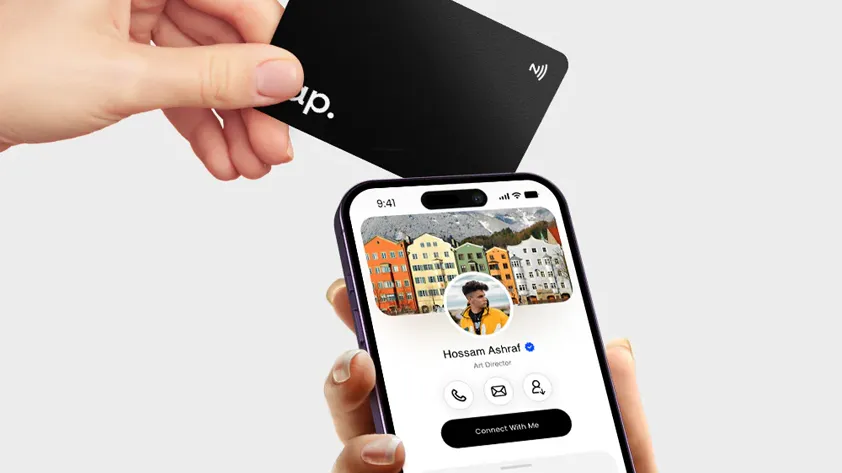
Smartphones equipped with NFC technology have become increasingly useful tools for interacting with certain RFID tags. While they cannot replace professional RFID readers, they can support a range of practical applications in both consumer and small business scenarios.
Contactless Payment and Access Control
NFC technology is widely used for contactless payments, such as Apple Pay and Google Pay. Users can complete transactions simply by bringing their phones close to a payment terminal.
Additionally, many companies and office buildings integrate NFC tags with smartphones for access control, enhancing work efficiency and security. Smartphones make it easy to interact with these systems in everyday environments, providing convenience without additional hardware.
Inventory Tracking and Asset Management for Small Businesses
For small businesses, smartphones can serve as simple RFID reading tools to assist in inventory tracking and asset management. By tagging products with NFC tags, businesses can quickly scan and manage stock without investing in expensive professional equipment.
Product Authentication and Verification
A particularly valuable application for small businesses is product authentication. By embedding NFC tags in packaging or labels, smartphones can be used to verify the authenticity of products, helping businesses prevent counterfeiting and protect brand integrity. This feature is especially useful in industries like consumer electronics, luxury goods, or specialty products.
Daily Use Scenarios for Consumers
Consumers can benefit from smartphones reading RFID/NFC tags in their personal lives:
- Tracking personal items such as keys, wallets, or gadgets by attaching NFC tags and scanning them with a smartphone.
- Organizing small items for easy location and management in everyday life.
Conclusion
Smartphones can read some RFID tags, but only those that use NFC technology at 13.56 MHz. They cannot read most other RFID types. For everyday use, this is enough for payments and basic access. But for businesses, smartphones cannot replace dedicated RFID systems in terms of performance, range, and reliability. Choosing the right RFID solution depends on your actual needs—not just device compatibility.
FAQs
1 Can all smartphones read RFID tags?
No. Most smartphones only support NFC tags and cannot read other types of RFID tags.
2 Is there an application that can read RFID chips?
Yes, users can download apps such as NFC Tools to read NFC tags.
3 What is the difference between NFC and RFID?
NFC is a type of RFID that is specifically designed for short-range communication, while RFID includes multiple frequencies and supports a wider range of applications.
4 How can I scan RFID tags in inventory using my phone?
You can attach NFC tags to items and scan them one by one with your smartphone, but this is suitable for small-scale inventory management.
5 Can I program RFID tags with my phone?
Some smartphones can program NFC tags, depending on the device and application support.


