

When planning an RFID system, the most common question asked is: “How far can this tag be read?” Whether you are looking to implement automated pallet identification at a busy warehouse dock or seamless access control at an office entrance, the read range of RFID tags directly determines the success or failure of your system. Choosing a range that is too short leads to missed reads, while blindly chasing excessive range increases unnecessary costs and signal interference. This guide dives deep into the core factors affecting the read range and provides professional selection advice for mainstream 2026 applications, helping you build an efficient and stable identification system.
1. Why is Understanding the RFID Tag Range Important?
RFID tag read range refers to the maximum distance at which an RFID reader can successfully detect and communicate with a tag under specific operating conditions. Read range is more than just a technical specification; it is directly linked to workflow fluidity:
•Logistics Efficiency: If a forklift has to stop and wait for a scan, automation loses its meaning.
•Asset Security: If critical assets move out of range without being recorded, it creates a security loophole.
•Cost Optimization: Understanding your actual range requirements prevents wasting budget on expensive active systems when passive ones would suffice.
2. Factors Affecting The Range of RFID Tags: Why Lab Results Often Differ from Reality
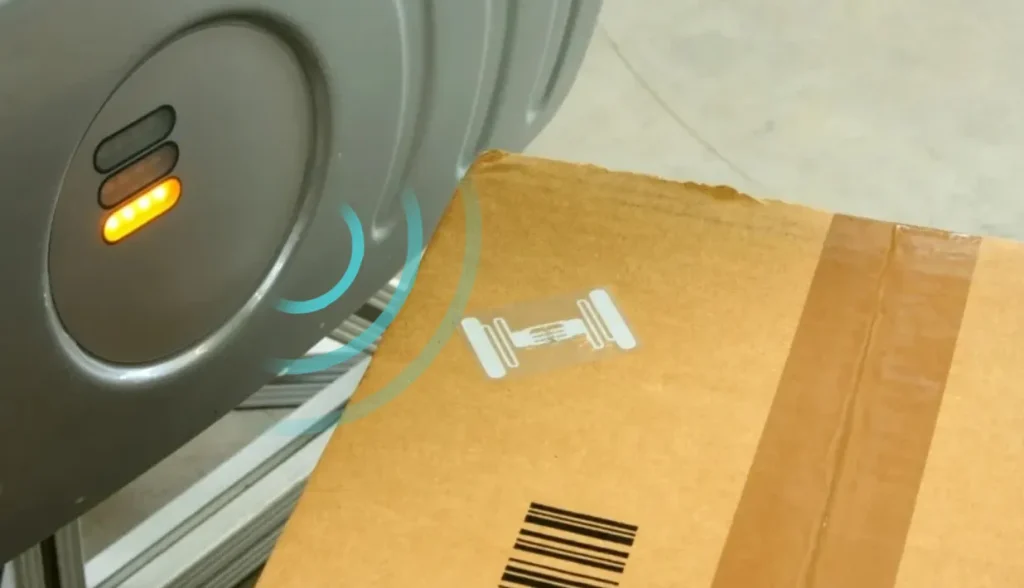
RFID read range is not determined by the tag alone. It is the result of the interaction between the tag, reader, antenna system, and surrounding environment. A tag rated for 10 meters in laboratory conditions might only achieve 5 meters in your warehouse. This is due to four key variables:
Reader Power: Higher power means a stronger signal, but it must comply with local radio frequency regulations.
Tag Size & Antenna Design: Generally, larger tags capture energy more effectively, resulting in a longer read range.
Environmental Media: Metal and liquids are the “natural enemies” of RFID. Metal reflects signals, while liquids absorb them.
Electromagnetic Interference: Large motors, Wi-Fi routers, or other electronic devices in a warehouse can compress the effective reading space.
3. Types of RFID Tags and Their Read Ranges: Selection Matrix
To simplify your decision-making, we have summarized the performance of different technologies below:
| Tag Type | How It Works | Typical Read Range* | Applications |
|---|---|---|---|
| Passive RFID | Powered by reader energy | From a few centimeters to several meters depending on frequency and design | Inventory, retail, apparel tracking |
| Active RFID | Uses an internal battery to transmit signals | Tens to hundreds of meters depending on environment | Vehicle tracking, RTLS, yard management |
| Battery Assisted Passive (BAP) | Uses battery assistance while communicating with readers | Several meters to tens of meters depending on configuration | Sensor monitoring, cold chain |
*Actual read range depends on frequency, reader power, antenna configuration, tag size, and installation environment.
4. The Impact of Frequency on RFID Tag Range
Frequency is one of the key factors influencing RFID read range. Choose the appropriate frequency band based on your business requirements:
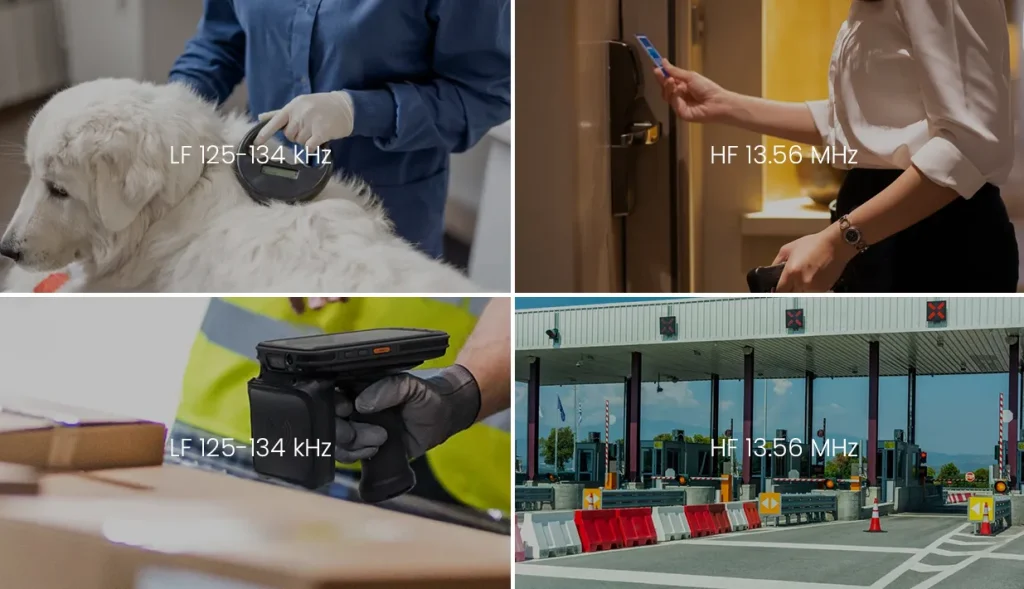
•Low-Frequency (LF, 125-134 kHz): < 10 cm. Low impact from liquids; ideal for animal identification.
•High-Frequency (HF, 13.56 MHz): < 1 meter. High security; ideal for payments and access control.
•Ultra-High-Frequency (UHF, 860-960 MHz): 3 – 12 meters. Strongest bulk-reading capability; the absolute mainstream for warehousing and logistics.
•Microwave (2.45 GHz): Up to 30 meters. Commonly used for high-speed toll collection (ETC).
5. Environmental Factors: How to Maintain Stable Range in Harsh Conditions
Challenge 1: Metal Surfaces
If a standard RFID tag is attached directly to a metal surface, its performance can be significantly reduced because metal affects antenna performance and signal propagation.
Solution: You must use specially designed On-metal RFID Tags that utilize ceramic or specialized spacers for signal isolation.
Challenge 2: Extreme Temperature & Humidity
High temperatures can cause chips to fail, while high humidity interferes with signal propagation.
Solution: Choose Industrial-grade Ruggedized tags to ensure the range does not shrink in cold storage or outdoor exposure.
6. A longer read range does not always mean a better RFID system.
For example:
- A warehouse may need long-range UHF reading for pallet tracking.
- A retail store may prefer controlled reading areas to avoid unwanted reads.
- An access control system usually requires short and precise reading distance.
The goal is not to achieve the maximum possible range, but to achieve reliable reads within the required operating area.
7. Practical Applications: How Much Range Do You Actually Need?
•Warehousing & Logistics: UHF RFID systems are commonly designed for pallet identification within approximately 5-8 meters. Actual performance depends on tag placement, pallet materials, reader configuration, and warehouse conditions.
•Retail Inventory: Recommended 1-3 meters. Allows staff to quickly scan shelves with handheld devices while helping reduce unintended reads from nearby areas.
•Medical Asset Tracking: Recommended 3-5 meters. Helps automatically identify tagged medical equipment when entering configured reading zones.

8. How to Choose the Right RFID Tag
Before contacting a supplier, please review this checklist:
Target Range: What is the maximum distance you need to read the tag?
Mounting Surface: What material will it be attached to? (Plastic, cardboard, or metal?)
Reading Speed: Is it single-item reading or 100+ items per second?
Budget Balance: Chasing extreme range usually implies higher tag costs.
Expert Support: Optimize Your RFID Read Performance
Read range insufficient? Signal unstable? Don’t waste time on trial and error. Our expert team provides:
[Free Online Environment Assessment] – Tell us your scenario, and we will recommend the best frequency band.
[Apply for On-metal/Long-range Tag Test Kit] – Verify performance in your actual environment.
[Custom Antenna Layout Plan] – Eliminate blind spots and ensure a 100% read rate.
FAQs
Q1: Why can’t my UHF RFID tag be read beyond 5 meters?
Check if the antenna polarization matches, or if the tag is attached to a surface with high water content.
Q2: Are there passive RFID tags that can read beyond 15 meters?
Yes, by using high-gain antennas and specialized long-range UHF chips, though these tags are typically larger in size.
Q3: Can I solve all problems by turning the RFID reader power to maximum?
Not necessarily. Excessive power increases signal reflection (multipath effect), which can cause reading confusion. Proper system design is more important than simply increasing power.


