


RFID Card Printing is not just about putting a logo on plastic. The real value comes from getting the print method, chip type, encoding data, and application fit right from the start. When these elements line up, cards issue faster, read more reliably, and work smoothly with access control, hotel locks, campus systems, and transit programs.
Why RFID Card Printing and Encoding Should Be Planned Together
In practice, the printed design, card construction, chip selection, and encoding workflow all affect issuance speed and system compatibility. HID notes that many printer platforms combine visual personalization with contact or contactless encoding in one issuance process, while NXP documents that secure card data can be initialized during production or later personalization.
Printing makes the card visible
Printing covers the human-facing layer: branding, photo ID, serial numbers, QR codes, barcodes, signature panels, or security graphics.
Encoding makes the card functional
Encoding writes data to the chip so the card can open a door, identify a user, log attendance, or support stored applications. For many HF cards, this sits within ISO/IEC 14443-based ecosystems at 13.56 MHz, which are widely used for secure short-range credentials.

A Practical RFID Card Printing Buyer Checklist
| Buyer Question | Why It Matters | What to Confirm |
| What system will the card work with | Compatibility decides everything | Reader model, protocol, software |
| Which chip is required | Wrong chip means failed deployment | MIFARE, DESFire, LF, UHF, etc. |
| What data must be encoded | Prevents rework later | UID use, sector data, key structure |
| How will cards be printed | Impacts image quality and durability | DTC, retransfer, monochrome, lamination |
| Where will cards be used | Environment affects material choice | Hotel, campus, office, transit |
How to Choose the Right Setup
Match the chip to the use case
For secure multi-application projects, buyers often move toward DESFire-class chips because they support stronger security features and flexible file structures. NXP positions MIFARE DESFire EV3 for smart city, campus, and secure service environments.
Choose the right RFID Card Printing method
For standard branded cards, direct-to-card printing is common. For higher image quality or edge-to-edge graphics, retransfer printing is often preferred. HID markets both inline printing and encoding for high-volume credential issuance.
Define the encoding rule before production
This is where many purchasing teams save time. Decide whether the card stores only an identifier or additional application data. In RFID projects tied to EPC workflows, GS1 provides encoding tools and guidance so data can be structured correctly before programming begins.

What Good RFID Card Printing Looks Like
Campus credential programs increasingly require one card to support photo identification, building access, and other services in a single issuance flow. Industry case material on university access systems highlights the importance of printing, encoding, and activation working as one managed process rather than separate tasks.
Wise Purchasing Decisions
RFID Card Printing should be evaluated as an issuance workflow, not a commodity item. A low unit price means little if the print surface scratches easily, the chip is incompatible, or the encoded structure must be redone. Buyers who specify material, print finish, encoding format, and test procedure upfront usually get faster deployment and fewer replacement orders.
Points to Consider Before Ordering RFID Cards
- Whether printing and encoding should be completed in one workflow
It is worth confirming whether printing and encoding should be completed within the same production process. This can reduce extra handling, improve consistency, and make card issuance more efficient. - Compatibility with existing systems
Compatibility with reader models, lock systems, software platforms, and communication protocols should be confirmed in advance to avoid deployment problems later. - Sample testing before mass production
Sample testing is recommended before mass production so that reading performance, encoding accuracy, and system compatibility can be verified under actual use conditions. - Customization requirements
Numbering, barcodes, QR codes, branding, photos, and other variable data should be defined clearly before production begins. Early confirmation helps reduce delays and rework. - Supply consistency for larger orders
For wholesale or ongoing projects, production capacity, lead time stability, and quality consistency should all be evaluated before order placement.

Conclusion
By treating printing, encoding, and application compatibility as one integrated decision, you could achieve a more efficient card issuance process, better system compatibility, and cards that perform reliably in real-world use. After reading this article, if you are looking for custom RFID Card Printing, hotel key cards, campus cards, or access control card solutions, you can visit rfidcard.com to explore more specifications, request samples, or get project advice.
FAQs
What is the difference between RFID Card Printing and RFID card encoding?
Printing creates the visual design on the card surface. Encoding writes usable data to the chip so the card can interact with readers and software.
Can RFID Card Printing include custom numbering, barcodes, and chip programming in one order?
It is usually possible to complete graphic printing, variable data printing, barcode or QR code generation, and chip encoding within the same production order.
Recommended Product
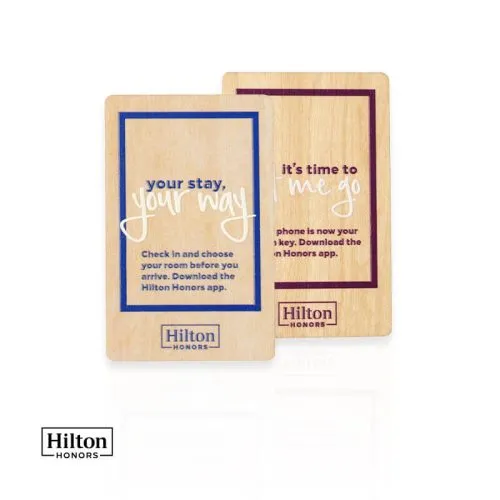
Wooden Hilton Key Card Copy

The wooden RFID key cards we designed for Hilton Hotels are made from sustainable, natural, eco-friendly wood, and their unique texture exudes a luxurious feel. Each card is fully customized to seamlessly integrate with Hilton’s existing RFID locking system, providing guests with secure and convenient access.
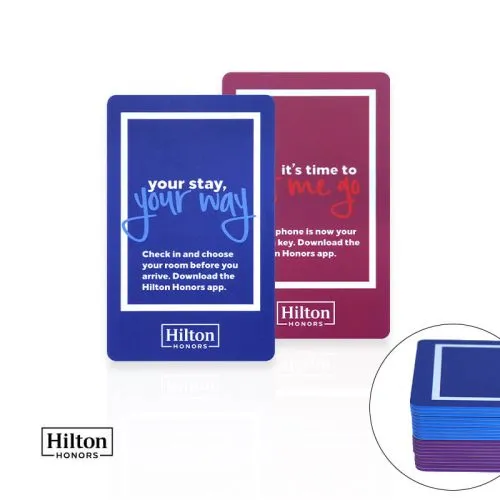
ColorEdge™ Hilton Key Card Copy
Our ColorEdge™ card is specifically designed for Hilton Hotels. Unlike ordinary white PVC cards, this card uses ColorEdge™ material, which not only provides secure room access but also aligns well with Hilton‘s brand image, reflecting the hotel’s fashion and luxury. Its unique design allows every guest to experience a high-end stay, perfectly combining security and style.
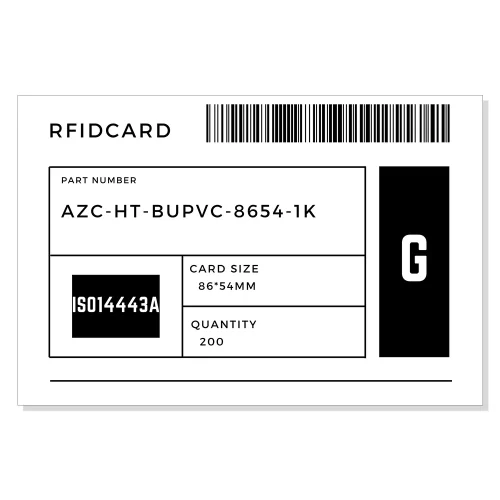
Hotel Key Card
Our ColorEdge™ card is designed to deliver a premium experience beyond traditional white PVC cards. Made with advanced ColorEdge™ material, it provides reliable room access while enhancing the visual appeal with a refined, stylish finish. Combining functionality, durability, and elegant design, this card helps hotels create a more memorable guest experience while reflecting a modern and sophisticated brand image.
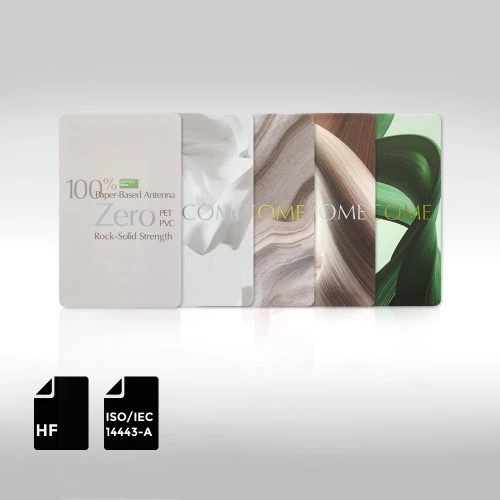
BioPoly™ Stone RFID Card Made with 100% Paper-Based Antenna NXP® MIFARE Ultralight® EV1
The RFID BioPoly™ Stone Card Made with 100% Paper-Based Antenna is designed for brands seeking high performance with a lower environmental footprint. Featuring a Zero PET, Zero PVC paper-based antenna combined with durable BioPoly™ Stone, it delivers rock-solid strength and reliable RFID performance. As the industry’s first developer of paper-antenna RFID cards, we continue to advance eco-friendly RFID solutions through sustainable innovation. Powered by NXP® MIFARE Ultralight® EV1 and compliant with ISO/IEC 14443-A, it is ideal for access control and identification applications.



