The proliferation of NFC technology in modern smartphones has fundamentally changed how we interact with the world, from making contactless payments to quickly pairing devices. A common question that arises is whether NFC in mobile phone, can function as a full-fledged Radio Frequency Identification (RFID) reader. While NFC is a subset of the broader RFID family, its capabilities and limitations, particularly concerning reading range and tag compatibility, are often misunderstood. This article will thoroughly explore the technical relationship between NFC and RFID, detail the reader capabilities of smartphones, and explain the practical constraints that define the role of a mobile phone in the world of RFID.
1. Understanding NFC in Mobile Phones
To understand the reading capabilities of a smartphone, one must first grasp the fundamentals of NFC and its hardware implementation.

1.1 NFC as Part of the RFID Family
NFC is a short-range, high-frequency (HF) wireless communication technology that operates at the 13.56 MHz frequency band. This places it squarely within the HF RFID standard. The relationship is hierarchical: all NFC devices are technically HF RFID devices, but not all HF RFID devices are NFC devices. NFC is essentially a standardized protocol built upon the HF RFID foundation, designed for secure, two-way communication over extremely short distances. While traditional RFID systems often focus on automation and long-distance identification, NFC emphasizes intentional actions such as tapping a card or phone. This design philosophy has a direct impact on how NFC in mobile phone behaves when attempting to read RFID tags.
1.2 Key NFC Components in Smartphones
To understand the limitations of NFC reading range, it is important to look at the internal components of a smartphone:
- NFC Antenna: Smartphone NFC antennas are extremely compact and constrained by device size and industrial design. They are typically placed near the top or back of the phone.
- NFC Controller: This chip manages communication protocols, modulation, and data exchange.
- Secure Element (SE) or Host Card Emulation (HCE): These components enable secure transactions and credential storage.
Unlike professional RFID readers, smartphones are not designed to output high RF power. This hardware limitation directly affects the performance of NFC in mobile as an RFID reader.
2. Can NFC in Mobile Phones Work as an RFID Reader?
The short answer is yes, but with significant caveats regarding the types of tags supported and the range achieved. Modern smartphones are designed to operate in three distinct modes: Reader, Card Emulation, and Peer-to-Peer. The Reader mode is the functionality that allows the mobile NFC to function as an RFID reader.

2.1 NFC Reader Mode in Smartphones
In reader mode, the phone is the active device, generating the electromagnetic field and initiating communication, while the tag is typically passive, drawing power from the phone’s field to transmit its data. Both major operating systems, Android and iOS, provide APIs that allow third-party applications to detect and read data from compatible NFC tags. This capability transforms the phone into a portable, low-power reader for specific applications.
2.2 RFID Tag Types Supported by Mobile NFC
Smartphones can read the following RFID tag types:
- NFC Forum Type 1–5 tags
- ISO/IEC 14443 Type A and Type B tags
- ISO/IEC 15693 tags (with limited range)
However, smartphones cannot read:
- UHF RFID tags (860–960 MHz), commonly used for inventory and asset tracking
- LF RFID tags (125 kHz), often used in legacy access control systems
This distinction is critical. Many indoor RFID systems rely on UHF technology for multi-tag and long-range scanning, which NFC in mobile phone devices simply cannot support.
3. Maximum Reading Range of NFC in Mobile Phones
The reading range is arguably the most significant constraint when attempting to use a mobile phone as an RFID reader.
3.1 Theoretical vs Practical Reading Distance
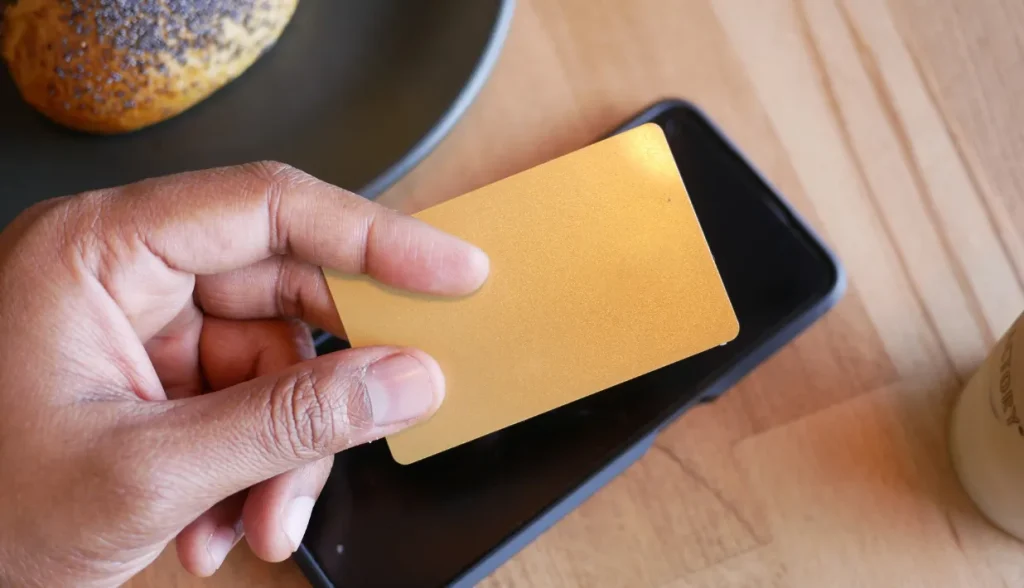
The NFC standard technically allows for a range of up to 10 cm, but this is an ideal, theoretical maximum achieved under perfect conditions with optimized, large antennas on both the reader and the tag. In practice, the effective reading distance for NFC in mobile phone is much shorter, typically between 1 cm and 5 cm. For reliable data transfer, the phone must often be placed directly against or very close to the tag, effectively making it a “tap” technology rather than a true short-range wireless one.
3.2 Factors Affecting Reading Range Indoors
Several factors contribute to the diminished real-world performance of mobile NFC:
- Antenna size and orientation: Both the phone and the tag must be properly aligned
- Tag antenna design: Larger HF tags perform better than compact ones
- Phone model and manufacturer: NFC performance varies significantly between devices
- Environmental interference: Metal surfaces, liquids, and electronic noise can degrade performance
As a result, NFC reading range indoors should always be evaluated in real-world conditions rather than assumed from specifications alone.
4. Performance of Mobile NFC in Indoor Environments
Despite the range limitations, mobile NFC excels in specific indoor use cases where short-range interaction is a feature, not a bug. The convenience and ubiquity of the NFC in mobile phone make it ideal for user-initiated, close-proximity tasks.

4.1 Typical Indoor Use Cases
Mobile NFC is widely adopted for:
- Access control and mobile credentials
- Identity verification
- Device configuration and commissioning
- Interactive user experiences
4.2 Limitations in Indoor RFID Applications
However, mobile NFC is not suitable for all indoor RFID use cases. Key limitations include:
- Single-tag reading only: Smartphones are not designed for bulk or anti-collision scanning
- No hands-free operation: User interaction is required for every read
- Limited speed: Not suitable for high-throughput environments
For applications such as inventory counting, asset tracking, or automated identification, these constraints make mobile NFC an impractical choice.
5. Mobile NFC vs Dedicated RFID Readers
Understanding the differences between mobile NFC and dedicated readers is crucial for selecting the right tool for an application. The table below summarizes the key distinctions:
| Feature | NFC in Mobile Phone | Dedicated RFID Reader (HF/UHF) |
| Reading Range | Very short (1–5 cm) | Short (HF: up to 1.5m) to Long (UHF: up to 10m+) |
| Output Power | Low (limited by battery/SAR regulations) | High (optimized for field strength) |
| Multi-Tag Reading | Non-existent | Excellent |
| Tag Compatibility | Limited to HF (13.56 MHz) protocols | Supports specific frequency bands (LF, HF, or UHF) |
6. Common Misconceptions About Using Mobile Phones as RFID Readers

Several misconceptions persist in the market:
- “All RFID tags can be read by smartphones” – False; only HF/NFC tags are supported
- “NFC reading range is similar to RFID readers” – Incorrect; smartphones are intentionally short-range
- “Mobile phones can replace industrial RFID readers” – Mobile phones cannot replace professional readers in industrial, high-volume, or long-range applications due to their limitations in power, range, multi-tag reading, and frequency compatibility.
7. Conclusion
So, can NFC in mobile phones work as RFID readers? The answer is yes—but with clear limitations. Smartphones can read certain HF RFID tags reliably at very short distances and are ideal for secure, intentional, and user-driven interactions. However, their limited reading range, lack of multi-tag capability, and lower RF output make them unsuitable for many traditional RFID applications.
FAQs
1. Can mobile NFC read all types of RFID tags?
No. Mobile NFC can only read high-frequency RFID tags operating at 13.56 MHz, such as ISO/IEC 14443 and some ISO/IEC 15693 tags.
2. Why is the NFC reading range on smartphones so short?
The short reading range is by design, not a flaw. NFC in mobile phone is optimized for secure, intentional interactions such as payments, access control, and identity verification. Limiting RF power reduces accidental reads, improves security, and lowers energy consumption, but it also restricts distance.
Recommended Product
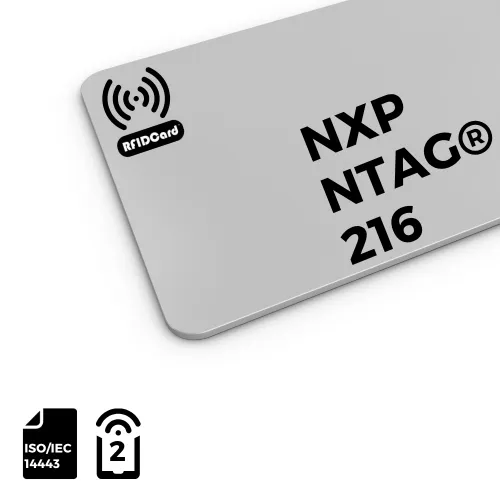
NFC Card NXP NTAG® 216 NFC Type 2

The NTAG® 216 RFID card is made with Photo quality standard PVC sheets into size of CR80, it programmed 7-byte UID with 888 bytes of user memory available (222 pages). The NTAG® 216 NFC ICs fully comply to NFC Forum Type 2 Tag and ISO/IEC14443 Type A specifications.