
When companies order NFC cards, they usually compare price, printing quality, and delivery time. Very few ask the most important question: How secure are these NFC cards? This is where many organizations unknowingly create serious security risks. Understanding NFC card security starts with understanding one critical fact:
The chip inside the card determines the security level — not the material, not the printing, not the frequency.
Mistake #1 — Choosing NTAG or UID Cards for Access Control or Payment
Many buyers select low-cost NFC chips like NTAG213, NTAG215, or simple UID-only cards for projects that actually require security.

To understand why this is a mistake, one must understand what these chips are: they are essentially digital sticky notes. NTAG chips are plain memory tags designed for marketing, URL sharing, or simple data exchange. But they have no encryption, no authentication, and open memory. Any smartphone with an NFC app can read or rewrite the data.
When a company uses the Unique Identifier (UID) of an NTAG card as the “key” to open a door, they are essentially using a lock that accepts any key with the right serial number written on it. Since these UIDs are broadcast openly to any reader that asks, an attacker doesn’t even need to steal the card; they just need to be near it for a split second to “sniff” the ID.
Mistake #2 — Not Understanding That Some NFC Cards Can Be Cloned in Seconds
The second mistake is a failure to recognize the ease with which legacy or low-end NFC cards can be cloned. In the world of hardware hacking, cloning is a commodity service. With tools, an amateur can duplicate a vulnerable card in less than five seconds.
The primary victims of cloning are cards that rely on static UIDs or outdated protocols like MIFARE Classic. In these systems, the reader simply asks the card for its ID, and the card provides it. This vulnerability has left thousands of legacy systems exposed. To mitigate this, companies must move toward chips that support mutual authentication.
Mistake #3 — Ignoring Encryption Standards (AES vs No Encryption)
This is where secure NFC cards become fundamentally different.
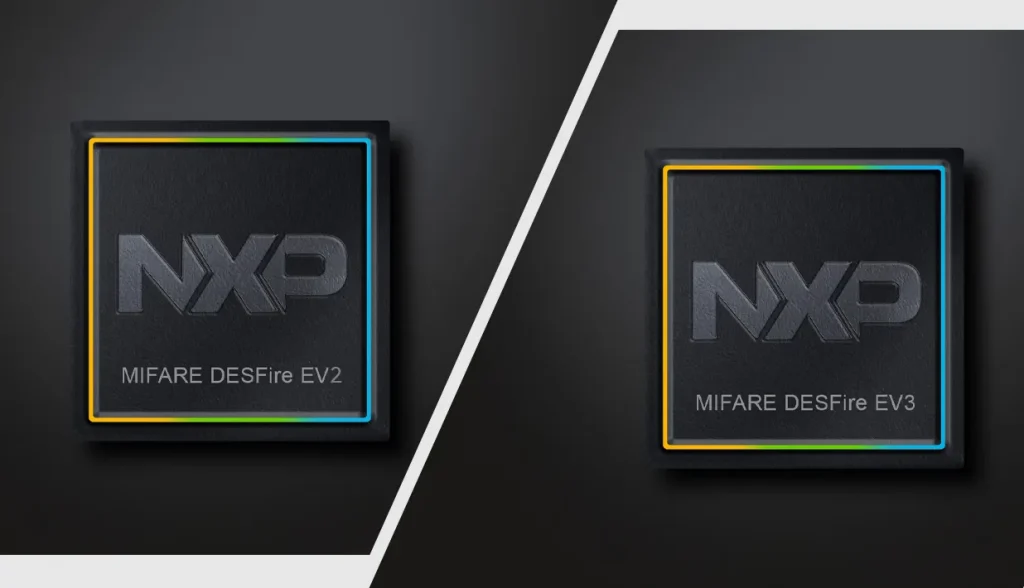
High-security chips such as MIFARE DESFire EV2 and MIFARE DESFire EV3 support:
- AES encryption
- Mutual authentication (card and reader verify each other)
- Encrypted memory structure
- Protection against replay and cloning attacks
Instead of exposing a readable UID, these cards perform a cryptographic handshake with the reader. Without the correct keys, the card simply will not respond with usable data.
Mistake #4 — Treating All MIFARE Cards as “Secure”
Many buyers believe: MIFARE cards are secure.But MIFARE is a brand family, not a security level. There is a major difference between:
| Chip Type | Security Level | Best Use Case |
| MIFARE Classic | Broken | Low-security loyalty cards, public transport (legacy) |
| MIFARE Plus | Medium | Migration path from Classic to DESFire |
| MIFARE DESFire | High | Corporate access, government ID, payment systems |
Mistake #5 — Not Discussing Security Requirements With the Card Supplier
The final mistake is a procedural one. Most procurement processes for NFC cards are “silent” on security. The buyer sends a high-resolution PDF of the artwork, specifies the quantity, and asks for a price. They never describe the application scenario.

A professional NFC card supplier will always ask these questions because security starts before production.
Proper steps may include:
- Chip selection based on application
- Key injection for encrypted chips
- UID management
- Secure data pre-encoding
How to Choose Secure NFC Cards — A Quick Buyer Checklist

To avoid these pitfalls, every procurement officer should run through this checklist before signing off on an order:
- What chip is being used? (Avoid NTAG or MIFARE Classic for security; insist on DESFire EV2/EV3 or MIFARE Plus).
- Does it support AES? (Ensure the chip uses AES-128 or higher for authentication).
- Does it support mutual authentication? (The reader and card must verify each other).
- Is the memory encrypted? (Data at rest should be as secure as data in transit).
Conclusion
In conclusion, the integrity of a corporate security system is only as strong as its weakest link, and all too often, that link is the NFC card itself. By avoiding common mistakes, companies can significantly harden their defenses. As you evaluate your current credentials or prepare for your next order, remember that true NFC card security is an investment in peace of mind. Before you order your next batch of NFC cards, make sure you are not only buying a card — you are choosing the right level of security.
RFIDCard provides high-quality NFC cards. Visit our website or contact us to choose the right solution for your business.
Recommended Product

RFID Card CR80 MIFARE® DESFire® EV2 2K

The MIFARE® DESFire® EV2 2K RFID card is a secure, high-capacity contactless smart card ideal for various applications like access control, transportation, and payment systems. It features 2KB of integrated memory, advanced encryption standards for security, and is compatible with existing MIFARE® systems. The EV2 version enhances data protection and transaction speed, making it a reliable and efficient choice for modern RFID solutions.