In today’s world, a secure and convenient access control system is essential for businesses and organizations. Many people compare HID cards and RFID cards when choosing access solutions. However, they are not completely separate technologies.
HID is a brand that provides access control solutions, while RFID is the wireless technology used by many access cards. Many HID contactless cards, such as HID Prox and HID iCLASS, also use RFID technology.
This guide will compare HID-branded access cards with other RFID card solutions, focusing on their security, compatibility, cost, and application scenarios.
What is an HID Card?
HID cards are access-control credentials developed by HID Global for identity verification and electronic access management. HID offers multiple credential technologies, including proximity cards, iCLASS cards, and Seos credentials, with different security features, communication technologies, and compatibility requirements.
Some HID credentials, such as Seos and certain iCLASS technologies, provide enhanced security features for applications that require stronger authentication. Other HID card technologies are designed for simpler access-control applications. Many HID contactless credentials use RFID technology to communicate with compatible readers, while overall security and functionality depend on the specific credential, reader, system configuration, and security requirements.

What is an RFID Card?
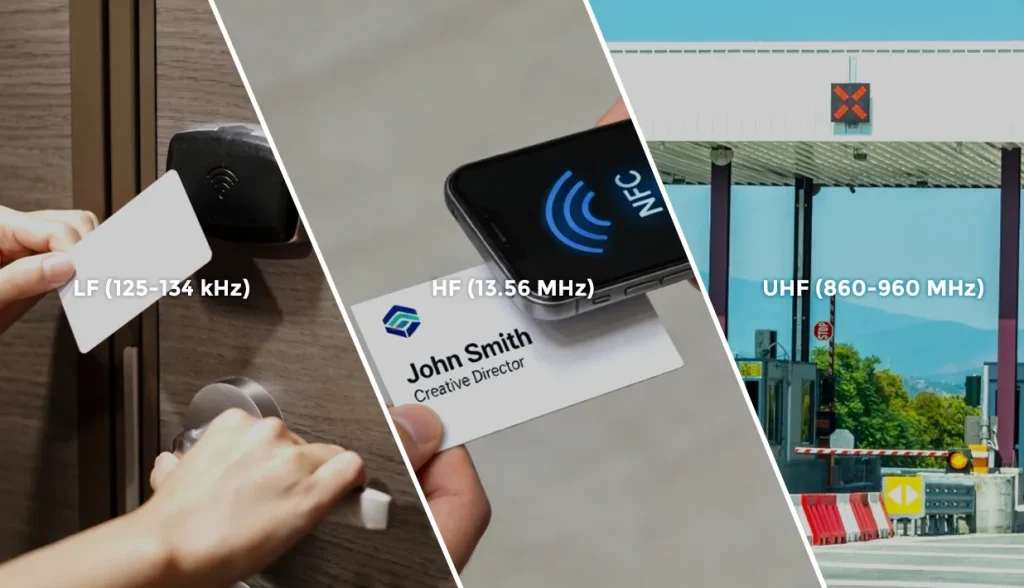
An RFID (Radio-Frequency Identification) card is a smart card that transmits data via radio waves. RFID cards are widely used in access control, identity verification, public transportation, and asset tracking. They are divided into three main types:
The key advantages of RFID cards include non-contact reading, fast access without insertion, and relatively long reading ranges. Reading range depends on the RFID frequency and system design. HF/LF cards are commonly used for access control, while UHF is often used for longer-range identification and tracking. This makes them suitable for diverse applications, from access control to vehicle identification and brand protection.
HID vs RFID Cards: Key Differences
Here’s a clear comparison of HID and RFID cards based on important factors:
| Feature | HID Credentials | RFID Card Solutions |
|---|---|---|
| Technology Basis | HID offers multiple contactless credential technologies. Many HID cards use RFID technology, including LF and HF solutions. | RFID cards use wireless identification technology and are available in LF, HF, and UHF variants. |
| Security | Security depends on the specific HID credential. Technologies such as Seos provide advanced security features, while legacy credentials may have different protection levels. | Security varies by card type, encryption, authentication methods, and system implementation. |
| Applications | Commonly used in access control, identity management, and enterprise security systems. | Used across access control, asset tracking, authentication, logistics, and many other applications. |
| Cost Factors | Depends on credential type, compatible readers, software, and system requirements. | Depends on RFID frequency, chip type, encoding needs, and deployment requirements. |
| Compatibility | Requires readers and systems that support the selected HID credential technology. | Requires compatible readers supporting the specific RFID frequency, protocol, and card technology. |
How to Choose the Right Card Type
When deciding between HID and RFID cards, consider these key factors:
1. Security Needs
For high-security applications, choose RFID cards using advanced security chips or platforms, including certain HID technologies.
2. Application Scenarios
For applications such as hotels, offices, parking systems, and public transportation, the best card solution depends on the required security level, system compatibility, and use case.
HID cards and other RFID cards can both be used for access control applications. The right choice depends on the specific technology, such as HID Prox, HID Seos, MIFARE Classic®, MIFARE DESFire®, or other RFID solutions.
For example, hotels may use different RFID-based technologies for guest access, including HID solutions, MIFARE cards, DESFire cards, or NFC-enabled systems.
3. Budget Considerations
Budget considerations should be based on the complete system configuration rather than the card brand alone. Compare like-for-like quotations for the required cards, encoding, readers, software, and management requirements. The total cost can vary depending on the selected credential technology, security level, and existing infrastructure.
4. System Compatibility
System compatibility depends on the selected credential technology, reader, and access-control platform. HID credentials generally require compatible HID-supported readers or systems, while other RFID cards also require matching protocols and reader support rather than universal compatibility.
Conclusion
HID provides access-control credentials and related technologies, many of which use RFID. The right choice depends on the specific credential, reader, and system configuration, along with your security requirements, usable features, total cost, and existing infrastructure—not on treating HID and RFID as mutually exclusive technologies.
Before selecting a solution, evaluate the complete access-control system, including credential technology, reader compatibility, security requirements, and long-term management needs. The goal is to choose a configuration that provides the right balance of security, cost, and flexibility for your application.
Interested in RFID cards for your business? Visit our official website to explore a wide range of RFID solutions. Contact our sales experts today for personalized recommendations and professional guidance tailored to your access control needs.
FAQs
Q1: What is the difference between HID and RFID cards?
HID is a brand that provides access-control credentials and related technologies, while RFID is a broader wireless identification technology used by many access cards. Many HID contactless credentials use RFID technology, so the difference is not between two completely separate technologies. The right comparison depends on the specific card technology, security features, and system compatibility.
Q2: Which card is better for hotels or offices?
The best choice depends on the installed access-control system, required security level, and application requirements. Hotels and offices may use different RFID-based credential technologies, including HID credentials, MIFARE cards, DESFire cards, or other supported solutions. Compare compatible configurations based on security, features, and total cost rather than choosing by brand alone.
Q3: Are RFID cards cheaper than HID cards?
There is no universal price difference between RFID cards and HID cards because many HID contactless credentials are also RFID products. The total cost depends on the specific card technology, encoding requirements, compatible readers, software, and system integration. Compare equivalent configurations before making a cost decision.
Q4: Can I use RFID cards with existing access systems?
Only if the specific RFID card technology, credential format, and reader system are supported. RFID is a broad category that includes different frequencies, chips, and protocols, so compatibility is not automatic. Always confirm compatibility with the access-control system provider before ordering or encoding cards.
Q5: Are HID cards more secure than RFID cards?
Not necessarily. Security depends on the specific credential technology, encryption methods, authentication mechanisms, and system implementation. Some HID technologies, such as Seos-based credentials, provide advanced security features, while other RFID technologies may also offer strong protection when properly configured.
Recommended Products

MIFARE Ultralight® AES PVC RFID Card

MIFARE Ultralight® AES PVC card is a contactless smart card based on MIFARE Ultralight AES chip, which supports AES encryption authentication, provides excellent performance and security, and is the highest security card in the MIFARE Ultralight® series. The card is made of PVC material and is widely used in access control, public transportation, ETC, events management, etc.
IMPORTANT NOTICE: All MIFARE Ultralight® AES cards supplied on this site is factory default (non-encrypted) version.