


The global shift toward a cashless economy has accelerated dramatically in recent years, transforming the way people make everyday purchases. From grocery stores and coffee shops to public transportation and e-commerce, contactless payment has become a defining feature of modern transactions. With just a simple tap of a card, phone, or smartwatch, consumers can complete secure payments in seconds—no swiping, no signing, and no physical contact required. This evolution reflects society’s growing demand for speed, safety, and convenience, especially in an age where digital transformation drives nearly every aspect of commerce. Across the worldwide, businesses and consumers alike are embracing this seamless payment method that not only enhances user experience but also reshapes financial interactions for the future.
1. The Early Days: From Magnetic Stripe to Chip Cards

Before contactless technology emerged, credit and debit cards relied on magnetic stripes to store and transmit payment data. These stripes, first introduced in the 1960s, contained static information that could easily be read by a magnetic reader at checkout. Although revolutionary at the time, magnetic stripe cards had major drawbacks. They were prone to wear and tear from frequent use, and the static data made them vulnerable to cloning and fraud. Criminals could skim card information using simple devices, leading to unauthorized transactions.
To address these issues, the banking industry introduced EMV (Europay, MasterCard, and Visa) chip cards. These cards stored encrypted data within an embedded microchip, creating a dynamic code for every transaction. This was a significant advancement in payment security, reducing fraud and providing a foundation for future innovations. While a significant leap forward, the process still involved physical interaction with a payment terminal. The true revolution, however, began when payments transcended physical contact and went entirely contactless.
2. The Birth of RFID and the Contactless Revolution

The real breakthrough came with the adoption of RFID (Radio Frequency Identification) technology. RFID uses electromagnetic fields to automatically identify and track tags attached to objects—in this case, payment cards or devices. Each RFID-enabled card contains a tiny antenna and chip that communicate wirelessly with payment terminals. This innovation allowed users to simply tap or wave their cards near a reader to complete a transaction, sparking what many call the “contactless revolution.”
RFID not only eliminated the need for physical contact but also significantly improved transaction speed. Payments that once took several seconds with swiping or inserting could now be processed almost instantly. Retailers, transport systems, and event venues quickly recognized the benefits of faster checkouts and improved customer flow. From here, contactless technology continued to evolve, eventually integrating with smartphones and wearable devices.
3. NFC: The Technology Powering Modern Contactless Payments

While RFID laid the groundwork, Near Field Communication (NFC) is the specific technology that powers the vast majority of modern contactless payment systems. NFC is a specialized subset of RFID, designed for short-range, high-frequency wireless communication. Unlike general RFID, NFC operates over very short distances, typically less than 4 centimeters (about 1.5 inches), which enhances security by requiring close proximity for a transaction to occur. This short range makes it difficult for unauthorized readers to intercept data or for accidental transactions to take place.
NFC powers the majority of contactless payment systems used today, including Apple Pay, Google Pay, and Samsung Pay. It allows smartphones, smartwatches, and even fitness trackers to store virtual cards securely and communicate payment information directly to a terminal. The convenience of simply tapping a phone or wearable to pay has transformed consumer expectations.
4. Security Innovations and Consumer Trust
Despite its popularity, some consumers initially hesitated to embrace contactless payment, concerned about potential data theft or unauthorized charges. However, modern security mechanisms have largely dispelled these fears. One key innovation is tokenization, where each transaction generates a unique, one-time code (token) that replaces the card’s actual number. This means even if the data were intercepted, it would be useless to criminals. Additionally, dynamic CVV codes and encrypted communication ensure that sensitive information never leaves the card or device unprotected. The short communication range of NFC also prevents remote attacks—transactions only occur when the card or device is extremely close to the reader. Many banks and fintech companies have added optional biometric or PIN verification for higher-value purchases. For further reassurance, RFID-blocking wallets and sleeves have become popular among consumers who seek additional peace of mind.
5. Conclusion
The journey from magnetic stripe cards to contactless payment represents one of the most significant evolutions in financial technology. What began as a simple improvement in transaction security has blossomed into a global movement toward speed, convenience, and digital integration. RFID and NFC have been at the core of this transformation, empowering consumers to pay with confidence and ease—whether using a card, a phone, or a wearable device.
FAQs
What is RFID contactless payment?
RFID contactless payment utilizes Radio Frequency Identification (RFID) or Near Field Communication (NFC) technology to facilitate secure, wireless transactions. When a user taps their card, smartphone, or smartwatch near a compatible payment terminal, the embedded RFID or NFC chip instantly communicates payment data. This process eliminates the need for physical actions like swiping or inserting a card, offering a fast, convenient, and encrypted method to protect sensitive information.
Are contactless payments safe?
Yes, contactless payments are designed with multiple layers of security, making them very safe. A key security feature is tokenization, where each transaction generates a unique, one-time code (token) that cannot be reused by fraudsters. The actual card number is never directly transmitted. Additionally, NFC technology operates over a very short distance (typically under 4 cm), which significantly reduces the risk of unauthorized interception. Many contactless systems also incorporate biometric authentication (like fingerprint or facial recognition) or PIN verification for an added layer of protection, further enhancing their security profile.
Recommended Product
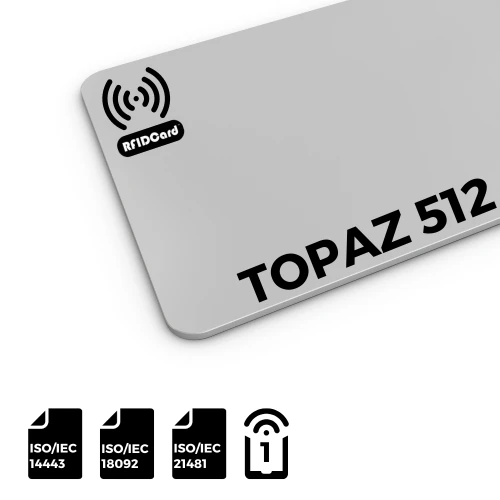
NFC Card Topaz512 | NFC Tag Type 1

The Topaz512 IC fully comply to NFC Forum Type 1 Tag and ISO/IEC 14443A specifications., the Topaz512 NFC card is uniquely identified by a 7 bytes UID with 454 bytes of user memory.



