In today’s rapidly evolving built environment, building access control systems have become a foundational element of security, operational efficiency, and user experience. From corporate offices and residential complexes to hospitals and commercial facilities, controlling who can enter which areas—and when—has never been more important. As buildings grow smarter and more connected, RFID cards have emerged as one of the most reliable, scalable, and cost-effective credentials powering modern building access control systems, offering a balance of security, convenience, and flexibility for building owners and operators.
1. The Role of RFID Technology in Access Control
RFID technology enables wireless data transmission between a credential and a reader using radio waves. In the context of building access control systems, RFID cards act as secure credentials that store a unique identifier or encrypted data.
The fundamental advantage of RFID over traditional keys is the elimination of physical contact and the ability to carry complex, encrypted data. Traditional keys are static and offer no audit trail; once lost or copied, the security of the entire facility is compromised until the lock is physically changed. In contrast, an RFID card is a dynamic credential. If a card is lost, it can be instantly deactivated in the backend system, rendering it useless. This combination of speed, convenience, and superior security makes RFID the preferred technology for modern access control. Furthermore, the non-contact nature of the transaction significantly reduces wear and tear on both the card and the reader, leading to lower maintenance costs and a longer operational lifespan for the entire building access control systems infrastructure.
2. Types of RFID Cards Used in Building Access Control Systems
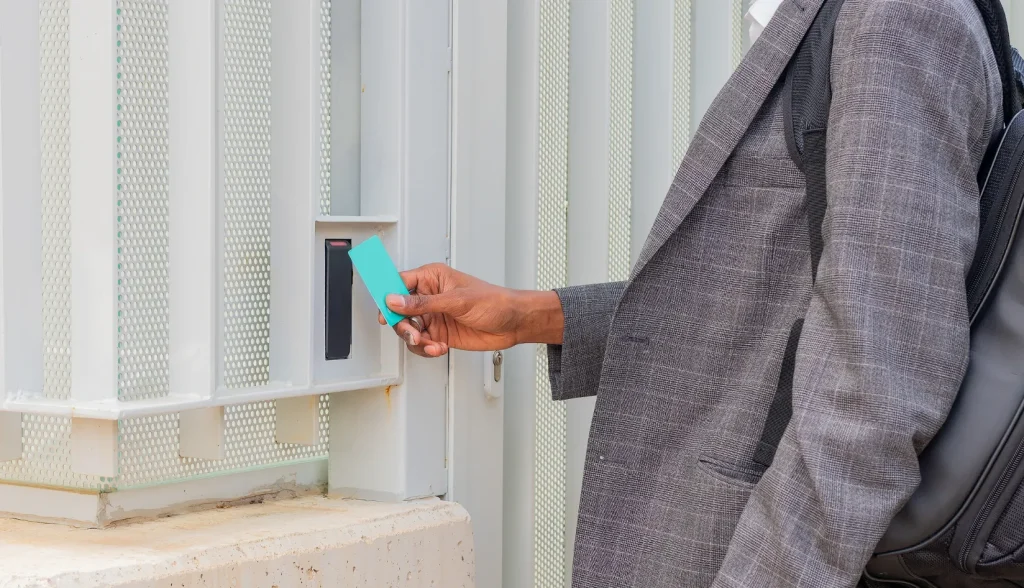
RFID technology is categorized primarily by the frequency band it operates on, which dictates its read range, data transfer speed, and suitability for different environments. The two most common types used in access control are Low Frequency (LF) and High Frequency (HF), which includes Near Field Communication (NFC).
| Feature | Low Frequency (LF) – 125 kHz | High Frequency (HF) / NFC – 13.56 MHz |
| Read Range | Very short (typically 1-10 cm) | Short (typically 1-30 cm) |
| Data Transfer | Slow | Faster |
| Security Level | Lower (often unencrypted, read-only) | Higher (supports encryption and mutual authentication) |
| Typical Use Cases | Basic door access, time and attendance | High-security access, cashless payments, public transit, mobile credentials |
3. How RFID Cards Enable Secure Access Management

Security is the primary reason organizations invest in building access control systems, and RFID cards contribute significantly to this goal. Each RFID card carries a unique identifier that links to a user profile within the access control software. Modern RFID cards often include advanced security features such as:
- Encrypted data transmission
- Anti-cloning mechanisms
- Mutual authentication between card and reader
These features make unauthorized duplication far more difficult than with mechanical keys or magnetic stripe cards. In addition, access permissions can be time-based, zone-specific, or role-based, ensuring users only access what they are authorized to enter.
4. Benefits of RFID-Based Building Access Control Systems
The transition to RFID-based access control offers a multitude of operational and security benefits that far surpass those of mechanical or even older magnetic stripe systems.

4.1 Enhanced Security and Controlled Access
The primary benefit is the significant boost in security. Instant card deactivation, encryption, and the detailed audit trail provide a level of control and accountability that is unmatched. In the event of a security breach or incident, administrators can quickly pinpoint the time, location, and identity of the person who last accessed a specific area.
4.2 Scalability for Multi-Building or Multi-Tenant Environments
RFID systems are inherently scalable. A single centralized backend system can manage thousands of readers and tens of thousands of users across multiple buildings, campuses, or even geographically dispersed locations. Adding a new user or a new access point is a simple matter of programming the backend, without the need for physical key cutting or lock changes.
4.3 Convenience for Users and Administrators
For users, the convenience of a simple tap or wave to gain access is a major improvement over fumbling with keys. For administrators, the centralized management platform simplifies tasks such as onboarding new employees, revoking access for departing personnel, and adjusting access schedules, all from a single interface.
4.4 Reduced Operational and Key-Management Costs
While the initial investment in an RFID system may be higher than traditional locks, the long-term cost savings are substantial. The cost of replacing a lost RFID card is negligible compared to re-keying an entire building. Furthermore, the automation of time and attendance tracking, often integrated with the access control system, reduces administrative overhead. This financial and operational efficiency is a key driver for the adoption of modern building access control systems.
5. RFID Cards in Different Building Scenarios
The versatility of RFID technology allows it to be tailored to the unique security needs of various building types.
- Office and Corporate Buildings: Employees use RFID cards to access offices, meeting rooms, and restricted areas. Integration with time and attendance systems is common.
- Residential and Apartment Buildings: RFID cards or fobs provide residents with convenient access to common areas, parking garages, and their individual units. The system allows property managers to easily manage tenant turnover by deactivating old credentials without affecting other residents. High-frequency cards are increasingly used here to support mobile credentials, allowing residents to use their smartphones for access.
- Industrial and Restricted-Access Areas: In manufacturing plants, laboratories, or utility facilities, security requirements are often stringent. RFID cards are used to enforce compliance and safety protocols, ensuring that only personnel with the correct training and authorization can access hazardous or sensitive zones.
6. Integration with Modern Building Technologies

Modern building access control systems rarely operate in isolation. RFID cards can integrate seamlessly with other building technologies, including:
- Integration with Smart Building Systems: RFID access events can trigger actions in other building systems. For example, a card tap can disarm the security alarm in a specific zone, adjust the lighting and HVAC settings in an office to “occupied” mode, or log a visitor’s entry into a visitor management system. This convergence of physical security and building automation is a hallmark of smart building design.
- Cloud-Based and Centralized Management Platforms: The shift to cloud-based access control platforms has revolutionized management. Administrators can manage access rights, view real-time audit logs, and troubleshoot issues from any location via a web browser or mobile app. Centralized platforms also facilitate the management of multi-site operations, ensuring consistent security policies across an entire enterprise.
7. How to Choose the Right RFID Card for Your Building Access Control System
Choosing the right RFID card depends on several factors:
- Card Frequency and Chip Selection: The choice between LF (125 kHz) and HF (13.56 MHz) is paramount. For basic, low-security applications, LF may suffice. However, for any modern facility requiring data encryption, future-proofing, and integration with mobile credentials, HF technologies like MIFARE DESFire EV2 or EV3 are the recommended standard. These chips offer superior memory, processing power, and cryptographic capabilities.
- Environmental and Durability Considerations: The physical environment dictates the card’s construction. Industrial settings may require ruggedized cards that can withstand extreme temperatures, moisture, or physical abuse. Standard PVC cards are suitable for office environments, but composite materials (e.g., PVC ) offer greater durability and resistance to cracking.
- Customization and Branding Options: RFID cards often serve as employee or resident identification. Customization options, including high-resolution printing, holographic overlays for anti-counterfeiting, and slot punching for lanyards, should be considered to enhance branding and visual security.
8. Conclusion
RFID cards play a vital role in powering modern building access control systems, offering a proven balance of security, convenience, and scalability. From offices and residential complexes to commercial and industrial facilities, RFID-based solutions provide reliable access management while supporting integration with smart building technologies. Looking to upgrade or implement RFID-based building access control systems? Choosing the right RFID cards today helps future-proof your building for years to come.
Recommended Product

BioPoly™ Vinyl Generic Hotel Key Card

The NXP MIFARE® DESFire® C RFID Hotel cards fully comply with ISO/IEC 14443-A. The Key cards are made with photo-quality standard BioPoly™ Vinyl in the size of CR80.