


The global hospitality industry is transforming rapidly, driven by new expectations for operational efficiency, security, and personalized guest services. Hotels, resorts, theme parks, and event venues are no longer just selling rooms—they are selling seamless experiences. This shift has placed significant pressure on workforce management systems and created a need for smarter ways to manage staff. A modern hospitality staffing solution does more than schedule shifts; it connects employees, systems, and services in real time. At the center of this transformation is an often-underestimated technology—RFID cards, which act as the digital key to identity, access, and workflow automation.
1. The Role of RFID in Hospitality Staffing
RFID is a technology that uses radio waves to identify and authenticate objects and users. In hotel operations, staff use RFID cards as ID badges to trigger specific permissions and actions within a hospitality staffing solution.

In the hospitality sector, several types of RFID cards are commonly employed, each suited to different applications:
- Low-Frequency (LF) Cards (125 kHz): Often used for basic access control, offering a short read range and lower data transfer speed. They are simple, reliable, and cost-effective for basic staff identification.
- High-Frequency (HF) Cards (13.56 MHz): These include Near Field Communication (NFC) and represent the most common type of contactless smart card used in hotels. They offer greater data storage capacity and support more complex applications like secure access, cashless payments, and data-rich transactions..
- Ultra-High Frequency (UHF) Cards (860–960 MHz): While less common for staff cards, UHF is crucial for asset tracking, such as tracking uniforms, linens, and large equipment across a property due to its long read range.
The true power of RFID in a hospitality staffing solution lies in its seamless integration with a hotel’s existing technological ecosystem. These cards serve as a single, multi-functional credential that connects to:
- Property Management Systems (PMS): Linking staff access and activity to operational data.
- Human Resources Management (HRM) Systems: Providing automated, accurate data for time, attendance, and payroll.
- Access Control Systems: Managing role-based permissions for all doors and secure areas.
- Point-of-Sale (POS) Systems: Facilitating staff purchases, discounts, and controlled access to transaction terminals.
2. Key Benefits of RFID Cards in a Hospitality Staffing Solution
The adoption of RFID cards delivers tangible, measurable benefits that directly address the core challenges of managing a large, diverse workforce in a hotel environment.

2.1 Secure Access Control
Hotels house multiple departments that require different security levels: engineering, kitchen, HR records office, maintenance rooms, storage, and back-of-house corridors. Traditional physical keys are a risk; they can be lost, copied, or misused.
An RFID card gives role-based access:
- A housekeeping staff member can access guest floors and laundry rooms.
- A technician can enter electrical rooms.
- HR officers can unlock sensitive document areas.
Access logs are recorded automatically, helping the hospitality staffing solution track who entered which area and when. This reduces internal theft, unauthorized entry, and master key misuse.
2.2 Accurate Time & Attendance
One of the most significant administrative burdens in hospitality is managing accurate time and attendance for a workforce with varying shifts, breaks, and overtime requirements. Traditional methods, such as manual sign-in sheets or even older punch-card systems, are prone to human error, leading to payroll disputes and inflated labor costs.
RFID cards solve this by providing a reliable, contactless, and verifiable method for clocking in and out. Staff simply tap their card at a designated reader at the start and end of their shift. The system instantly records the time and links it directly to the employee’s profile in the HRM system. This automation ensures that payroll is based on precise, real-time data, drastically reducing administrative overhead and ensuring compliance with labor laws. The resulting automatic attendance reports provide management with invaluable data for optimizing shift scheduling and labor forecasting.
2.3 Asset and Equipment Management
In a large hotel, tools, devices, and high-value equipment—from specialized cleaning machines and walkie-talkies to tablets and master keys—are constantly in motion. Loss or misuse creates significant costs.
By integrating the staff RFID card with an asset tracking system, hotels can implement a seamless equipment checkout process. When an employee needs a specific tool, they tap their card at a reader linked to the equipment storage area. The system automatically logs the item to the employee’s profile. This creates a clear chain of custody and accountability. The simple act of using the staff card ensures that every piece of equipment is tracked, reducing the loss of tools and devices.
2.4 Cashless & Controlled Staff Facilities
Beyond operational functions, the staff RFID card can significantly enhance the employee experience by serving as a multi-functional credential for internal services. This is particularly evident in cashless and controlled staff facilities.
For instance, in the employee cafeteria or break room, the RFID card can be linked to a pre-loaded balance or a payroll deduction system, allowing for quick, cashless payment for meals and snacks. This speeds up service, reduces the need for cash handling, and provides management with data on cafeteria usage. Similarly, the card can be used to access staff-only amenities like gyms, locker rooms, or parking facilities, ensuring that only authorized personnel can utilize these resources. This consolidation of functions onto a single card simplifies the employee’s daily routine and reinforces the efficiency of the overall hospitality staffing solution.
3. RFID-Enabled Processes Across Hospitality Departments
The utility of the RFID staff card extends across every department, streamlining workflows and enhancing control.

3.1 Front Office
Front Office staff are the face of the hotel, and their access needs are unique. Their RFID cards grant them access to the Front Office area, but more importantly, they can be integrated with the PMS to allow secure, logged access to guest information and room status updates. In some advanced systems, the card can also be used to securely log into POS terminals or specialized guest service kiosks, ensuring that every transaction and system interaction is tied back to a specific employee for accountability.
3.2 Food & Beverage
In the fast-paced Food & Beverage (F&B) environment, speed and accuracy are critical. F&B staff use their RFID cards for secure POS access, instantly logging them into the system to take orders and process payments. This prevents unauthorized use of terminals and ensures accurate sales tracking per employee. Furthermore, the card can be programmed to automatically apply staff discounts on meals or beverages purchased during breaks, eliminating manual verification and potential errors.
3.3 Engineering & Maintenance
The Engineering and Maintenance department relies heavily on access to utility rooms, equipment, and master keys. The RFID card is crucial for key control and equipment checkout. Instead of a physical key log, the engineer taps their card to access a secure key cabinet, and the system records which master key was taken and when. This dramatically improves security and accountability for the most sensitive keys on the property. The card is also used to log the checkout of specialized tools and diagnostic equipment, ensuring they are returned promptly.
3.4 HR & Administration
For Human Resources (HR) and Administration, the RFID card is a powerful data collection tool. Beyond providing the foundation for digital attendance records, the card can be linked to an employee’s training and certification data. When a staff member accesses a specific area, the system can cross-reference their card ID with their required training status, providing an extra layer of compliance assurance. For example, only staff with up-to-date food safety certification can access the main kitchen area. This integration of physical access with digital HR data is a hallmark of a sophisticated hospitality staffing solution.
4. Implementing RFID in a Hospitality Staffing Solution

The successful implementation of RFID technology requires careful planning and execution to ensure maximum return on investment and seamless integration into the existing operational framework.
- Card Personalization and Security: Each card must be personalized with the employee’s photo, name, and ID number. More critically, the card’s chip must be securely encoded with unique identifiers and security keys. This is because the encoding process is vital to prevent cloning and unauthorized access. In addition, the system must meet data protection and encryption requirements, ensuring that all data transmitted between the card and the reader remains secure and compliant with privacy regulations.
- Integration with Existing Systems: The most complex, yet most critical, step is the integration with existing HR, payroll, and access control systems. The RFID system must be able to “talk” to the Property Management System (PMS) and the Human Resources Management (HRM) software to ensure that data—such as time logs and access events—is accurately transferred and processed. This often requires custom API development or the use of middleware to bridge the gap between disparate systems.
- Staff Training and Onboarding: Finally, the success of any new technology hinges on user adoption. Comprehensive staff training and system onboarding are essential. Employees must understand not only how to use the card but also the security and efficiency benefits it provides. Teams must establish clear protocols for lost or damaged cards to minimize disruption. A well-executed implementation plan helps the new RFID-enabled hospitality staffing solution achieve smooth adoption and deliver its full potential.
5. Conclusion
Speed, trust, and service experience define the hospitality industry. To meet these demands, a modern hospitality staffing solution must bring together staff identity, access permissions, real-time data, and automation. RFID cards are a critical enabler of this transformation. From secure access control to accurate attendance tracking, they form the digital backbone of staffing operations. As a result, hotels can maintain greater operational transparency and efficiency. As hotels move toward intelligent, data-driven management, RFID technology will continue playing a central role in building efficient, secure, and scalable workforce systems. We offer RFID card customization and integration services tailored to the unique needs of the hospitality sector. Contact our team today for a personalized quote.
Recommended Product
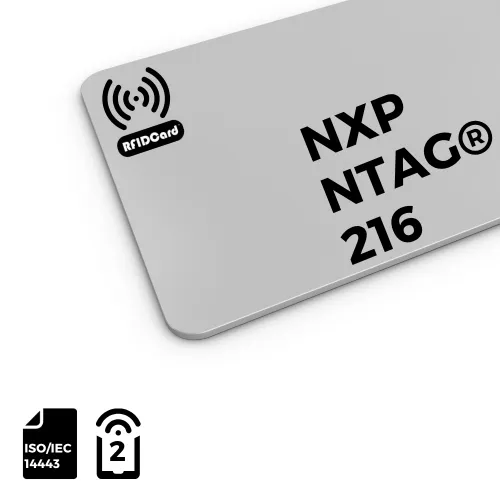
NFC Card NXP NTAG® 216 NFC Type 2

The NTAG® 216 RFID card is made with Photo quality standard PVC sheets into size of CR80, it programmed 7-byte UID with 888 bytes of user memory available (222 pages). The NTAG® 216 NFC ICs fully comply to NFC Forum Type 2 Tag and ISO/IEC14443 Type A specifications.



