In the modern corporate landscape, the traditional perimeter-based security model is rapidly becoming obsolete. As organizations face increasingly sophisticated physical and digital threats, the reliance on mechanical keys have proven to be a significant vulnerability. To address these challenges, many forward-thinking enterprises are turning to the RFID employee card as a cornerstone of their smart security strategy.
1. What Is an RFID Employee Card?
At its core, an RFID employee card is a contactless credential that uses radio waves to communicate with a reader. Unlike magnetic stripe cards that require a physical swipe, RFID cards can be read from a distance, offering both convenience and enhanced durability. The technology relies on three primary components:
- RFID chip: Stores unique ID and security credentials
- Antenna: Enables wireless communication with readers
- Card body: Usually made of PVC, PET or composite materials
2. Key Security Challenges in Traditional Workplaces
Before understanding the benefits of RFID technology, it is essential to examine the weaknesses of traditional security systems.

2.1 Unauthorized Physical Access
Mechanical keys are notoriously easy to lose or duplicate. Furthermore, legacy systems lack a mechanism to prevent “tailgating” or “piggybacking,” where an unauthorized individual follows a legitimate employee through a secured door. This lack of control makes it difficult to maintain a secure perimeter.
2.2 Weak Identity Verification
Manual ID checks are prone to human error and fatigue. In large facilities, security personnel cannot possibly memorize every face, making it easy for intruders to use fake or duplicated cards that lack digital authentication. This creates a significant gap in the organization’s defensive posture.
2.3 Insider Threats and Limited Auditability
One of the most overlooked risks is the “insider threat.” Without granular access control, employees may have excessive privileges, allowing them to enter sensitive areas like server rooms or executive suites without a legitimate business need. Furthermore, if a security breach occurs in a facility using traditional locks, there is often no real-time log to determine who was in the building or when they left.
3. How RFID Employee Cards Enhance Workplace Security
The implementation of an RFID employee card system transforms security from a reactive hurdle into a proactive asset. By digitizing access, organizations can implement a multi-layered defense strategy.

3.1 Strong Identity Authentication
Each RFID employee card carries a unique digital signature that is virtually impossible to replicate if implemented with modern encryption. By integrating these cards with Multi-Factor Authentication (MFA), such as requiring a PIN or a biometric scan alongside the card tap, organizations can ensure that the person holding the card is indeed the authorized user.
3.2 Controlled Access to Sensitive Areas
RFID systems allow for sophisticated “zoning.” An organization can define specific permission levels based on an employee’s role. For example, a laboratory technician might have 24/7 access to the lab but no access to the accounting department. These rules can be updated dynamically; if an employee changes roles or leaves the company, their access rights can be revoked instantly across the entire network.
3.3 Anti-Counterfeiting and Anti-Cloning Features
Modern RFID technology has moved far beyond the easily clonable 125kHz proximity cards of the past. High-frequency (13.56 MHz) cards utilizing AES-128 or AES-256 encryption, such as MIFARE DESFire, employ mutual authentication. This means the card and the reader must “handshake” and verify each other’s authenticity before any data is exchanged, effectively neutralizing cloning attempts.
3.4 Real-Time Monitoring and Traceability
Every time an RFID employee card interacts with a reader, a digital footprint is created. Security teams can monitor access events in real-time, receiving alerts for unauthorized attempts. This data is invaluable for compliance audits and provides a clear “paper trail” for internal investig.
4. Advanced Security Applications
The utility of the RFID employee card extends far beyond the front door, integrating deeply with an organization’s IT and operational infrastructure.
| Application Area | Description | Security Benefit |
| IT Access Control | Using RFID cards for PC logon and network authentication. | Prevents unauthorized access to workstations and sensitive data. |
| Secure Printing | Documents are only released when the user taps their card at the printer. | Ensures sensitive physical documents are not left unattended. |
| Asset Tracking | Tagging high-value equipment and linking movement to employee cards. | Reduces theft and improves accountability for shared assets. |
| Visitor Management | Issuing temporary RFID cards with restricted permissions. | Controls the movement of contractors and guests within the facility. |
5. Best Practices for Implementation

To maximize the security of an RFID deployment, organizations should follow a structured approach that balances cost, convenience, and protection.
- Choose High-Frequency Encrypted Chips: Avoid legacy “Proximity” cards. Opt for MIFARE DESFire EV3 or HID iCLASS SE, which offer robust encryption and are resistant to common hacking tools.
- Implement Multi-Factor Authentication (MFA): For high-security areas, the card should be the “something you have” component of a three-factor authentication process (Card + PIN + Biometric).
- Regular System Updates: Security is not a “set it and forget it” solution. Conduct regular penetration testing on your access control system and ensure that reader firmware is kept up to date to patch emerging vulnerabilities.
6. Real-World Industry Use Cases
The versatility of RFID technology allows it to be tailored to the specific needs of various sectors:
- Healthcare: Hospitals use RFID to restrict access to pharmacies and patient records, ensuring HIPAA compliance and patient safety.
- Data Centers: Multi-layer zoning ensures that only authorized technicians can access specific server racks, protecting critical digital infrastructure.
- Manufacturing: RFID cards ensure that only certified staff can operate heavy machinery, reducing workplace accidents and liability.
- Corporate Offices: Integration with elevators and parking systems provides a seamless employee experience while maintaining a secure perimeter.
7. Future Trends in RFID-Based Workplace Security
As we look toward the future, the RFID employee card is evolving into a component of a broader “Zero Trust” architecture. In a Zero Trust model, the system assumes no one is trusted by default, even if they are inside the building.
7.1 Mobile Credentials and Virtual Cards
The physical card is increasingly being supplemented or replaced by virtual credentials stored in smartphone digital wallets. Using NFC or Bluetooth Low Energy (BLE), employees can use their phones to gain access, reducing the risk of lost physical badges.
7.2 AI-Driven Analytics and Biometrics
Security systems are beginning to use AI to analyze access patterns. If an employee who normally works 9-to-5 suddenly tries to access the server room at 3 AM, the system can automatically flag the behavior as suspicious. Furthermore, “Match-on-Card” technology allows biometric templates to be stored locally on the RFID chip, enhancing privacy while providing ironclad identity verification.

8. Conclusion
In an era of increasing security challenges, organizations must move beyond traditional access control methods. The RFID employee card offers a powerful combination of security, scalability, and intelligence, enabling companies to protect their people, assets, and data more effectively. RFIDCard provides customizable RFID blank cards with flexible material and chip options for various enterprise applications. If you are looking for reliable RFID card solutions, feel free to contact us to discuss your requirements.
Recommended Product
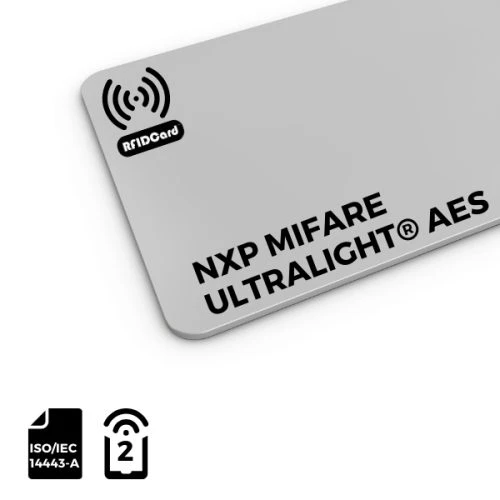
MIFARE Ultralight® AES PVC RFID Card

MIFARE Ultralight® AES PVC card is a contactless smart card based on MIFARE Ultralight AES chip, which supports AES encryption authentication, provides excellent performance and security, and is the highest security card in the MIFARE Ultralight® series. The card is made of PVC material and is widely used in access control, public transportation, ETC, events management, etc.
IMPORTANT NOTICE: All MIFARE Ultralight® AES cards supplied on this site is factory default (non-encrypted) version.