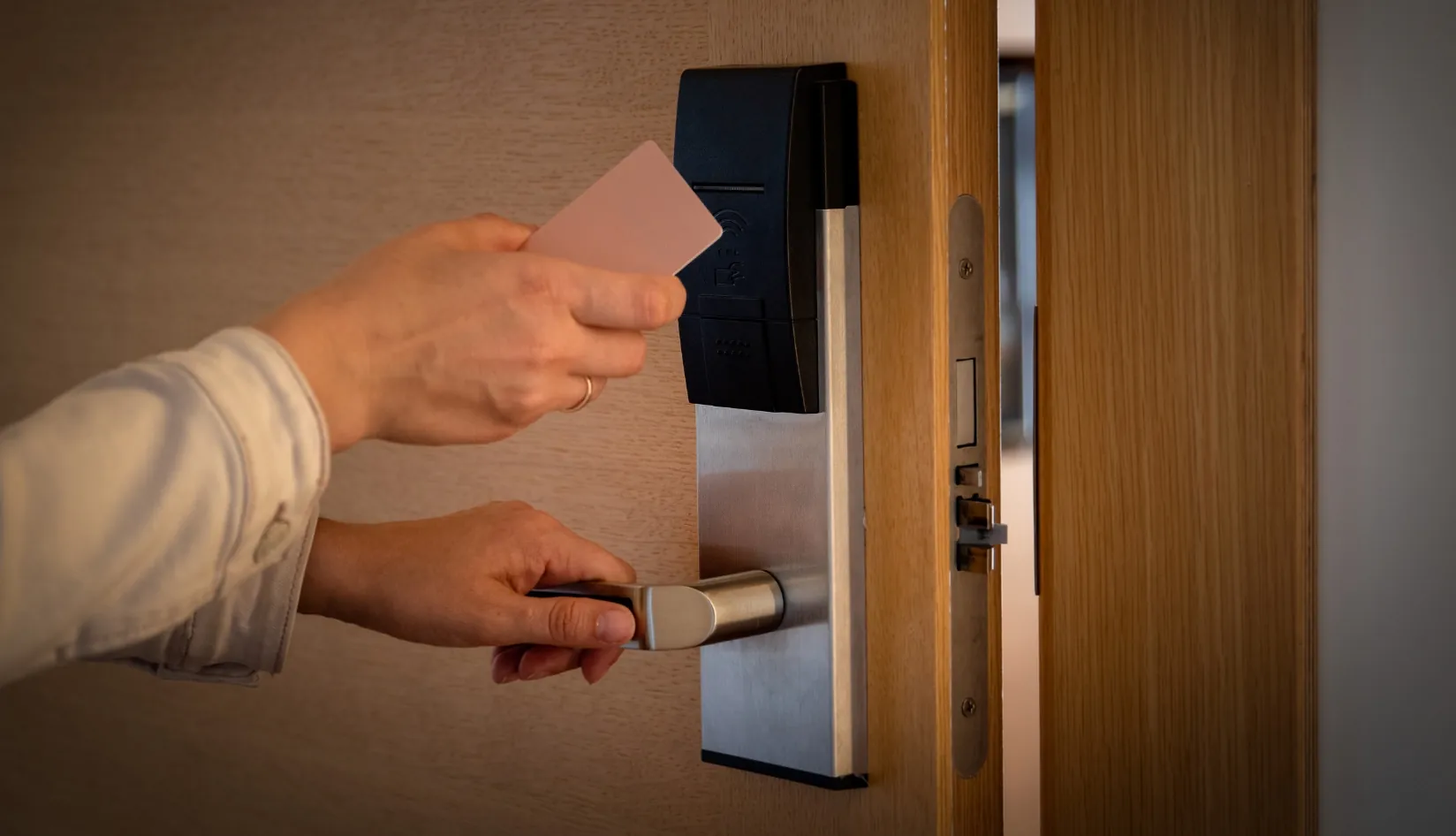
RFID (Radio Frequency Identification) technology transmits data using radio waves and employs tags with embedded chips and antennas to identify items. Compared to traditional metal keys and magnetic stripe cards, RFID key cards are more secure and convenient. They offer encryption protection to guard against copying and cracking, and they support contactless entry, enhancing the guest experience.
As hotels’ demands for security and customer convenience rise, RFID key cards have become the top choice for an increasing number of hotels. RFID cards not only boost the management efficiency of hotels but also provide guests with a fast and contactless entry experience, addressing the issues of traditional key cards being easily lost or damaged. Therefore, RFID technology is becoming an essential tool for modern hotel management.

RFID Key Card Basics
RFID technology is used to transmit data and identify items using radio waves. It operates with a tag that has a microchip and an antenna, allowing data exchange through radio frequency signals without direct contact or line of sight. RFID technology is widely applied in fields such as item tracking, identity authentication, and access control.
Composition of RFID Key Cards
The basic components of RFID key cards include a chip, an antenna, and a shell.
Chip: The chip is the core component of the RFID card. It stores data related to the room or user’s identity, usually including a unique identifier (ID). The chip is also responsible for receiving and transmitting data, communicating with the reader by modulating and demodulating radio waves.
Antenna: The antenna is used to receive and send radio wave signals. The antenna in an RFID card is typically small and flexible to accommodate various card designs. Its role is to pass signals to the chip or receive data from the chip.
Shell: The shell serves as a carrier that integrates the chip and antenna together. It is usually packaged in the form of a card for users to carry and utilize.
How to Interact with the Hotel System
RFID key cards interact with the hotel’s access control system through radio signals. In the hotel management system, the administrator links each guest’s information with the unique ID of the corresponding RFID card, storing this data in the hotel’s control system.
When a guest approaches the door lock with an RFID key card, the chip in the card establishes a radio wave connection with the RFID reader on the lock. The door lock reader reads the unique ID from the RFID card and compares it with information in the system database. If there’s a match, the door lock unlocks, allowing the guest to enter the room. If it fails to match, the door lock remains locked to prevent unauthorized access.
This process is typically very fast and doesn’t require direct insertion or sliding of the card, which enhances user experience and security, as RFID cards are hard to copy or crack.
In this way, the RFID key card works seamlessly with the hotel’s access control system, ensuring that each guest can use the room key securely and conveniently, while greatly reducing security risks that traditional mechanical keys may pose.

How RFID Key Cards Improve Hotel Security
With the increasing security demands of modern hotel management, traditional mechanical keys and magnetic stripe cards have been unable to meet the stringent security needs. RFID key cards, with their advanced technology and functions, have become an essential tool for enhancing hotel security. Here are several key advantages of RFID key cards in improving hotel security:
Prevent Copying and Forgery
Prevent Copying of Traditional Mechanical Keys: Traditional metal keys and magnetic stripe key cards are easy to copy or forge. With just a metal key or a simple copying device for magnetic stripe cards, a new key can be made easily, which directly threatens the hotel’s security. RFID key cards use unique encryption chips, and each card has a unique identifier. These cards generally do not expose specific information and are difficult to replicate.
Since the data stored inside the RFID chip is dynamically encrypted, even if the key card is stolen, it cannot be used through traditional copying methods, greatly reducing security risks.
Secure Encryption Technology: RFID key cards typically use complex encryption technology to ensure the security of card data. The information on each card is not just a fixed ID; it’s a code generated after encryption. Therefore, even if hackers obtain the card signal, they can’t crack it using simple decryption methods. Additionally, RFID systems often employ two-way authentication (two-way encryption technology) to ensure that communication between the reader and the card is secure, further preventing information theft or tampering. Thus, RFID key cards are more counterfeit-resistant than traditional keys or magnetic stripe cards, improving the overall security of the hotel.
Preventing Loss Risks
Countermeasures for Lost or Stolen Key Cards: If a traditional mechanical key or magnetic stripe card is lost or stolen, the hotel often needs to create a new key and replace the door lock to ensure safety. This not only increases costs but may also cause operational challenges. The RFID key card system is more flexible. If a card is lost or stolen, the hotel manager can immediately deactivate the card in the system without needing to replace the door lock.
Through the hotel management system, the administrator can quickly locate the unique ID of the lost card and immediately delete or deactivate it from the access control system, ensuring unauthorized individuals cannot use the card to enter the room. This effectively controls the risk of losing the card for customers as well, avoiding potential security hazards.
Security Compared to Traditional Key Systems: Compared to traditional metal key systems, RFID key cards provide higher security. When a traditional metal key is lost, anyone with the key can enter the room. However, the RFID system can instantly deactivate the lost card through system management, keeping the room locked and effectively preventing criminals from taking advantage of the situation. While magnetic stripe cards can also be re-encoded to prevent theft, RFID key cards offer greater flexibility and immediate response capabilities, enabling quick enhancement of hotel security levels.
Restricting Access Rights
Setting Access Rights for Different Rooms and Areas: RFID key cards can not only be used for access control but also for permission management across various areas in the hotel. Through RFID technology, hotels can set different access rights for different guests or employees. For example, a guest can enter only their booked room, while the hotel assigns employees access to specific areas such as storage rooms, staff break areas, or executive zones. This permission setting makes it difficult for unauthorized personnel to easily access sensitive areas, significantly improving hotel security.
Additionally, the RFID system can monitor and adjust permissions in real-time in the background, ensuring that each cardholder can only enter the authorized areas.
Timing and Area Control: In addition to access control based on personnel identity, RFID technology can also limit room access rights based on time and area. For instance, a hotel can set room access rights to be valid only during the guest’s stay. After checkout time, the card will automatically become invalid, preventing guests from staying in or entering the room unlawfully.
Furthermore, the hotel can also control the access rights of employees or other staff members according to different time periods, ensuring that relevant personnel can only enter specific areas when necessary. For example, during late-night hours, the RFID system can restrict staff from entering the guest room area to ensure the safety of that area.
This time-area control function greatly enhances the security and flexibility of hotel management.

How RFID Key Cards Improve Hotel Convenience
With the continuous advancement of technology, the hotel industry is increasingly relying on innovative technologies to enhance guests’ stay experiences and operational efficiency. As an intelligent access control management tool, RFID key cards greatly improve hotel convenience. From express check-in to multiple uses of a single card, to real-time updates and control, RFID technology makes hotel operations more efficient and guests’ accommodation experiences more convenient. Here are a few key aspects of how RFID key cards improve hotel convenience:
Express Check-In and Check-Out
Self-Check-In Equipment: In traditional hotels, guests often have to wait in line to check in, which is often the most time-consuming part of the check-in experience. With the introduction of RFID key cards, hotels can provide self-service check-in equipment so that guests do not have to wait in line at the front desk. After entering their reservation information or scanning their ID card on the device, the system will automatically recognize this and generate an RFID key card. Guests can directly enter their rooms with just this card, avoiding tedious manual operations and long queues, significantly improving check-in efficiency.
No Need to Touch the Door Lock: One of the biggest advantages of RFID key cards is their contactless unlocking feature. Guests only need to bring the RFID key card close to the card reader on the door, and the door lock will automatically unlock. Guests do not need to insert the card, swipe it, or press a button. This simplified process not only greatly reduces the hassle for guests, but also improves hygiene levels, especially during an epidemic, allowing them to avoid contact transmission risks. Additionally, contactless unlocking enhances the hotel’s modern image, providing guests with a smoother, tech-savvy check-in experience.
One Card for Multiple Uses
In Addition to Access Control, RFID Cards Can Also Be Used for Payment, Parking, Gym Access, and Other Hotel Facilities: RFID key cards are more than just a tool for unlocking guest room doors. More and more hotels are extending the functionality of RFID cards to control access to other facilities. For instance, guests can use RFID cards to enter the hotel’s gym, swimming pool, spa, and other areas. Some hotels also allow guests to use RFID cards for dining, hotel shopping, or even parking payments, further improving the card’s versatility and ease of use.
Through RFID technology, hotels can offer guests an integrated service experience, reducing the need for multiple cards or paper vouchers, which not only makes it more convenient for guests but also improves the operational efficiency of the hotel.
Guests Can Use the Same Card to Complete Multiple Operations: The versatility of RFID key cards means that guests only need to carry one card to handle multiple tasks, such as opening doors, making payments, and accessing facilities. Compared to traditional methods, guests do not need to carry multiple cards with different functions or remember multiple passwords, greatly simplifying the operation process and daily needs. This “all-in-one card” design simplifies hotel management and enhances efficiency while also providing guests with a more convenient experience.
Real-Time Updates and Control
How the Hotel Management System Remotely Updates Guests’ Room Access Rights via RFID Cards: The intelligent management of the RFID system enables hotels to remotely update guests’ room access rights based on real-time needs. Whether it is a late check-out or changing rooms, hotel staff can directly adjust the permissions of the RFID card through the back-end management system, and guests do not need to go to the front desk to go through the procedures again. This way, the hotel not only improves management efficiency but also better meets the immediate needs of guests and improves customer satisfaction.
For example, if a guest delays their check-out time during their stay, hotel managers can modify the RFID card permissions for the guest’s room through the system to ensure the guest can continue to use the room during the extended period without having to reissue a new card. This flexible management method brings greater convenience to both hotels and guests.
Guests Can Adjust or Reprogram Their Key Cards at Any Time without Manual Intervention: In addition to hotel managers remotely updating RFID card permissions, guests can also adjust or reprogram their cards themselves. For instance, if a guest temporarily changes rooms or adds additional services, the hotel system can adjust access rights via RFID cards as needed. Guests do not need to manually intervene or go to the front desk; they only need to complete the settings through the hotel’s self-service equipment or mobile application, greatly facilitating their operational experience and reducing manual intervention and waiting time in line.

Other Advantages of RFID Key Cards
The advantages of RFID key cards in improving hotel security and convenience have been widely recognized. Additionally, they also show significant benefits in reducing operating costs and improving customer satisfaction. These advantages not only help hotels enhance operational efficiency but also effectively enhance the overall customer experience, thereby bringing long-term revenue and brand value to the hotel. Here are some other notable advantages that RFID key cards provide:
Reducing Operating Costs
Lower Costs Associated with Traditional Key Loss and Replacement: In traditional metal key systems, when a key is lost, it must be remade, and the door lock cylinder replaced. This not only increases the hotel’s physical costs but can also lead to operational inconveniences. The risk of loss with RFID key cards is lower because each card is electronic and linked to the room lock system. If an RFID card is lost or stolen, hotel managers can instantly deactivate the card through the system without having to replace the door lock, significantly reducing the costs associated with replacing keys and locks.
Durability and Low Maintenance Costs of RFID Cards: RFID cards are made of plastic, making them drop-resistant, dirt-resistant, and highly durable. They can withstand long-term use without easily wearing out or being damaged. While magnetic stripe cards are prone to failure during normal use due to magnetic loss or physical wear, the durability of RFID cards eliminates the need for hotels to frequently replace key cards, thereby reducing card replacement and management costs. Additionally, the maintenance cost of the RFID system is relatively low, mainly due to software system updates and normal hardware operations, which rely less on manual intervention, thus significantly reducing overall operating costs.
RFID Cards Can Be Reprogrammed Multiple Times and Reused: Traditional key cards or magnetic stripe cards generally lose their function after one use and need to be remade or replaced to continue being used. In contrast, RFID cards support multiple programming and reuse. Hotels can reprogram cards after they expire, adjust access rights, and continue using them for other guests. In this way, hotels can not only reduce card purchase costs but also maximize card utilization, further reducing material costs in long-term operations.
Improving Customer Satisfaction
Increasing Overall Customer Satisfaction Through Enhanced Security and Convenience: RFID key cards provide enhanced security and convenience, allowing guests to enjoy a smoother, seamless stay experience. Whether it’s fast self-check-in, contactless door lock operation, or convenient multi-purpose services with one card, RFID cards significantly improve guest satisfaction. Guests no longer need to worry about the risk of losing or having their traditional keys stolen, and contactless operations reduce cumbersome procedures, enhancing their sense of safety and trust in the hotel.
Moreover, RFID technology also helps hotels provide more personalized services. For instance, guests can adjust room access rights as needed or access other hotel facilities with RFID cards, enhancing their sense of control and convenience. In short, RFID cards offer guests a better service experience, improving security and convenience, thereby increasing their overall satisfaction.
How to Use RFID Technology to Enhance the Hotel’s Brand Image and Attract More High-End Customer Groups: Modern travelers, especially high-end customers, increasingly value the intelligent and modern services offered by hotels. RFID technology represents advanced technology and efficient services, and its introduction undoubtedly enhances the hotel’s brand image. High-end hotels typically strive to provide customers with convenient, fast, and secure services, and RFID key cards are the perfect embodiment of this demand.
For high-end customers, RFID key cards not only imply security but also represent the hotel’s high-tech level and meticulous management. By leveraging RFID technology, hotels can boost their competitiveness and attract customers who prioritize efficient services and smart experiences. This is especially true among global high-end travelers, who are increasingly pursuing digitalization and personalization; RFID technology can help improve both market appeal and brand value for hotels.

RFID Key Card Challenges and Solutions
While RFID key cards offer significant advantages in enhancing hotel security, convenience, and operational efficiency, hotels face several challenges in the practical implementation of this technology. Major challenges include cost issues and technology compatibility. Fortunately, with proper planning and solutions, hotels can overcome these obstacles and fully enjoy the long-term benefits of RFID technology. Here are the challenges that RFID key cards may encounter in hotel applications and their coping strategies:
Cost Issues
The Initial Investment and Implementation Costs for An RFID System Are High. How to Balance Costs and Benefits: Implementing an RFID system requires a significant upfront investment, which includes hardware (RFID door locks, card readers, etc.), software systems (management platforms, background data analysis, etc.), and staff training, among other expenses. For some small and medium-sized hotels or those with limited budgets, this expense may pose a major obstacle to adopting RFID technology.
Solutions
Phased Implementation: Hotels don’t have to invest in the RFID system all at once. They can gradually promote RFID technology based on the hotel’s size and needs. For instance, starting with high-end rooms or specific areas and gradually covering the entire hotel would be a practical approach.
Choosing the Right Supplier: Prices for equipment and services from various RFID suppliers can vary greatly, so hotels can select cost-effective solutions based on their budgets. Many suppliers offer flexible pricing models, including leasing arrangements, installment payments, etc., which help hotels alleviate the burden of initial investment.
Quantified Returns: By calculating the savings from operating costs (such as reduced key loss, management costs, and so forth) and increased customer loyalty post-implementation of RFID technology, hotels can gain a clearer understanding of the long-term returns on their investment. Although the initial investment is high, in the long run, RFID technology will offer substantial returns by decreasing operating costs and enhancing customer satisfaction and brand image.
Long-term returns from RFID are considerable, especially regarding reduced operating costs and increased customer loyalty.
Technical Compatibility
How to Ensure That the RFID System Is Compatible with Existing Hotel Management Software and Hardware: Another challenge during the implementation of RFID technology is technical compatibility. Many hotels already possess certain management software systems and hardware equipment, such as access control systems, room control systems, reservation platforms, etc. If an RFID system is not compatible with existing systems, additional system integration or replacement of existing equipment may be necessary, which can elevate both costs and complexity.
Solutions
Choose a System with Strong Compatibility: When selecting an RFID system, hotels should consider opting for solutions that have better compatibility with their existing systems. Many RFID vendors offer systems that integrate smoothly with major hotel management software and hardware, and they can tailor these systems to ensure compatibility.
Provide System Integration Services: Some RFID technology suppliers specialize in offering technology integration services to assist hotels in seamlessly connecting new RFID systems to existing management systems and equipment. With professional technical support, hotels can effectively mitigate integration challenges and ensure a smooth transition to the new system.
Adapting to Diverse Needs
How to Choose An Appropriate RFID System Based on Different Hotel Sizes: Different hotel sizes and needs lead to varying choices of RFID systems. For example, large luxury hotels and small to medium-sized boutique hotels may have differing funding, guest flow, and technical requirements, necessitating selecting an appropriate RFID solution that fits the actual situation.
Solutions
Modular System Selection: For small to medium-sized hotels, selecting a modular RFID system may be wise, allowing for the gradual addition of functional modules as needs grow. This approach not only meets initial budget constraints but also allows for flexible upgrades in the future as the hotel expands.
Customized Solutions: Larger hotels or hotel groups may opt for a customized RFID system that allows for comprehensive planning and unified implementation across multiple hotels. While such systems may require a higher initial investment, they can efficiently enhance overall operational efficiency and manage data and information across multiple hotels in a unified fashion, achieving economies of scale.
Assess Long-term Needs: Hotels should select a highly scalable RFID system based on their long-term development plans and technical needs, ensuring the system can flexibly adapt and expand as the hotel grows or needs evolve.

Future Outlook
With the continuous development of science and technology, the application prospects of RFID technology in the hotel industry are very broad. In the future, RFID key cards will not only continue to enhance hotel security and convenience but may also integrate with other advanced technologies to promote the further evolution of smart hotels. Here are the future development trends of RFID technology and the outlook for RFID popularization in the global hotel industry:
Future Development of RFID Technology
Integration with the Internet of Things (IoT) and Smart Technologies: With the rapid growth of the IoT and smart technologies, RFID key cards will play an increasingly crucial role in the hotel industry. In the future, RFID systems will extend beyond access control management and will integrate deeply with other smart devices, further transforming hotels into comprehensive intelligent service providers.
For instance, RFID key cards can be combined with smart room control systems. Guests will simply need to use the RFID card to enter their rooms, and the system will automatically adjust the temperature, lighting, curtains, and other amenities to create a personalized stay experience. RFID cards link with other smart hardware within the hotel, such as smart TVs and temperature control systems, enabling more automated and intelligent operations.
With support from the IoT, RFID technology will become a key element in the hotel’s intelligent upgrade, further enhancing operational efficiency and the overall guest experience.
Integration with Smartphones: With the ubiquity of smartphones, the integration of RFID key cards with smartphones will become an important direction for future development. Hotels may introduce dedicated apps that allow guests to simulate RFID key card functions through their mobile phones, thereby achieving the convenient experience of using a “phone as a key.”
In the future, guests will unlock doors directly through their mobile phones’ Bluetooth or NFC functions, eliminating the need to carry traditional RFID cards. This integration not only enhances the customer experience but also further promotes the digitalization and smartification of hotels.
Additionally, by integrating with smartphones, RFID systems can collect and analyze data more accurately, such as tracking guest usage patterns of hotel facilities, thus providing a basis for hotels to offer personalized services and improving overall service quality.
RFID Popularization Trends in the Global Hotel Industry
Global Trends in RFID Technology Adoption: Globally, RFID technology is gradually becoming standard in the hotel industry. These hotels often experience high passenger flow and have elevated customer expectations; therefore, utilizing RFID technology to enhance check-in efficiency, ensure guest safety, and improve service quality is crucial for boosting competitiveness.
For example, many high-star hotels in Europe, the Americas, Asia, and the Middle East have begun to widely adopt RFID key card systems, while some hotels in emerging markets are actively following suit and gradually applying RFID technology to enhance their market positioning and service levels.
According to research data from MarketsandMarkets, “The RFID market size is projected to reach USD 40.9 billion by 2032 from USD 15.8 billion in 2023; growing at a CAGR of 11.1% from 2023 to 2032.” Technological advances, decreasing costs, and customer demand for smart services are driving this trend to expand into more regions and hotel scales.
Possible Future Developments and Challenges: Although RFID technology is increasingly prevalent worldwide, its popularization in some developing regions still faces technological and cost challenges. Particularly, small and medium-sized hotels may find it difficult to fully deploy RFID systems at present due to the high initial investment.
However, as technology continues to mature and costs decrease, RFID technology will become easier to popularize and apply. In the future, RFID technology will not only dominate the high-end market but also potentially reach more mid-range and budget hotels, contributing to the intelligent transformation of the global hotel industry.
Moreover, with the acceleration of global digitization and intelligent trends, RFID technology will continue to evolve towards more advanced functions, such as smarter access control, more refined data analysis, and more efficient personalized services to meet the ever-changing needs of customers.

Conclusion
The use of RFID key cards in the hotel industry is increasingly becoming an essential tool for modern hotel management, thanks to their outstanding security, convenience, cost-effectiveness, and ability to enhance the customer experience. With RFID technology, hotels can effectively reduce the risk of lost keys, improve check-in efficiency, optimize customer service, and significantly cut operational costs. Additionally, the high integration and intelligent features of RFID cards have further facilitated the transformation of hotels towards greater intelligence and digitalization.
Looking ahead, as technology continues to advance and customer needs evolve, RFID technology will remain a core element in the hotel industry. Hotel managers should actively consider adopting RFID systems to meet the changing market demands, boost competitiveness, and provide guests with a safer, more convenient, and personalized service experience.

FAQs
What Are the Advantages of RFID Key Cards over Traditional Magnetic Stripe Cards?
RFID key cards have several advantages over traditional magnetic stripe cards. First off, RFID cards allow for contactless operation. Guests just need to bring the card close to the door lock to unlock it, which avoids all the hassle of physical contact and potential magnetic stripe damage. Second, RFID cards are harder to duplicate or forge, making them more secure. RFID systems offer greater durability because the cards resist damage or demagnetization from wear and tear, which reduces replacement costs. Most importantly, hotels can extend RFID cards beyond access control to payment options, room facility control, and more, enhancing overall convenience.
How Does the RFID System Help Hotels Improve Operational Efficiency?
RFID systems can significantly boost the operational efficiency of hotels. With automated door lock management, RFID cuts down the time front desk staff spend on check-in processes and minimizes the risk of human errors. Furthermore, RFID tech enables real-time monitoring and updating of customer room access rights, streamlining the cumbersome practices of traditional key management. Hotel staff can remotely manage card authorizations and deactivations through a centralized system, simplifying daily operations. Additionally, RFID tech can help reduce key loss, saving valuable manpower and materials.
Does RFID Technology Impact the Privacy of Hotel Guests?
RFID technology itself doesn’t directly deal with guests’ personal privacy information. Hotels often use encryption methods to safeguard data transmission between RFID cards and systems, preventing unauthorized access. The hotel stores guests’ personal information—like names and reservation details—securely on its servers, separate from the RFID system. To further protect privacy, hotels can implement measures like assigning a one-time password for each card to make it valid for a specific time frame or immediately deactivating the card after checkout. All in all, the design of RFID systems should prioritize customer privacy and data security.
Can RFID Key Cards Be Integrated with Other Hotel Management Systems, Such As Booking and Payment Systems?
Absolutely, hotel management systems like booking systems, payment systems, and room control systems can integrate RFID key cards. This integration allows the RFID system not just to provide access control but also to deliver more personalized services. For instance, guests can use their RFID cards to directly pay for services within the hotel, like dining, spa treatments, and parking. Moreover, RFID cards can connect to smart room management systems for automation features like temperature regulation and lighting adjustments. By integrating RFID systems with other hotel management technologies, hotels can offer a smoother, more tailored guest experience while improving operational efficiency.
Is the Application of RFID Technology in the Hotel Industry Suitable for Hotels of All Sizes?
While large hotels and international chains widely employ RFID technology, decreasing technology costs have made it attractive for small to medium-sized hotels as well. Smaller hotels may face higher initial investment costs when implementing RFID systems, but they can gradually roll out the technology by opting for modular solutions and phased deployment. Additionally, some RFID suppliers offer flexible pricing and leasing options, making it easier for small and medium-sized hotels to adopt RFID technology within their budget. Therefore, the application of RFID technology is not only suitable for large hotels but can also be customized to meet the needs of hotels of various sizes.