In modern hospitality, contactless access systems have become the standard, replacing traditional mechanical keys and magnetic stripe cards. Among these technologies, RFID hotel key cards are widely adopted due to their convenience, scalability, and integration with digital systems. However, as hotels increasingly rely on RFID technology, concerns about card security have grown significantly. This article provides a comprehensive analysis of RFID hotel key card security, exploring how these systems work, where vulnerabilities arise, and how hotels can implement effective strategies to strengthen security.
1. How RFID Hotel Key Cards Work: A Quick Look
To understand their security, it’s essential to grasp the basic operational principles of RFID technology. Unlike magnetic cards that require a physical swipe, RFID uses electromagnetic fields to transfer data.

1.1 Frequency Bands
RFID operates across several frequency ranges, each with distinct characteristics:
- Low Frequency (LF): Short read range and no encryption capabilities. Rarely used in modern hotels except for very old legacy systems.
- High Frequency (HF): Operating at 13.56 MHz. This is the sweet spot for the hospitality industry. Most hotel key cards operate here. It allows for complex data exchange and robust encryption.
- Ultra High Frequency (UHF): Ranging from 860 MHz to 960 MHz, UHF RFID offers the longest read range and very fast data transfer. It suitable for supply chain management and inventory tracking where long-range reads are beneficial.
1.2 Basic Architecture of RFID Hotel Access Systems
A typical RFID hotel access system comprises several interconnected components:
- RFID Card: Contains a tiny chip and an antenna.
- Door Lock Reader: Sends out an interrogation signal and processes the card’s response.
- Hotel PMS (Property Management System): The front-desk software where the room number and stay duration are encoded.
- Access Control Backend: The centralized server that manages “keys” and audit trails.
2. Core Security Components of RFID Hotel Key Cards
The effectiveness of RFID card security in hotels hinges on several core components designed to protect data and prevent unauthorized access.

2.1 UID vs Secure Authentication
Every RFID card has a Unique Identifier (UID). In many legacy systems, access control relies solely on this UID. While simple and cost-effective, UID-based systems are fundamentally insecure because UIDs can be easily copied or emulated.
From a security perspective, relying only on UID is one of the most critical design flaws in hotel systems.
2.2 Memory Structure and Access Control
High-quality RFID chips like the MIFARE DESFire series organize data into sectors and blocks. Each sector can be protected by its own set of “keys”. This allows for data segmentation—one sector might handle room access, while another handles “charge-to-room” privileges at the hotel bar, each isolated from the other.
2.3 Encryption Mechanisms
Encryption is a cornerstone of robust RFID card security.
- Proprietary encryption (e.g., Crypto-1 in MIFARE Classic): Early smart cards, such as MIFARE Classic, utilized proprietary encryption algorithms like Crypto-1. While initially considered secure, these algorithms have since been extensively analyzed and found to have significant vulnerabilities, making them susceptible to various attacks.
- Standard encryption (AES, 3DES): Industry leaders have transitioned to AES (Advanced Encryption Standard) or 3DES. AES-128 is currently considered computationally “unbreakable” for the purposes of hotel access.
- Mutual authentication protocols: Secure RFID systems implement mutual authentication, where both the card and the reader verify each other’s authenticity before any data exchange occurs. This prevents unauthorized readers from extracting data and unauthorized cards from gaining access.
3. Major Security Threats to RFID Hotel Key Cards
Despite advancements in technology, RFID hotel key cards remain targets for various sophisticated attacks. Understanding these threats is crucial for implementing effective countermeasures.

3.1 Card Cloning and Emulation Attacks
Card cloning is one of the most common threats. Attackers use specialized devices to copy card data and create duplicates.
Systems using MIFARE Classic or UID-based authentication are particularly vulnerable. From a card security standpoint, cloning attacks represent a fundamental risk in many existing hotel installations.
3.2 Replay and Relay Attacks
Relay attacks extend the communication range between a card and a reader, allowing attackers to bypass proximity constraints. Replay attacks involve capturing legitimate authentication data and reusing it.
These attacks highlight the importance of dynamic authentication mechanisms in RFID card.
4. Security Comparison: Different RFID Chips in Hotels
Not all chips are created equal. Hotels often balance the cost of the card against the level of security required.
4.1 Security Level Ranking
| Security Level | Chip Example | Vulnerability | Recommendation |
| Low | UID-only | Extremely easy to clone. | Avoid for guest rooms. |
| Medium | MIFARE Classic | Known cryptographic flaws; vulnerable to “DarkSide” attacks. | Legacy use only; upgrade recommended. |
| High | MIFARE DESFire EV2/EV3 | Uses AES-128; hardware-level tamper resistance. | The industry standard for security. |
4.2 Cost vs Security Trade-Off
One reason many hotels continue using less secure chips is cost. High-security RFID cards are more expensive, and upgrading infrastructure requires additional investment.
However, the long-term cost of security incidents often outweighs the initial savings.
From a strategic perspective, investing in RFID card should be viewed as risk mitigation rather than optional expenditure.
5. How to Improve RFID Card Security in Hotels
To stay ahead of the curve, hotel operators must adopt a multi-layered defense strategy.

5.1 Choosing Secure RFID Chips
- Why DESFire is the gold standard: MIFARE DESFire chips offer the highest level of security for hotel key cards due to their robust AES encryption, mutual authentication, and multi-application capabilities. Hotels prioritizing guest safety and data protection should opt for DESFire or equivalent AES-based solutions.
- When MIFARE Plus is sufficient: MIFARE Plus, particularly in its SL3 mode with AES-128 encryption, can be a suitable option for hotels seeking a balance between cost and security, especially when upgrading from MIFARE Classic systems.
- Avoiding UID-only solutions: Under no circumstances should hotels use RFID cards that rely solely on UIDs for access control. The vulnerabilities are too significant, making such systems inherently insecure.
5.2 Implementing Strong Encryption
- AES-based authentication: All communication between the RFID card and the reader, as well as with the backend system, should be protected by strong, industry-standard encryption like AES.
- Secure session keys: Every time the card is tapped, a new, temporary key is generated for that specific transaction.
- Mutual Authentication: The lock proves it’s a “real” lock to the card, and the card proves it’s a “real” card to the lock.
5.3 Secure System Architecture Design
Access rights should never be stored solely on the card. Instead, the card should hold a secure token. When tapped, the lock checks this token against its internal database or the backend server to verify permissions.
5.4 Operational Security Measures
Technology is only half the battle. Hotels must:
- Regular security audits: Hotels should conduct regular security audits of their RFID access control systems to identify vulnerabilities, assess compliance with security policies, and ensure that all components are functioning securely.
- Firmware updates: Keeping all system components, including door lock readers and backend software, updated with the latest firmware and security patches is critical to address newly discovered vulnerabilities.
- Staff training: Hotel staff should be trained on security best practices, including proper handling of key cards, recognizing suspicious activities, and understanding the importance of security protocols.
6. Customization Options for RFID Hotel Key Cards
While security is the priority, RFID cards are also a branding opportunity. Hotels don’t have to sacrifice aesthetics for safety.

6.1 Tech Customization
Hotels can choose chips based on their specific ecosystem. If your hotel have a “cashless” resort, you need chips with larger memory (like 4K or 8K) to store encrypted balance data or loyalty information.
6.2 Physical Customization
- Card materials (PVC, wood, eco-friendly materials): Beyond security, hotels can choose materials that align with their brand image and sustainability goals.
- Printing and branding (logo, colors, QR codes): Custom printing allows for branding, inclusion of hotel information, and even QR codes for additional guest services.
7. Conclusion
Are RFID hotel key cards secure? The short answer is: they can be. The security of a hotel’s access system is a chain that is only as strong as its weakest link. For hotel owners, the message is clear: investing in high-security RFID isn’t an expense—it’s an essential insurance policy for your guests’ safety and your brand’s integrity. RFIDCard offer high-quality RFID key cards with multiple material and chip options. Contact us to find the right solution for your hotel.
Recommended Product

100% Plastic-Free RFID Paper Card NXP® MIFARE Ultralight® EV1

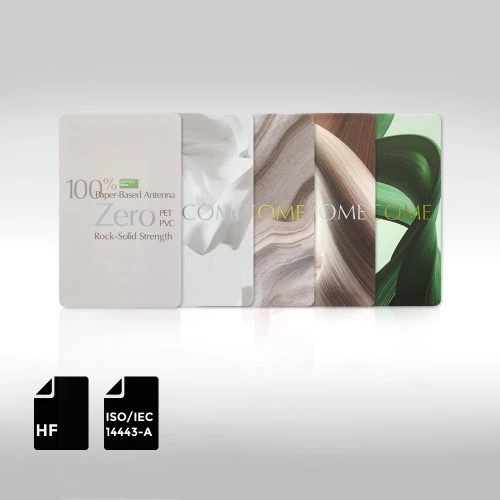
The 100% plastic-free RFID Paper Card uses an innovative paper-based antenna to replace traditional plastic and PET structures, significantly reducing environmental impact. As the industry’s first developer of paper-based antenna RFID cards, we are committed to advancing truly 100% eco-friendly RFID solutions. Powered by the NXP® MIFARE Ultralight® EV1 chip and compliant with ISO/IEC 14443-A, it ensures reliable contactless performance for access control and identification applications.
BioPoly™ Stone RFID Card Made with 100% Paper-Based Antenna NXP® MIFARE Ultralight® EV1
The RFID BioPoly™ Stone Card Made with 100% Paper-Based Antenna is designed for brands seeking high performance with a lower environmental footprint. Featuring a Zero PET, Zero PVC paper-based antenna combined with durable BioPoly™ Stone, it delivers rock-solid strength and reliable RFID performance. As the industry’s first developer of paper-antenna RFID cards, we continue to advance eco-friendly RFID solutions through sustainable innovation. Powered by NXP® MIFARE Ultralight® EV1 and compliant with ISO/IEC 14443-A, it is ideal for access control and identification applications.