
In the world of contactless smart cards, choosing the right chip technology is not just a technical decision—it directly affects system security, scalability, and long-term operational costs. Among the most widely used RFID technologies, MIFARE Classic vs DESFire is one of the most frequently debated topics in access control, transportation, hospitality, and smart infrastructure projects. Understanding their differences is essential for organizations that want to build reliable and future-proof RFID systems.
1. Overview of MIFARE Classic

1.1 What Is MIFARE Classic?
Developed by NXP Semiconductors, MIFARE Classic stands as one of the most widely deployed legacy RFID technologies globally. Introduced in the mid-1990s, it quickly became a standard for various applications due to its simplicity and cost-effectiveness. Despite its age, MIFARE Classic cards remain prevalent in numerous systems worldwide.
1.2 Key Features of MIFARE Classic
MIFARE Classic cards are typically available in 1K and 4K memory variants. Their memory is organized into sectors and blocks, with each sector protected by two cryptographic keys (Key A and Key B). The security mechanism relies on the proprietary Crypto-1 algorithm, which was considered adequate at the time of its introduction.
However, over the years, vulnerabilities in Crypto-1 have been publicly documented. Although MIFARE Classic is still widely used due to its low cost and legacy infrastructure, it is increasingly viewed as a transitional technology rather than a long-term security solution.
2. Overview of MIFARE DESFire

2.1 What Is MIFARE DESFire?
In contrast to its Classic counterpart, MIFARE DESFire was engineered from the ground up to address the escalating demand for high-security, multi-application RFID solutions. Also developed by NXP, DESFire chips are essentially microprocessors, offering advanced cryptographic features and a flexible file system. The ‘DES’ in DESFire refers to the Data Encryption Standard, indicating its commitment to robust security protocols.
2.2 Key Features of MIFARE DESFire
MIFARE DESFire cards boast significantly enhanced security features, primarily utilizing advanced encryption standards such as AES (Advanced Encryption Standard) with 128-bit keys and 3DES (Triple DES). This cryptographic strength provides superior protection against various attacks, including cloning and data manipulation. Unlike the sector-based memory of MIFARE Classic, DESFire employs a secure file system, allowing for greater flexibility in data management and supporting multiple independent applications on a single card. This architecture enables secure separation of data for different services, such as access control, cashless payments, and public transport ticketing.
2.3 The Evolution from EV1 to EV3
The MIFARE DESFire family has undergone several evolutionary stages, with EV1, EV2, and EV3 representing significant advancements in functionality and security.
MIFARE DESFire EV1: This was the initial iteration of the high-security DESFire platform, introducing AES encryption and a robust file system.
MIFARE DESFire EV2: Building upon EV1, the EV2 version introduced improvements in operating distance and transaction speed. It also featured “MIsmartApp” functionality, enabling more sophisticated multi-application schemes and backward compatibility with EV1.
MIFARE DESFire EV3: EV3, offers further enhancements in security, performance, and features. Key advancements include:
- Secure Unique NFC (SUN) message: This feature provides a secure and unique identifier for each transaction, enhancing privacy and preventing relay attacks, particularly relevant for secure web authentication.
- Transaction Timer: Designed to mitigate relay attacks, the transaction timer ensures that transactions are completed within a defined timeframe.
- Improved RF performance: EV3 boasts a greater operating distance and faster transaction speeds, optimizing user experience.
3. MIFARE Classic vs DESFire: Key Technical Differences
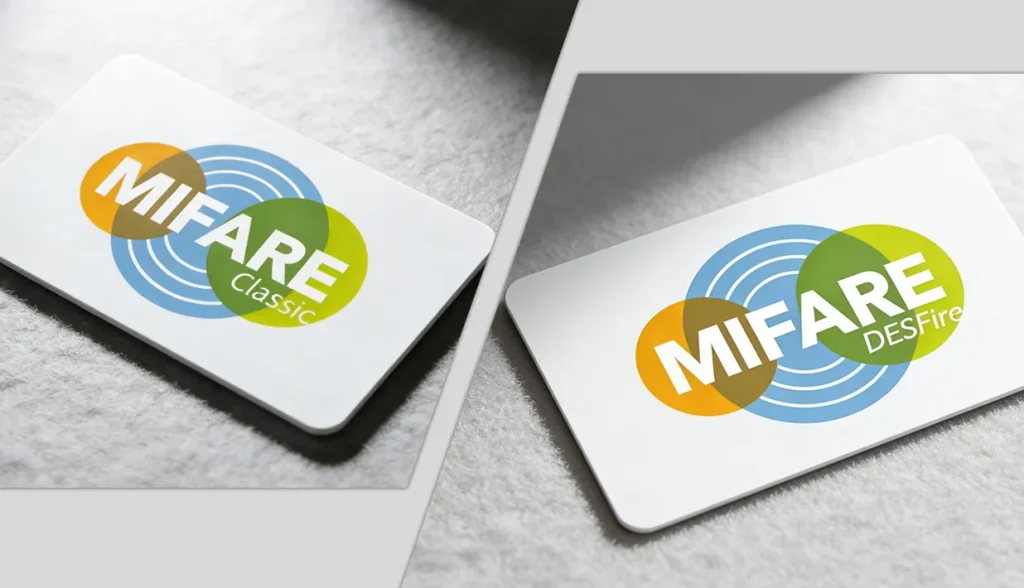
The fundamental disparities between MIFARE Classic vs DESFire extend beyond their initial design philosophies, encompassing critical technical aspects that dictate their suitability for various applications.
3.1 Security Architecture
MIFARE Classic relies on the proprietary Crypto-1 encryption algorithm. While innovative for its time, Crypto-1 has been extensively analyzed and publicly compromised since 2007/2008. This vulnerability means that MIFARE Classic cards can be easily cloned or eavesdropped upon using readily available tools, rendering them unsuitable for applications requiring robust security.
In contrast, MIFARE DESFire employs industry-standard cryptographic algorithms such as AES-128 and 3DES. These algorithms are well-vetted, publicly scrutinized, and significantly more resistant to cryptographic attacks. The DESFire chip itself is a secure microcontroller, designed to protect cryptographic keys and perform secure operations, offering a much higher level of data integrity and confidentiality.
3.2 Memory and Data Structure
MIFARE Classic organizes memory into fixed sectors and blocks, which limits flexibility. Application design must adapt to the card’s rigid structure.
DESFire provides a hierarchical file system that allows developers to create multiple applications with independent security policies. This makes it easier to design complex systems and expand functionality over time.
3.3 Compatibility and Ecosystem
MIFARE Classic has a vast installed base and a mature ecosystem of readers and infrastructure. This widespread compatibility can be an advantage for organizations looking to integrate with existing legacy systems. However, its security limitations often necessitate costly upgrades or parallel systems.
MIFARE DESFire, while newer, has also gained significant traction and is supported by a growing number of readers and system integrators. Its advanced features and security make it a preferred choice for new deployments and upgrades. Compatibility with older MIFARE Classic systems can be achieved through dual-interface readers or transitional solutions like MIFARE Plus, which offers backward compatibility while enabling a migration path to higher security.
4. Quick Security Comparison:MIFARE Classic vs. DESFire
Security is the most critical factor in the MIFARE Classic vs DESFire discussion.
| Feature | MIFARE Classic (EV1) | MIFARE DESFire (EV3) |
| Security Standard | Crypto-1 | AES-128 / 3DES |
| Vulnerability | High | Very Low |
| Data Structure | Fixed Sectors and Blocks | Flexible File System |
| Data Transfer Speed | 106 kbit/s | Up to 848 kbit/s |
| Multi-application | Limited | High (Up to 28 apps per card) |
| Typical Use Case | Low-security access | Contactless payment; Public transportation systems |
When evaluating MIFARE Classic vs DESFire from a security perspective, the answer is unequivocally clear: MIFARE DESFire is vastly more secure.
5. Application Scenarios: Choosing the Right Chip for Different Industries
The choice between MIFARE Classic vs DESFire is heavily dictated by the specific application requirements, particularly concerning security, functionality, and budget.
5.1 Access Control Systems
For small offices or low-risk environments, MIFARE Classic may still be acceptable due to its low cost. However, large enterprises increasingly adopt DESFire to protect sensitive areas and integrate with digital identity platforms.
5.2 Transportation and Ticketing
Public transportation systems require high-speed transactions and strong security to prevent fraud. DESFire has become the dominant choice in this sector, replacing older Classic-based systems in many cities.
5.3 Hospitality and Hotels
Budget hotels typically adopt MIFARE Classic cards to balance cost efficiency and system compatibility, while high-end hotels and integrated systems that combine access control, payment, and other multi-application functions tend to prefer MIFARE DESFire cards.
5.4 Education and Campus Cards
Universities often use MIFARE Classic for student ID cards due to budget considerations. However, multi-service campus cards—integrating payments, access control, and digital services—are increasingly built on DESFire.
6. Conclusion
Choosing between MIFARE Classic and DESFire is not merely a technical decision—it is a strategic choice that shapes the security, scalability, and longevity of an RFID system. MIFARE Classic remains suitable for low-risk, cost-sensitive applicatins with limited security requirements. MIFARE DESFire, however, offers superior security, flexibility, and long-term value, making it the preferred option for modern, high-security environments.
Whether you require cost-effective MIFARE Classic chips or advanced, high-security MIFARE DESFire chips, RFIDCard strives to be your trusted partner, delivering the most suitable solutions to meet your diverse application needs.
Recommended Product
RFID Card NXP MIFARE® DESFire® EV3 4K

Blank or customized printing RFID cards with a choice of dimensions are available. The MIFARE® DESFire® EV3 4K is Common Criteria EAL5+ security certified for smart card IC products. The MIFARE® DESFire® EV3 4K ICs fully comply with NFC Forum Type 4 Tag.
RFID Card NXP MIFARE Classic® EV1 4K (S70) CR80
The MIFARE Classic® EV1 4K RFID card is made with Photo-quality standard PVC sheets into the size of CR80, that are suitable for use with most direct thermal or thermal transfer card printers. MF1S70 series to be used in a contactless smart card according to ISO/IEC 14443 Type A.