Access control systems have become essential in everything from office buildings and hospitals to parking facilities and university campuses. Among the many authentication methods available today, passive RFID cards remain one of the most widely used due to their reliability, low cost, and ease of integration. One of the most common questions users and system designers ask is: “What is the actual reading range of passive RFID cards?” Understanding passive RFID distance is crucial because it directly impacts user experience, system accuracy, installation design, and security. Although passive RFID cards do not have batteries of their own, their reading distance can vary greatly depending on frequency, antenna design, reader configuration, and environmental conditions. In this article, we explore everything you need to know about passive RFID distance in access control applications and how to optimize it for best performance.
1. What Is Passive RFID Distance?

Passive RFID distance refers to the maximum range at which a passive RFID card can be detected and read by an RFID reader. Passive RFID cards work by harvesting electromagnetic energy emitted from the reader. When the card receives enough energy, its internal chip powers up and sends data back to the reader. Because passive cards do not contain a battery, their reading distance relies heavily on external factors. There are two types of reading distances commonly discussed:
- Theoretical reading distance: This is measured in laboratory conditions with minimal interference, ideal card orientation, and optimal reader power. These conditions rarely match real-world usage.
- Real-world reading distance: This is what users experience in practical environments—near metal surfaces, in outdoor conditions, surrounded by people, or while holding the card in their hand. The real-world passive RFID distance is typically shorter than the theoretical distance but is the most relevant for access control design.
In access control, reading distances generally range from a few centimeters for HF and LF cards to several meters for UHF cards.
2. Common Passive RFID Frequencies Used in Access Control
The achievable passive RFID distance is primarily dictated by the operating frequency of the system. Access control systems typically utilize three main frequency bands, each with distinct characteristics regarding range, data rate, and susceptibility to interference.
2.1 LF (Low Frequency – 125 kHz) Access Cards
LF systems, such as those using the common EM4100 or HID Prox standards, operate at 125 kHz. This is the oldest and most established technology in access control.
- Typical Reading Distance: 2–10 cm (1–4 inches).
- Pros: Excellent penetration through non-metallic materials (e.g., clothing, plastic wallets), low susceptibility to interference from liquids or human bodies, and a simple, robust design.
- Cons: Very short reading range, slow data transfer rate, and generally lower security features (often unencrypted).
The short range of LF systems means the user must physically place the card very close to the reader, making it a “tap” or “present” interaction.
2.2 HF (High Frequency – 13.56 MHz) Access Cards
HF systems, which include widely adopted standards like MIFARE and NFC (Near Field Communication), operate at 13.56 MHz.
- Typical Reading Distance: 2–5 cm (1–2 inches). While the frequency is higher, the power limitations and coupling mechanism (inductive coupling) keep the range very short, often shorter than LF for the same power.
- Security Advantages: HF tags often support advanced cryptographic features, enabling secure, mutual authentication between the card and the reader. This makes them the preferred choice for high-security applications and multi-application cards (e.g., combining access control with cashless payments).
- Coupling: Like LF, HF uses near-field inductive coupling, where the reader and tag antennas act as a transformer. This physical principle inherently limits the passive RFID distance.
2.3 UHF (Ultra-High Frequency – 860–960 MHz) Access Cards
UHF systems are the choice for applications requiring a significantly longer passive RFID distance. These systems operate in the 860–960 MHz band (with regional variations).
- Longer Reading Distance: Up to several meters (e.g., 3–10 meters or more) depending on the reader power and tag size.
- Use Cases: UHF access control is typically reserved for applications where hands-free or long-range identification is necessary, such as:Parking Lots, Gate Systems and Toll Collection.
- Coupling: UHF uses far-field electromagnetic wave propagation (radiating coupling), similar to radio waves, which allows for the extended range. However, this also makes it highly susceptible to interference from metals and liquids.
3. Key Factors That Influence Passive RFID Distance in Access Control
Even when using the same type of RFID card, passive RFID distance can vary significantly depending on several important factors.

3.1 Reader Power & Sensitivity
The reader’s output power directly determines the strength of the electromagnetic field it generates. A more powerful reader can energize a passive tag from a greater distance. Equally important is the reader’s sensitivity—its ability to detect the weak signal transmitted back by the tag. High-performance readers are engineered with advanced filtering and noise reduction to maximize both the outgoing power and the incoming signal reception.
3.2 Card Chip & Antenna Design
The tag itself is a major factor. A larger tag antenna can capture more energy from the reader’s field, increasing the effective passive RFID distance. The chip’s power consumption is also critical; a chip that requires less power to operate can be energized further away. For access control, the tag is typically a credit-card-sized plastic card, which imposes a physical limit on the antenna size. Specialized tags, such as windshield stickers or larger industrial tags, can achieve much greater ranges.
3.3 Environment
Environmental factors play a role. High humidity or rain can affect the dielectric properties of the air and materials, slightly reducing range. Outdoor installations require robust, weather-sealed readers and tags, and the presence of other RF noise (e.g., from Wi-Fi, cell towers, or other electronic devices) can introduce interference that degrades the reader’s sensitivity.
4. How to Improve Reading Distance in Access Control Systems
Optimizing the passive RFID distance is a balance of technology selection, installation practices, and user training.
4.1 Selecting the Right Reader
- Power and Sensitivity: Invest in high-quality readers known for superior power output and advanced signal processing capabilities.
- Antenna Tuning: Ensure the reader’s antenna is correctly tuned for the specific frequency and environment.
4.2 Choosing the Best Frequency for the Access Scenario
The most effective way to improve the functional distance is to select the appropriate frequency from the outset:
- LF/HF: Best for short-range, secure “tap-and-go” applications.
- UHF: Essential for long-range, hands-free applications.
4.3 Adjusting Gate or Reader Installation Height/Distance
In long-range UHF applications, the reader’s position is critical. The reader should be mounted at a height and angle that maximizes the line-of-sight to the tag on the vehicle or person, avoiding obstructions and minimizing ground reflections.
5. Choosing the Best Passive RFID Card for Your Access Control Needs
The final component in maximizing the passive RFID distance is the card itself.
5.1 How to Match Card Type with Distance Requirements
- Short Range (LF/HF): Standard PVC cards are sufficient. Focus on security features (e.g., encrypted sectors on HF cards) rather than range.
- Long Range (UHF): Look for cards with a larger, more efficient antenna design, often visible as a fine wire pattern inside the card. Ensure the card is compatible with the reader’s specific frequency band.
5.2 Importance of Chip Selection, Material, and Reader Compatibility
The chip’s quality and the card’s material composition affect durability and performance. Always ensure the card’s chip and encryption protocol are fully compatible with the reader’s firmware and security requirements. A mismatch in protocol can lead to a complete failure to read, regardless of the physical passive RFID distance.
6. Conclusion
Passive RFID distance is a key performance factor that shapes the effectiveness of an access control system. While LF and HF cards provide close-range, high-security identification, UHF cards enable long-range, hands-free entry suitable for vehicles and large facilities. By understanding the factors that influence reading distance—such as frequency, antenna design, reader power, interference, and environmental conditions—you can design a more reliable and efficient access control system. Whether you are managing door entry systems, hotel room access, campus management, or parking gate automation, choosing the right passive RFID technology is essential for ensuring safety, convenience, and operational efficiency.
Recommended Product
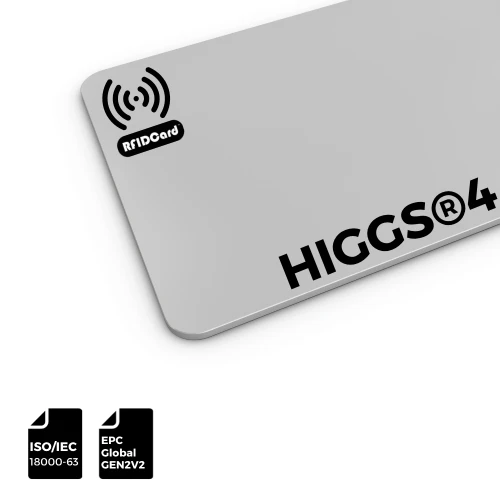
RFID Card EPC Class 1 Gen 2 UHF IC Higgs® 4

Blank or customized printing RFID card with choice of dimensions available. Higgs® 4 conforms to the EPCglobal Class 1 Gen 2 specifications and is one of highest market performing RFID IC.