
In professional poker environments, the ability to prevent cheating in poker is no longer just a matter of fairness but a business necessity. Despite the advancements in surveillance technology and rigorous dealer training, the persistent threat of cheating continues to loom over both professional tournaments and casual games. Among the most insidious forms of deception are marked cards and card switching, tactics that are notoriously difficult to detect in real-time, often leaving victims with little recourse. RFID playing cards introduce a fundamentally different approach. Instead of relying on human observation or post-incident investigation, RFID systems make every card digitally identifiable and traceable in real time.
1. Understanding Marked Cards: How Cheaters Exploit Traditional Decks
Marked cards represent a classic yet evolving form of poker cheating. The ability to identify a card without seeing its face provides an enormous advantage to the cheater.

1.1 What Are Marked Cards in Modern Poker?
Marked cards are no longer limited to obvious scratches or bent corners. Modern techniques include:
- Micro-abrasions along edges that alter light reflection
- Ink markings visible only under certain angles or UV light
- Subtle pressure marks detectable through touch
- Variations in card thickness or finish
These marks are designed to survive repeated shuffling and handling while remaining invisible to dealers and cameras.
1.2 Why Marked Cards Are Hard to Detect
Human-based detection has inherent limitations:
- Visual fatigue: Dealers handle thousands of cards per shift
- Camera constraints: Angles, lighting, and resolution limit effectiveness
- Delayed discovery: Marked cards are often noticed only after suspicious outcomes
By the time an investigation begins, the damage may already be done.
2. How RFID Playing Cards Eliminate the Value of Marked Cards
RFID technology offers a robust solution to the problem of marked cards by fundamentally altering how cards are identified and tracked. By embedding tiny RFID tags into each card, the system shifts identification from visual cues to digital verification, rendering traditional marking techniques obsolete.

2.1 Unique Card Identity: Every Card Has a Digital Fingerprint
Every RFID playing card contains a passive chip with a unique identifier (UID). This UID is bound to that specific card for its entire lifespan. From the system’s perspective, a card is not defined by its appearance, but by its digital identity.
This means that even if a card is physically marked, its informational value is irrelevant unless the RFID system confirms its identity during play.
2.2 Real-Time Card Recognition vs. Visual Guessing
RFID readers, typically integrated into the poker table, can instantly identify cards as they are dealt or placed on the table. Unlike human eyes, which can be deceived by subtle markings or distracted by the game’s intensity, RFID readers are impervious to such limitations. They identify cards accurately and consistently, regardless of surface condition, lighting, or the speed of play. Even if a card has been physically marked, its true identity, as verified by the RFID chip, must still match the system’s records for that specific card. Any discrepancy would immediately flag the card as suspicious, effectively neutralizing the cheater’s advantage.
2.3 Detecting Irregular Card Behavior
RFID systems can automatically flag anomalies such as:
- The same card UID appearing twice in a single hand
- A card appearing that does not belong to the registered deck
- Missing cards that were never read during a round
These events are impossible to detect consistently through manual observation, but trivial for an RFID system. By shifting control from perception to verification, RFID playing cards fundamentally change how operators prevent cheating in poker.
3. Card Switching Explained: The Most Dangerous Form of Poker Cheating
Card switching is often considered a more dangerous form of cheating due to its direct manipulation of the game’s outcome and the difficulty in proving its occurrence.

3.1 How Card Switching Happens
Card switching involves introducing unauthorized cards into play or removing legitimate ones. It can occur during:
- Shuffling or deck changes
- Dealer distraction moments
- Player-dealer collusion
Because poker cards are visually identical, switched cards are almost impossible to distinguish without system-level tracking.
3.2 Why Card Switching Is So Hard to Prove
The primary reason card switching is so difficult to prove is the lack of immediate, concrete evidence. Unlike a marked card, which can be physically examined, a switched card often looks identical to the legitimate cards in the deck. The identical appearance of casino-grade playing cards makes it nearly impossible to visually distinguish a foreign card from a legitimate one. As a result, accusations of card switching often rely on suspicion and circumstantial evidence rather than hard data, making it a challenging and often fruitless endeavor to prove.
4. How RFID Playing Cards Prevent Card Switching at the System Level
Just as with marked cards, RFID technology provides a powerful, system-level solution to prevent card switching.

4.1 Deck Registration: Locking Each Card to a Session
Before a game or tournament begins, every RFID card in the deck is scanned and registered. The system knows exactly which card IDs are authorized for that session. If an unregistered card appears, the system detects it instantly even if the card looks identical.
4.2 Real-Time Alerts for Unauthorized Cards
With the deck registered, the RFID system continuously monitors the cards in play. If a foreign or duplicate card is introduced onto the table, the RFID reader will instantly detect it. The system will either fail to recognize the card’s UID or identify it as a duplicate of a card already in play. In either case, an automatic alert is triggered, notifying the dealer or game supervisor of the anomaly. This real-time alerting capability is a game-changer, transforming the fight against card switching from a reactive, evidence-gathering process to a proactive, preventive one.
4.3 Full Hand and Deck Traceability
Beyond real-time alerts, RFID technology provides a complete and auditable history of every card dealt in a game. The system logs the time, position, and hand to which each card was dealt. This creates an invaluable data trail that can be used for post-incident audits. In the event of a dispute, game officials can review the detailed logs to reconstruct the game and verify the integrity of every hand. This data-driven approach replaces suspicion and assumption with concrete, verifiable evidence, making it far easier to resolve disputes and maintain a fair gaming environment. This level of traceability is a powerful tool to prevent cheating in poker.
5. Why RFID Works Better Than Cameras and Manual Controls
While traditional security measures like surveillance cameras and dealer training are important, they have inherent limitations that RFID technology effectively overcomes. The table below highlights the key differences:
| Method | Limitation | RFID Advantage |
| Surveillance Cameras | Passive, after-the-fact analysis. Relies on human observation to spot anomalies. | Real-time, automated identification and alerting. |
| Dealer Training | Susceptible to human error, distraction, and collusion. | Automated, consistent, and impartial verification. |
| Manual Deck Checks | Time-consuming, disruptive to game flow, and only provides a snapshot in time. | Continuous, non-intrusive monitoring throughout the game. |
6. Real-World Impact: How RFID Protects Game Integrity and Trust

When implemented correctly, RFID poker cards deliver measurable benefits:
- Fewer cheating disputes and investigations
- Increased player confidence in game fairness
- Stronger compliance with regulatory requirements
- Enhanced reputation for poker rooms and tournaments
Most importantly, RFID shifts the conversation from suspicion to certainty.
7. Conclusion
Marked cards and card switching thrive on invisibility and ambiguity. RFID playing cards remove both. By assigning every card a verifiable identity and tracking it throughout play, operators can prevent cheating in poker at a structural level rather than reacting to incidents after the fact. Looking to prevent cheating in poker with RFID playing cards? Contact us to discuss requirements, pricing, or sample requests.
FAQs
1. Do RFID cards affect the feel or handling of traditional poker cards?
High-quality RFID poker cards are designed to maintain standard card thickness, flexibility, and shuffle performance. The RFID chip is fully embedded and does not interfere with normal gameplay.
2. What should I look for when choosing RFID poker cards?
Key factors include chip stability, read accuracy, durability under frequent shuffling, and compatibility with existing poker systems. Card quality directly affects how reliably the system can prevent cheating in poker over long-term use.
3. Are RFID poker cards only useful for large casinos and tournaments?
No. While widely used in casinos and televised tournaments, RFID poker cards are also valuable for poker clubs and private game operators who want to improve fairness, reduce disputes, and protect their reputation.
4. Do RFID poker cards need to be used with a dedicated poker table?
Yes. In most professional applications, RFID poker cards must be used together with a dedicated RFID poker table. The cards themselves only contain an RFID chip and antenna and cannot be identified without an external reading system. The poker table integrates RFID readers and antenna arrays that enable stable, real-time card detection during gameplay.
Recommended Product
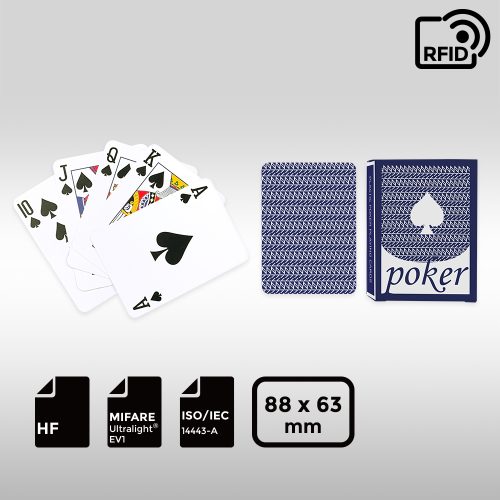
MIFARE Ultralight® EV1 PVC RFID Playing Cards

RFID playing cards are special cards based on regular playing cards, with additional RFID chips embedded. This type of playing card is suitable for scenarios with higher quality and requirements, such as casinos, magic shows, or collectors who enjoy collecting special playing cards.