
For decades, PVC has been the default RFID card material across access control, hospitality and identification systems. It was cheap, easy to process, and good enough for most short-term applications. However, as RFID deployments scale up and expectations around durability, sustainability, and lifecycle performance increase, PVC is no longer the automatic choice it once was.
1. Why Traditional PVC Is Losing Its Advantage
While PVC offers a compelling blend of low unit cost and adequate durability, two major forces—environmental regulation and corporate ESG mandates—are increasingly challenging its long-term viability.
1.1 Environmental Concerns Around PVC Production and Disposal
PVC is a petroleum-derived plastic whose production involves chlorine, a process that can release highly toxic dioxins into the environment. Furthermore, PVC is notoriously difficult to recycle. Its chemical composition makes it incompatible with most standard recycling streams, leading to the vast majority of PVC cards ending up in landfills, where they persist for centuries. As global waste management crises deepen and regulatory bodies impose stricter controls on single-use plastics, the environmental liability associated with PVC is becoming too significant to ignore.
1.2 Growing ESG Requirements in Enterprise and Government Tenders
Today, an increasing number of companies regard ESG as a core strategic priority and actively fulfill their social responsibilities to achieve long-term sustainable growth. Deploying millions of PVC cards can actively undermine these goals, creating a tangible compliance risk. This is why “cheap PVC cards” often create long-term financial and reputational risks that far outweigh the initial unit cost savings. Procurement teams are now required to actively seek alternatives that demonstrate a commitment to circularity and a reduced carbon footprint.
2. Sustainable RFID Card Material Alternatives Replacing Traditional PVC
The market has responded to this demand with a robust suite of innovative materials that offer comparable performance to PVC while drastically reducing environmental impact.

2.1 BioPoly™ Vinyl
BioPoly™ Vinyl provides a seamless transition for organizations accustomed to PVC’s feel and performance. It is a biodegradable formulation that maintains the PVC-like durability, flexibility, and print quality required for high-volume applications.
- Key Difference: Unlike standard PVC, BioPoly™ Vinyl is formulated with additives that allow it to break down in biologically active environments within 3 years, rather than centuries.
- Performance: It offers comparable scratch, moisture, and UV resistance, meaning it can be used in the same operational environments as traditional PVC without compromising card lifespan.
- Decision Insight: This material works with existing printers and lamination processes while offering a significantly lower environmental impact. It provides a stable TCO and is often the first step for organizations seeking a quick, effective sustainability upgrade.
2.2 BioPoly™ Stone
BioPoly™ Stone is a revolutionary composite material that dramatically reduces the reliance on petroleum-based plastics. It achieves this by incorporating a high percentage of mineral content, typically calcium carbonate.
- Composition: The material can contain up to 60% mineral filler, meaning a significant portion of the card’s mass is derived from abundant, non-petroleum resources.
- Aesthetics and Rigidity: This high mineral composition gives the card excellent rigidity, superior waterproof and oil-proof, premium surface finish. It feels substantial and high-quality in the hand.
- Decision Insight: BioPoly™ Stone is an excellent choice for projects where sustainability must be paired with brand differentiation. The unique feel and look of the RFID card material elevate the perceived value of the credential, making it popular for loyalty programs and high-end access control.
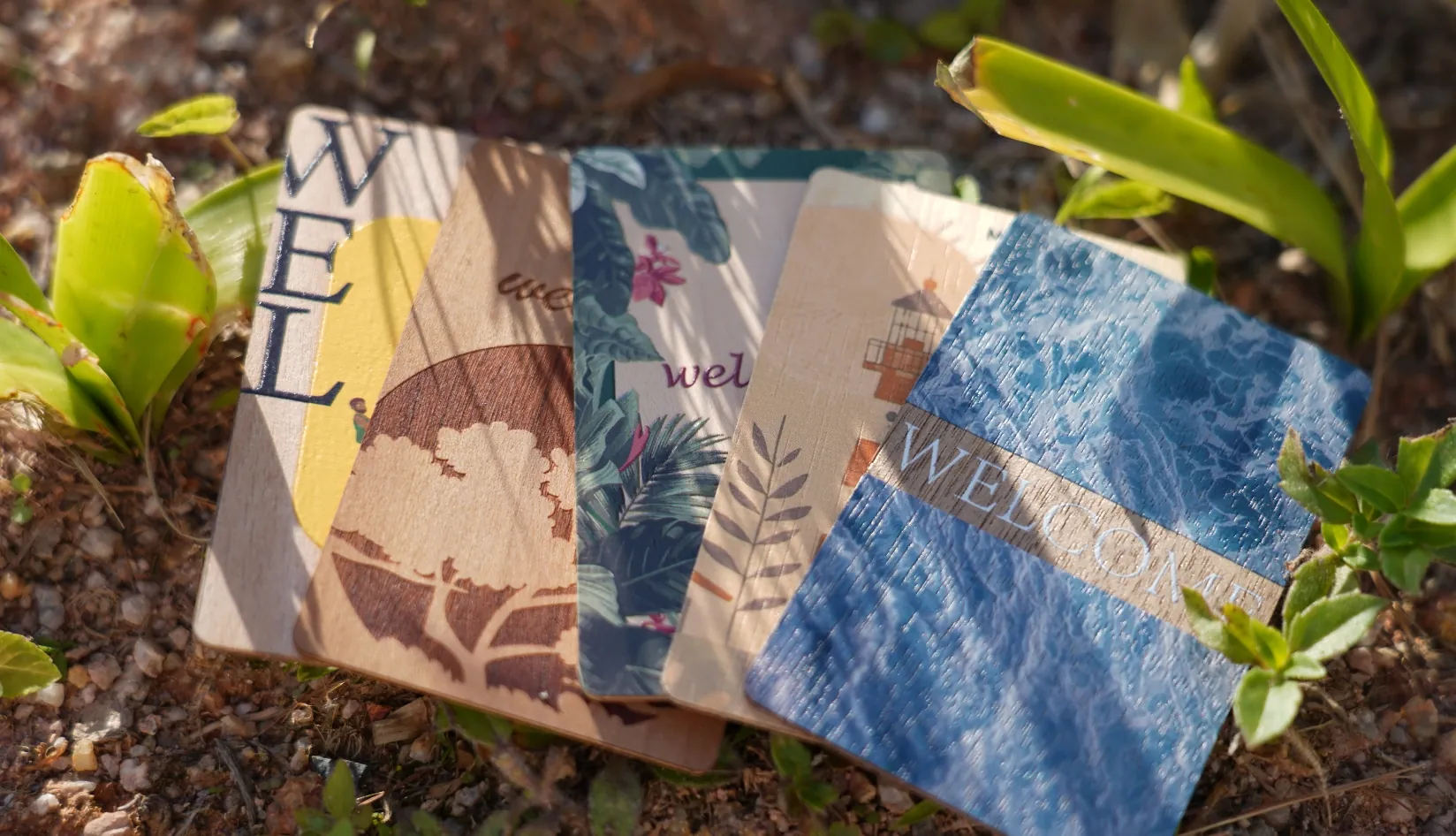
2.3 Wooden RFID Cards
Wooden RFID cards offer a fully renewable and biodegradable solution. These cards use sustainably sourced natural wood veneers as the core substrate.
- Sustainability: Wood is a fully renewable resource, and the cards are inherently biodegradable, returning to the earth without leaving behind microplastics.
- Identity: The unique texture, grain, and visual identity of wood make the card a powerful branding asset, not just a functional carrier. It communicates a strong commitment to natural and sustainable values.
- Technical Consideration: While highly durable, wood is a natural material and may require specialized lamination to ensure long-term protection of the embedded electronics and antenna.
- Decision Insight: Wooden cards are ideal for organizations where the material itself is a key part of the brand message, such as eco-tourism, sustainable retail, or corporate headquarters aiming for a natural aesthetic.
2.4 100% Plastic-Free Paper-Based RFID Cards
Representing the maximum reduction in environmental impact, these cards are use fiber-based materials, utilizing a paper antenna inlay to ensure 100% Plastic-Free.
- Zero Plastic: The entire card, from the substrate to the inlay, is designed to be plastic-free, making it fully recyclable and biodegradable through standard paper waste streams.
- Performance Trade-offs: While offering unparalleled environmental benefits, the performance profile is tailored for short-term or low-stress applications.
- Decision Insight: This RFID card material is perfect for single-event passes, temporary visitor badges, hotel key cards, or short-lifecycle credentials where maximum environmental impact reduction is the primary goal, and acceptable performance trade-offs are understood.
3. How Card Material Choice Directly Impacts Project ROI
The true cost of an RFID card is not its unit price, but its Total Cost of Ownership (TCO). A strategic choice of RFID card material can be a significant driver of long-term Return on Investment (ROI).
3.1 Lifecycle Cost vs Unit Cost
The initial unit cost of a sustainable card may be marginally higher than PVC, but this is often offset by a significantly lower lifecycle cost.
| Cost Factor | Low-Grade PVC Card | High-Quality Sustainable Card | Impact on ROI |
| Unit Cost | Lowest | Moderate | Short-term saving |
| Failure Rate | High (due to material stress) | Low (due to material stability) | High operational disruption |
| Reissuance Cost | High (labor + material + shipping) | Low | Direct TCO reduction |
| Operational Disruption | Significant (downtime, access issues) | Minimal | Hidden cost savings |
3.2 Material Stability and Read Performance Over Time
The stability of the card substrate is crucial for maintaining consistent RFID read performance.
- Substrate Protection: If the substrate material is prone to warping, shrinking, or cracking, the geometry of the antenna can be compromised. Even microscopic changes can detune the antenna, leading to intermittent or failed reads.
- Long-Term Consistency: Materials like BioPoly™ Stone or high-grade wooden substrates offer superior dimensional stability. This stability protects the antenna geometry, ensuring long-term read consistency.
4. Decision Framework: How to Choose the Right RFID Card Material

The environment and expected lifespan of the credential must dictate the material choice:
- Short-Term vs. Long-Term Credentials: For credentials with a lifespan of less than one year, 100% plastic-free paper-based cards are often the most environmentally and economically sound choice. For credentials expected to last three to five years, BioPoly™ Vinyl or BioPoly™ Stone offer the necessary durability.
- Indoor vs. Outdoor Environments: Outdoor or industrial environments require materials with high UV and moisture resistance. While PVC is traditionally used here, BioPoly™ Vinyl is now a viable, sustainable alternative.
- Consumer-Facing vs. Industrial Deployments: Consumer-facing card benefit from the premium feel and aesthetic of BioPoly™ Stone or Wooden cards, which act as brand differentiators. Industrial deployments prioritize ruggedness and stability.
5. When Traditional PVC Still Makes Sense—and When It Doesn’t

PVC has not disappeared, and it still makes sense in limited scenarios: short-term use, controlled environments, and projects with extreme cost sensitivity. However, warning signs that PVC is the wrong choice include long expected lifespans, sustainability mandates, and high reissuance costs.
The key is not to over-engineer, but to avoid under-estimating material impact.
6. Conclusion
The transition away from traditional PVC is not a trend; it is a fundamental shift in how organizations view their physical credentials. The selection of RFID card material is a critical decision that impacts performance, sustainability, and operational risk. Buyers must evaluate material choice not as a commodity purchase, but as a long-term investment in system reliability and corporate responsibility. If you are evaluating alternatives to traditional PVC, RFIDCard provides a range of sustainable card materials designed to balance durability, RFID performance, and environmental responsibility.
Recommended Product
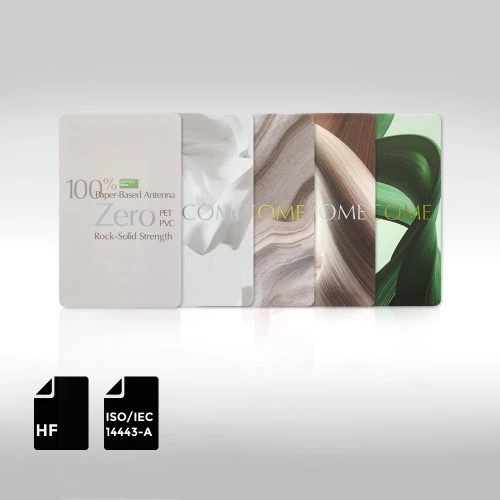
BioPoly™ Stone RFID Card Made with 100% Paper-Based Antenna NXP® MIFARE Ultralight® EV1

The RFID BioPoly™ Stone Card Made with 100% Paper-Based Antenna is designed for brands seeking high performance with a lower environmental footprint. Featuring a Zero PET, Zero PVC paper-based antenna combined with durable BioPoly™ Stone, it delivers rock-solid strength and reliable RFID performance. As the industry’s first developer of paper-antenna RFID cards, we continue to advance eco-friendly RFID solutions through sustainable innovation. Powered by NXP® MIFARE Ultralight® EV1 and compliant with ISO/IEC 14443-A, it is ideal for access control and identification applications.

BioPoly™ Vinyl Generic Hotel Key Card
The NXP MIFARE® DESFire® C RFID Hotel cards fully comply with ISO/IEC 14443-A. The Key cards are made with photo-quality standard BioPoly™ Vinyl in the size of CR80.

100% Plastic-Free RFID Paper Card NXP® MIFARE Ultralight® EV1
The 100% plastic-free RFID Paper Card uses an innovative paper-based antenna to replace traditional plastic and PET structures, significantly reducing environmental impact. As the industry’s first developer of paper-based antenna RFID cards, we are committed to advancing truly 100% eco-friendly RFID solutions. Powered by the NXP® MIFARE Ultralight® EV1 chip and compliant with ISO/IEC 14443-A, it ensures reliable contactless performance for access control and identification applications.

Wooden Generic Hotel Key Card
The NXP MIFARE Ultralight® C and NXP MIFARE Ultralight® AES RFID Hotel cards fully comply with ISO14443-A. The Key cards are made with Wooden in the size of CR80.
IMPORTANT NOTICE: All MIFARE Ultralight® AES cards supplied on this site is factory default (non-encrypted) version.