


RFID card scanners are available in different types, including fixed RFID card scanners, handheld RFID card scanners, desktop RFID card scanners, portable RFID card scanners, and embedded RFID card scanners. Each type is designed for different application scenarios, such as access control, inventory management, asset tracking, and automated identification systems.
RFID card scanners play an important role in RFID systems by reading data stored in RFID tags and transferring information to connected software platforms. Choosing the right RFID card scanner can directly affect system performance, operational efficiency, security, and long-term business costs.
Therefore, understanding the characteristics, advantages, and suitable applications of different RFID card scanner types is essential for businesses looking to implement an effective RFID solution.
What Types of RFID Card Scanners are There?
RFID card scanners are available in several types based on installation method, mobility, and application requirements. Each type has different advantages and is designed for specific applications such as access control, inventory management, asset tracking, and automation systems.
Fixed RFID Card Scanner
A fixed RFID card scanner is a permanently installed RFID reading device designed to continuously identify RFID cards or tags within a specific area. It is commonly used in locations that require automatic and large-scale identification.
Common applications:
- Access control entrances and exits
- Warehouse management
- Production line tracking
- Logistics centers
- Automated inventory systems
Advantages:
- Supports continuous operation
- Provides stable reading performance
- Suitable for high-volume RFID identification
Limitations:
Not suitable for applications requiring frequent movement
Requires installation and configuration
Handheld RFID Card Scanner
A handheld RFID card scanner is a portable RFID reading device that allows operators to scan RFID cards or tags while moving between different locations. It is designed for applications requiring mobility and real-time data collection. For example, our R2, MR20, and C72 are all portable handheld and wearable scanners.
Common applications:
- Inventory counting
- Asset inspection
- Warehouse operations
- Retail stock management
Advantages:
- High mobility
- Flexible operation
- Suitable for field applications
Limitations:
- Limited battery capacity
- Usually shorter reading range than fixed readers
Desktop RFID Card Scanner
A desktop RFID card scanner is a compact RFID reader designed for close-range scanning on desks, counters, or workstations. It is commonly used where accurate card identification and easy computer integration are required. For employee attendance and access control, RL173 desktop reader is both cheap and high-performance.
Applications:
- Employee attendance
- Library management
- Document tracking
- Membership systems
- Desktop access control
Advantages:
- Easy installation
- Accurate short-range reading
- Convenient USB or Bluetooth connection
Limitations:
- Limited mobility
- Shorter reading distance
Portable RFID Card Scanner
A portable RFID card scanner is a lightweight RFID scanning device that usually connects with mobile devices through Bluetooth or wireless communication. It is designed for users who need RFID identification capabilities while moving between different locations.
Applications:
- Mobile asset management
- Event management
- Field service
- On-site inspection
Advantages:
- Lightweight design
- Wireless operation
- Easy transportation
Limitations:
- Battery dependency
- Limited scanning range
Embedded RFID Card Scanner
An embedded RFID card scanner is integrated directly into another device or system to provide built-in RFID identification capabilities. It is commonly used in automated equipment and smart devices.
Applications:
- Self-service terminals
- Smart lockers
- Automated checkout systems
- Integrated access control devices
Advantages:
- Space-saving design
- High system integration
- Customized functionality
Limitations:
- Requires technical integration
- Less flexible after deployment
Comparison Table
| Type | Best For | Main Advantage |
|---|---|---|
| Fixed RFID Scanner | Warehouse, access control, logistics | Stable continuous reading |
| Handheld RFID Scanner | Inventory, inspection | High mobility |
| Desktop RFID Scanner | Office, attendance | Easy close-range scanning |
| Portable RFID Scanner | Field applications | Wireless flexibility |
| Embedded RFID Scanner | Smart devices | High integration |
Considerations for Selecting an RFID Card Scanner
Choosing the right RFID card scanner depends on several factors, including reading range, scanning speed, working environment, budget, portability requirements, and maintenance needs. Evaluating these factors helps businesses select an RFID scanner that matches their application requirements and improves long-term operational efficiency.
Reading Range and Scanning Speed
Reading range and speed are two of the most important factors when selecting an RFID card scanner. Different applications require different scanning capabilities.
For large-scale asset management, logistics, and warehouse operations, RFID scanners with longer reading ranges and faster scanning speeds are usually preferred. For close-range applications such as employee identification, access control, and desktop management, shorter reading distances may be sufficient.
The antenna design of an RFID scanner also affects reading coverage and accuracy. Multi-antenna configurations can provide wider coverage and improve identification performance in complex environments. For example, the U300 RFID reader supports 4 and 8 antenna interfaces, providing greater flexibility for large-area RFID applications.
Environmental Adaptability
The working environment is another important consideration when choosing an RFID card scanner.
For outdoor, industrial, or harsh environments, businesses should consider scanners with features such as:
- Dust resistance
- Water resistance
- Shock resistance
- Stable operation under temperature variations
For handheld and portable RFID scanners, power consumption is also important because lower power consumption can extend battery life and improve operational efficiency during mobile applications.
Budget and Long-Term Value
Cost is an important factor when selecting an RFID card scanner, but businesses should consider more than the initial purchase price.
A reliable RFID scanner with stable performance, durability, and technical support can reduce maintenance costs and provide better long-term value. Choosing a cost-effective solution helps organizations balance performance requirements and budget limitations.
Portability or Fixed Installation Requirements
The choice between fixed and portable RFID scanners depends largely on the application environment.
Fixed RFID scanners are suitable for applications requiring continuous operation, such as:
- Warehouse management
- Access control systems
- Production line monitoring
Handheld or portable RFID scanners are better suited for applications requiring mobility, including:
- Asset inspections
- Inventory counting
- Field data collection
Connectivity options also affect deployment flexibility. RFID scanners supporting interfaces such as USB, RS232, Ethernet, and Wi-Fi can be more easily integrated into different systems. For example, the C72 handheld RFID scanner provides multiple connectivity options for flexible deployment.
Maintenance and Upgrade Support
Long-term maintenance and upgrade capabilities should also be considered before selecting an RFID card scanner.
Devices that support easy maintenance, software updates, and system upgrades can reduce future operational costs and help businesses adapt to changing requirements.
In addition, a user-friendly interface can improve employee efficiency, reduce operational errors, and make RFID systems easier to manage.
Conclusion
Choosing the right RFID card scanner requires a clear understanding of different scanner types, application requirements, reading performance, installation environment, and long-term maintenance needs. Fixed, handheld, desktop, portable, and embedded RFID card scanners each have their own advantages, and selecting the right solution can help businesses improve identification efficiency, optimize operations, and reduce long-term costs.
As an RFID card manufacturer and solution provider, we provide customized RFID cards, RFID tags, and compatible RFID reader solutions for various industries, including access control, hospitality, retail, logistics, and asset management. With professional RFID manufacturing capabilities and customized solution support, we help businesses select and implement reliable RFID identification systems based on their specific requirements.
Contact us today to discuss your RFID card scanner and RFID solution needs.
Recommended Products
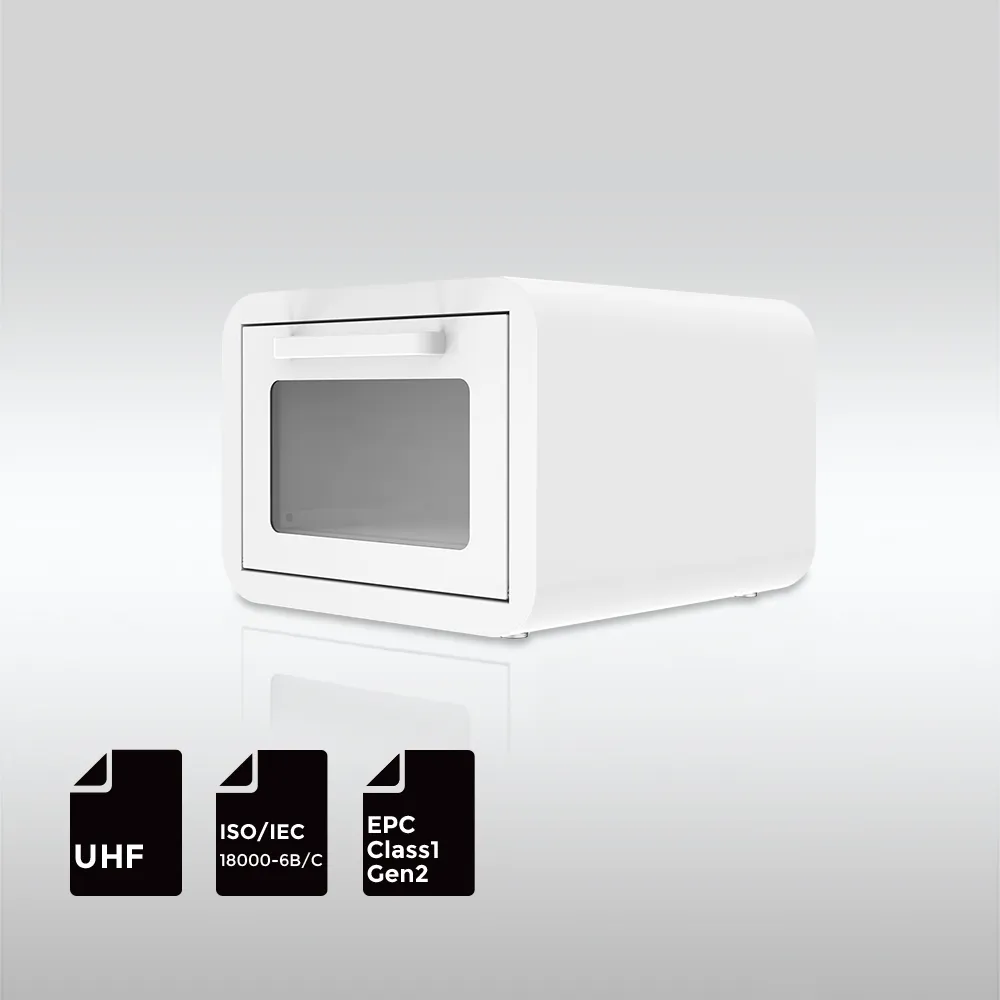
RFID Jewelry Counting Box

The RFID jewelry counting box is designed for rapid batch inventory of jewelry and precious metal items fitted with compatible UHF RFID tags. Its RFID module enables multiple items to be identified within an enclosed inventory space, helping simplify routine stock counts.
A portable enclosure and shielding design support use across jewelry inventory locations. The device provides a default serial interface and SDK/API development support for integration with an inventory application.

Overhead UHF RFID Reader with Sound and Light Alarm | ISO18000-6B/C
AZFC-G1 is a UHF RFID reader designed for long-range, high-throughput multi-tag identification in ceiling-mounted, wall-mounted, and pole-mounted access-control and asset-flow scenarios. Based on an Impinj E710 RF chip module, it combines strong dense-tag reading capability, long reading distance, built-in audible and visual alarm, and flexible wired or optional wireless communication interfaces.
With a 10 dBi high-gain circularly polarized antenna and optional infrared, 360° 2D laser LiDAR, or millimeter-wave radar trigger, AZFC-G1 can intelligently identify RFID-tagged goods or assets during inbound/outbound movement. It is suitable for warehouse material management, new-retail footwear and apparel anti-theft management, and library/archive borrowing and asset identification.

UHF RFID Gate Reader with Light & Sound Alarm
The Q410PF UHF RFID Gate Reader is a mature and widely adopted RFID access control solution designed for high-efficiency identification and monitoring in busy environments. Featuring a clean, modern design and easy installation, it integrates a high-performance RF module capable of fast and accurate dense tag reading, making it well suited for warehouse inbound and outbound asset inventory, retail loss prevention, and circulation management. Infrared trigger sensors are used to activate tag reading and determine entry and exit direction, while built-in sound and light alarm functions support both online and offline EAS anti-theft modes. The system supports RJ45 Ethernet communication and can be expanded to WiFi or 4G connectivity to meet different deployment requirements.
This UHF RFID Gate Reader is widely applied in libraries, archives, warehouses, and apparel retail stores, enabling batch identification, flow statistics, and unauthorized removal alerts. It features high-quality infrared sensors for precise triggering and direction detection, a powerful RF module for high-speed and high-accuracy tag recognition, and a 10.1-inch HD touch display for intuitive human–machine interaction and LiDAR-based triggering for smarter read-zone control. Equipped with four narrow-beam, low-axis-ratio antennas and adjustable output power from 0–33 dBm, the gate ensures accurate coverage with minimal misreads or cross-reads, delivering reliable performance with no blind spots in complex environments.

UHF RFID Ceiling-Mount Reader with Light & Sound Alarm
The ultra-high frequency RFID access control device features a sleek ceiling-mounted design with built-in antennas and advanced dual-sensing multi-tag reading. Its compact and space-efficient construction allows easy installation, while integrated sound and light alarms provide intelligent detection of unauthorized tags. Ideal for warehouse logistics, retail inventory, and asset tracking, it ensures rapid identification of multiple tags and streamlines inbound and outbound management for maximum efficiency.

Integrated UHF RFID Reader
The integrated UHF RFID reader is a single-channel fixed UHF RFID reader, which is equipped with an integrated high-performance antenna based on the self-developed module based on the Impinj® E710 chip. It supports multiple communication interfaces such as RS-232, RJ45, GPIO, etc., enabling it to be widely used in multiple scenarios such as warehousing, file management, book management, banking, and production line management.

UHF RFID Handheld Reader AZ-R2
This is a handheld data collection device with a stylish design and incredible performance. It delivers superior UHF reading and writing, barcode scanning, and transmits data to the data center via Bluetooth with ease. It can complete tasks in inventory management, asset management, inspection, etc.

UHF Desktop RFID Reader / Writer AZD-R1
This is a newly developed desktop UHF reader. It supports Windows, Android, and iOS applications and enables a short read distance of 50cm. Combined with a high-efficiency collision processing algorithm, it delivers fast reading and writing of tags and maintains a high identification rate as well. It allows data transmission via Bluetooth and Type-C USB. R3 can be deployed in retail collection, logistics, identity verification, smart parking, access control, anti-counterfeiting systems, production process control, etc.

Wearable Bluetooth UHF RFID Reader AZ-MR20
With a built-in UHF module, the wearable Bluetooth UHF RFID reader possesses a powerful data collection and transmission function via a simple Bluetooth connection with Android/iOS devices. All these functions make it the most adaptable device in a wide spectrum of circumstances, such as logistics & express delivery, retail store management, warehouse management, power patrol inspection, asset management, e-commerce picking, ticket checking, etc., helping users free their hands and significantly improve work efficiency.

UHF RFID Handheld Reader | ISO 18000-6C
Elevate asset management with the Android-powered UHF RFID Handheld Reader AZH-P1. Featuring a robust Cortex-A53 2.3 GHz Octa-core processor, 8000mAh battery, and advanced Impinj E710 reader chip, it offers superior UHF RFID scanning. With a read/write range up to 15 meters and rapid read rate of 1300+ tags/sec, it’s ideal for retail, warehousing, and fleet management.

UHF RFID 4-Port | 8-Port Reader AZF-M1
This is a newly launched high-performance fixed RFID reader. Adopting the Android 11 operating system, a 2.0GHz quad-core CPU possesses powerful data processing capabilities.
The reader Integrates RS232, RJ45, HDMI, and other interfaces, and supports DC, POE, and POE+ power supplies. It can meet the application needs in complex environments such as warehousing, file management, library management, production line management, medical device cabinets, unmanned retail, etc.


