
In today’s hyper-connected logistics landscape, efficiency isn’t just a metric; it’s a survival trait. If you are still relying on manual checks or short-distance line-of-sight scanning, your operations are likely leaking revenue through labor costs and data inaccuracies. Selecting the right RFID scanner is the most critical decision a warehouse or facility manager will make this year. This guide breaks down five crucial features that truly determine whether a long range RFID scanner will deliver reliable, scalable, and future-proof performance in 2026 and beyond.
1. Understanding the “Long Range” Landscape
Before diving into features, we must define the field. “Long Range” typically refers to Ultra-High Frequency (UHF) passive RFID systems. Unlike the NFC in your smartphone or the proximity cards used for office doors, a high-quality long range RFID scanner can capture data from tags located 5 to 15 meters away and even further. This allows for “bulk reading,” where an entire pallet of goods can be scanned as it passes through a portal, without a human ever touching a single box.
2. Real-World Read Range vs. Theoretical Range
The most common mistake buyers make is taking the “Max Range” printed on a spec sheet at face value. Manufacturers often test these devices in idealized environments with zero interference. In the real world, your warehouse is a chaotic symphony of metal racking, concrete floors, and wireless signals, all of which act as enemies to RFID performance.

2.1 Environmental Factors That Affect Read Range
Several physical and electromagnetic factors can significantly impact read performance:
- Multipath interference: Radio waves bounce off metal surfaces, walls, machinery, and floors, creating overlapping signals that distort tag responses.
- Dead zones: Certain areas experience signal cancellation due to phase interference, resulting in unreadable spots.
- Material absorption: Liquids, human bodies, and certain packaging materials absorb RF energy, reducing read distance.
- Tag orientation and placement: Even high-quality tags can perform poorly if mounted incorrectly.
2.2 What to Look For: Adjustable Sensitivity
A premium long range RFID scanner should offer granular control over its output power. You don’t always want the maximum range; if your scanners are too powerful, they might “over-read” tags in the next aisle, leading to ghost inventory. Look for a device that allows you to calibrate the RSSI (Received Signal Strength Indicator) thresholds so you only capture the tags you intended to read.
3. Anti-Collision & Multi-Tag Reading Speed
In a high-volume supply chain, a scanner that can only read one tag at a time is useless. You need a device capable of “inventorying”—reading hundreds of tags simultaneously as they move through a choke point.

3.1 Solving the “Shouting Match”
When 500 tags are hit by an RF signal at once, they all try to respond at once. Without sophisticated anti-collision logic, this results in a “shouting match” where the scanner hears nothing but noise. Modern scanners use a protocol known as slotted Aloha or tree-walking to organize these responses.
3.2 The 2026 Benchmark
The industry benchmark has shifted significantly. A high-quality scanner in 2026 should handle between 500 and 1,300+ tags per second without breaking a sweat. This capability is vital for high-speed environments, such as fast-moving conveyor belts or forklifts passing through dock doors at full speed.
4. Antenna Polarization (Linear vs. Circular)
This is the “secret sauce” of RFID success that most non-technical buyers overlook. The way a scanner’s antenna emits its radio waves (its polarization) determines how sensitive it is to the orientation of the tags.
4.1 Linear Polarization
Think of this like a flashlight beam that only travels in a straight, flat line. If your RFID tag is aligned perfectly with that line, you get incredible distance—often exceeding 20 meters. However, if the tag is tilted 90 degrees, the scanner might not see it at all. This is great for controlled environments where every box is labeled in the exact same spot.
4.2 Circular Polarizationon
A circular antenna sends out waves in a “corkscrew” pattern. While this slightly reduces the absolute maximum distance, it means the scanner can read a tag regardless of its orientation. In a real-world warehouse where boxes are stacked haphazardly, Circular Polarization is the gold standard for reliability. It ensures that your long range RFID scanner catches every “stray” tag, no matter how it was tossed onto the pallet.
5. Connectivity & Edge Computing Capabilities
The modern long range rfid scanner is no longer a “dumb” peripheral; it is an intelligent IoT node. In 2026, flexible connectivity is the baseline. Modern readers must offer a suite of options to adapt to diverse deployment environments:
- Ethernet (RJ45): For stable, high-bandwidth wired networking in permanent installations.
- PoE / PoE+: Power over Ethernet simplifies installation by delivering both power and data through a single cable, reducing electrical infrastructure costs.
- Wi-Fi 6 (802.11ax): Essential for mobile scanners or areas where wiring is impractical.
- Bluetooth 5.0+: Used for quick device configuration via mobile apps and short-range peripheral connectivity.
Beyond simple connectivity, buyers should ensure compatibility with modern software ecosystems. Key requirements include:
- Support for standard communication protocols such as HTTP and REST APIs.
- Integration with cloud platforms and enterprise systems (WMS, ERP, IoT platforms).
- Flexible SDKs and APIs for custom development.
6. Durability & IP Rating (Industrial Strength)
The final feature to consider is the physical build of the device. Warehouses are inherently hostile environments for electronics; they are dusty, vibrate with heavy machinery, and loading docks are often exposed to extreme temperatures and moisture.

The IP (Ingress Protection) rating indicates how well a device is protected against dust and water.
- IP65: Protected against dust and low-pressure water jets.
- IP67: Fully dustproof and resistant to temporary immersion in water.
For industrial RFID deployments, an IP67 rating is often non-negotiable. It ensures long-term reliability and reduces maintenance costs.
7. Conclusion
Choosing the right long range RFID scanner requires more than comparing price tags and maximum read distances. The most effective solutions are those that align with real operational workflows, environmental conditions, and digital infrastructure. If you are planning to upgrade your RFID infrastructure or deploy a new long-range RFID system, choosing the right scanner is the first critical step. Contact us today to discover a RFID scanner solution tailored to your real-world application.
Recommended Product
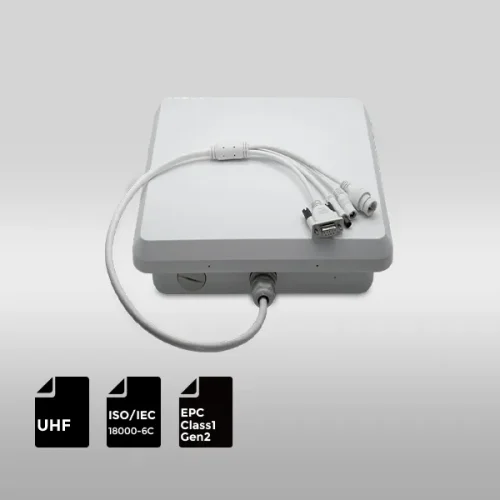
Integrated UHF RFID Reader
The integrated UHF RFID reader is a single-channel fixed UHF RFID reader, which is equipped with an integrated high-performance antenna based on the self-developed module based on the Impinj® E710 chip. It supports multiple communication interfaces such as RS-232, RJ45, GPIO, etc., enabling it to be widely used in multiple scenarios such as warehousing, file management, book management, banking, and production line management.