


RFID technology has become deeply integrated into our daily lives, from access control cards to contactless payment systems. While it significantly enhances convenience and operational efficiency, growing concerns over RFID card security have emerged alongside its widespread adoption. Issues such as unauthorized scanning and card cloning continue to surface, raising public awareness and concern. This article will provide a clear explanation of how RFID technology works and explore practical strategies to effectively prevent these security risks.
1. How RFID Cards Work
Before exploring how to enhance RFID security, it is essential to first understand how RFID cards work. Most access control RFID systems rely on wireless communication between a card and a reader. When a card is presented, the reader captures its identifier (UID) and verifies it against a backend database.

There are two primary types of cards:
- Basic UID-based cards – Transmit a static identifier without strong authentication.
- Encrypted secure cards – Use cryptographic authentication and mutual verification.
Legacy cards often transmit information without encryption, which directly impacts RFID card security. Modern secure chips such as advanced HF solutions implement encrypted communication and challenge-response authentication to significantly enhance the security.
2. Common RFID Card Security Risks
The following are several common RFID security risks.

2.1 Unauthorized Scanning (Eavesdropping)
Eavesdropping, also known as data interception, involves passively capturing the wireless communication between an RFID card and a reader. While the cardholder might be unaware, an attacker with appropriate equipment can intercept the data transmitted during a legitimate transaction. If this data includes sensitive information, such as personal identifiers or access credentials, it can be exposed and potentially misused.
2.2 Card Cloning
Card cloning is one of the most serious threats to RFID card security. Attackers use portable devices to read the card’s transmitted data and write it onto a blank card. The vulnerability of unencrypted cards to this type of attack is a major concern for RFID card security.
2.3 Replay Attacks
Replay attacks are based on eavesdropping. In this type of attack, someone secretly records the communication between an RFID card and a reader during a normal, legitimate transaction. Instead of trying to break or decode the information, the attacker simply plays back the recorded data later to trick the system into thinking it is the real card. This kind of attack works especially well in systems that use the same verification process every time, without changing or updating the authentication details.
3. Effective Methods to Prevent RFID Card Cloning
To counter the growing threats to RFID systems, a multi-layered approach to RFID card security is essential. Implementing advanced technologies and protocols can significantly mitigate the risks of cloning and unauthorized access.

3.1 Upgrade to Encrypted RFID Cards
The most fundamental step in enhancing RFID security is to move away from vulnerable, unencrypted cards. Modern encrypted RFID cards, such as those utilizing MIFARE DESFire chip, which provide:
- AES encryption
- Mutual authentication
- Session-based keys
- Anti-rollback protection
This prevents unauthorized readers from interacting with the card and unauthorized cards from gaining access to the system. The use of strong, open-standard encryption makes it incredibly difficult for attackers to clone these cards or intercept their data.
3.2 Implement Dynamic Authentication
Dynamic authentication mechanisms are vital in preventing replay attacks. Instead of relying on static identifiers or predictable sequences, these methods introduce variability into each authentication session:
- Rolling Codes: In systems employing rolling codes, the authentication value changes with each transaction. Both the card and the reader use a synchronized algorithm to generate the next expected code.
- Challenge-Response Mechanisms: When a card is presented, the reader issues a unique, random challenge. The card must then perform a cryptographic calculation using its secret key and the challenge, and send the correct response back to the reader. Since the challenge is different each time, a replayed response will be invalid. This two-way verification process ensures that only legitimate cards can authenticate successfully.
3.3 Use Multi-Factor Authentication (MFA)
Multi-Factor Authentication (MFA) significantly enhances security by requiring more than one form of verification. Even if an RFID card is cloned, the attacker would still need the second factor to gain access.
Common MFA implementations for RFID systems include:
- Card + PIN code
- Card + biometric verification
- Card + mobile authentication
In environments involving sensitive data or critical infrastructure, MFA has become a standard practice for strengthening RFID card security.
3.4 Using RFID Shielding Products
While upgrading infrastructure is critical, individual users can also strengthen RFID card security through physical protective measures. RFID shielding products such as RFID-blocking wallets and Anti-scan card sleeves are designed to block or attenuate radio frequency signals, preventing unauthorized scanning. These products use metallic layers or conductive materials to disrupt electromagnetic signals, effectively isolating the card when not in use.
Tip: If you prefer not to purchase RFID shielding products, placing aluminum foil on both sides of your RFID card can help reduce signal transmission due to the Faraday shielding effect.
4. Best Practices for Enterprises and Organizations

Beyond technical upgrades, organizations should adopt operational policies to improve RFID card security:
- Conduct periodic penetration testing on access systems
- Audit card inventory and deactivate unused credentials
- Replace legacy low-frequency cards
- Monitor suspicious access patterns
Security is not a one-time upgrade but an ongoing process. Enterprises and organizations have a responsibility to continuously ensure and strengthen RFID card security within their access control systems.
5. Conclusion
As RFID cards become increasingly widespread, security concerns inevitably arise. However, these risks do not need to be a cause for excessive concern. For enterprises, adopting encrypted chips, regularly updating systems, and implementing multi-factor authentication when necessary can significantly reduce the risk of RFID card cloning, thereby effectively safeguarding corporate assets and personnel security.
RFIDCard provides high-quality, secure RFID cards tailored to your business needs. We look forward to becoming your trusted and reliable partner.
Recommended Product

RFID Card CR80 MIFARE® DESFire® EV2 2K

The MIFARE® DESFire® EV2 2K RFID card is a secure, high-capacity contactless smart card ideal for various applications like access control, transportation, and payment systems. It features 2KB of integrated memory, advanced encryption standards for security, and is compatible with existing MIFARE® systems. The EV2 version enhances data protection and transaction speed, making it a reliable and efficient choice for modern RFID solutions.
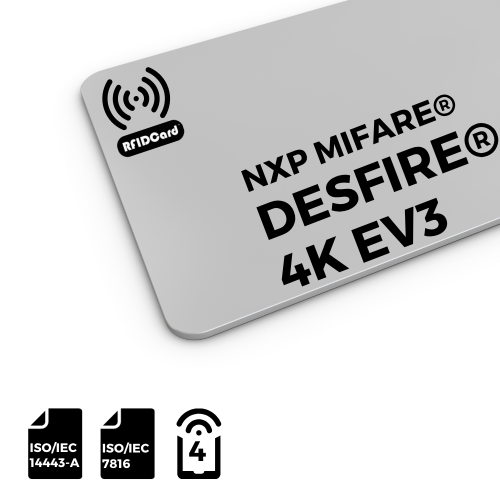
RFID Card NXP MIFARE® DESFire® EV3 4K
Blank or customized printing RFID cards with a choice of dimensions are available. The MIFARE® DESFire® EV3 4K is Common Criteria EAL5+ security certified for smart card IC products. The MIFARE® DESFire® EV3 4K ICs fully comply with NFC Forum Type 4 Tag.



