In today’s dynamic corporate landscape, the employee ID card has evolved from a simple identification tool into a cornerstone of modern workplace security and operational efficiency. Initially serving as a basic credential for visual identification, the traditional employee ID card has undergone a significant transformation, giving way to advanced solutions. Modern RFID employee ID cards are redefining how companies manage access, track attendance, and protect their assets. From global corporations to startups, organizations across industries are adopting RFID-enabled identification systems to strengthen security and streamline operations. But what exactly makes these cards so special? And why are they quickly becoming the new standard for workplace identification and access control?
1. What is an RFID Employee ID Card?

An RFID employee ID card is a contactless smart card embedded with a Radio Frequency Identification (RFID) chip that communicates wirelessly with a reader through radio waves. Unlike traditional magnetic stripe or barcode cards, RFID cards do not require physical contact or line-of-sight scanning. Instead, employees can simply tap or wave their card near a reader to gain access or record attendance—making the process faster, cleaner, and more efficient. RFID systems can be broadly categorized into passive and active types; passive RFID cards, which draw power from the reader’s electromagnetic field, are most commonly used for employee identification due including NFC-enabled ID cards, which are a subset of passive RFID operating at a high frequency and enabling short-range, secure communication with compatible devices.
2. Key Benefits of RFID Employee ID Cards
The advantages of implementing RFID employee ID cards are multifaceted, impacting security, efficiency, convenience, and durability.
2.1 Enhanced Security
RFID cards provide a superior level of security compared to their predecessors. They enable secure access to offices, restricted areas, and sensitive data by employing encryption and unique identifiers that are difficult to counterfeit. The contactless nature of RFID reduces the risk of card cloning through physical access, and advanced systems can incorporate multi-factor authentication, further bolstering security. In the event of a lost or stolen card, RFID systems allow for immediate deactivation, preventing unauthorized access and mitigating potential security breaches.
2.2 Efficiency
Efficiency gains are a significant driver for RFID adoption. Faster entry and exit through access points, automated attendance tracking, and streamlined time management are direct benefits. Employees can simply tap or wave their employee ID card near a reader, eliminating queues and manual logging processes. This automation not only saves time but also minimizes errors and cuts down on administrative tasks.
2.3 Convenience
For employees, the convenience offered by RFID cards is substantial. Contactless usage means less wear and tear on the card and reader, and the ability to integrate with various digital systems makes the employee ID card a versatile tool. Many RFID cards are multifunctional, serving not only as an access credential but also as a payment method for cafeteria services, a library card, consolidating multiple functions into a single, easy-to-carry item.
2.4 Durability
Unlike magnetic or barcode cards, RFID cards are designed to withstand long-term use. They are resistant to scratches, moisture, and dust, making them ideal for both office environments and industrial facilities. Many RFID employee ID cards are built using durable PVC or composite materials, ensuring years of reliable performance. Their passive, contactless design also means minimal maintenance and fewer replacements, saving costs over time.
3. Real-World Applications in the Workplace

The practical applications of RFID employee ID cards extend across various aspects of workplace management, demonstrating their versatility and value.
3.1 Access Control
Perhaps the most common application is access control. RFID cards are used to grant or deny entry to office buildings, laboratories, data centers, and other restricted zones. This granular control ensures that only authorized personnel can access specific areas, which is crucial for maintaining security and compliance, especially in industries with strict regulatory requirements.
3.2 Attendance and Workforce Management
RFID systems automate attendance tracking, providing accurate records of employee presence and working hours. This eliminates the need for manual time sheets or punch clocks, reducing errors and potential for time fraud. The data collected can also be used for workforce management, helping to optimize staffing levels and improve operational planning.
3.3 Integration with Corporate Services
Beyond security and attendance, RFID employee ID cards can be integrated with a wide range of corporate services. This includes cashless payments in cafeterias, access to parking facilities, and even tracking asset usage. Such integrations create a seamless and efficient experience for employees, consolidating multiple functions into a single credential and simplifying daily routines.
4. Key Features to Look for When Choosing RFID Employee ID Cards

When selecting RFID employee ID cards, organizations should consider several key features to ensure they meet their specific needs and security requirements.
4.1 Security Features
Choose cards that support encryption and anti-cloning technology. Modern RFID cards, such as those using MIFARE® DESFire technology, offer advanced cryptographic protection to safeguard against unauthorized duplication. Including photo ID printing and company logos further prevents misuse while reinforcing brand identity.
4.2 Optional Features
Depending on specific organizational needs, optional features can significantly enhance the utility of RFID cards. These might include Near Field Communication (NFC) capabilities for mobile interactions, smart chips for advanced cryptographic functions, or integration with mobile wallet applications for added convenience and flexibility. These features can future-proof the investment and expand the card’s functionality.
5. Conclusion
The transition from traditional employee ID cards to RFID-enabled solutions represents a significant leap forward in workplace technology. These intelligent cards combine security, efficiency, and convenience, enabling organizations to safeguard their facilities while enhancing employee experience. By adopting RFID employee ID cards, companies gain not just a tool for identification but a comprehensive access and management system that integrates seamlessly into modern digital ecosystems. As businesses continue to prioritize data security and operational efficiency, RFID solutions will remain a cornerstone of smart workplace infrastructure.
Recommended Product
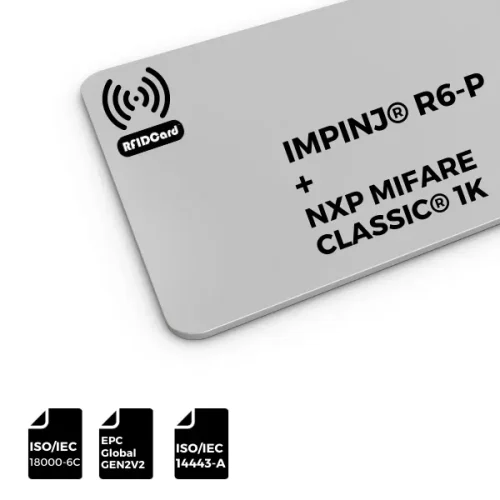
RFID Dual-Band HF+UHF Combo Card NXP MIFARE Classic® EV1 1K (S50) & Impinj® Monza® R6-P

This RFID Dual Frequency Card seamlessly combines the features of both chips, ensuring compatibility across various RFID systems. This hybrid card enhances flexibility and convenience, bridging gaps between different systems. It finds versatile applications in access management, smart city solutions, and event ticketing.