In an increasingly interconnected and health-conscious world, the demand for efficient, secure, and hygienic access solutions has never been higher. This surge has led to the widespread adoption of touchless access control systems, transforming how individuals interact with their physical environments. While various technologies contribute to this paradigm shift, the humble yet sophisticated access control card remains a cornerstone of modern security infrastructure. These cards, often powered by Radio-Frequency Identification (RFID) and Near Field Communication (NFC) technologies, are central to enabling seamless and secure entry without the need for physical contact, marking a significant evolution from traditional methods that relied on keypads, fingerprint scanners, or magnetic stripe cards.
What Are Touchless Access Control Solutions?

Touchless access control refers to systems that allow individuals to gain entry to a secured area without physically touching a reader or input device. This approach has gained considerable traction due to its inherent benefits in terms of hygiene, speed, and operational efficiency. The core technologies underpinning these solutions include RFID, NFC, biometric recognition (such as facial or iris scanning), and mobile credentials. Among these, RFID and NFC technologies are particularly prevalent, especially when integrated with access control card systems. RFID, or Radio-Frequency Identification, utilizes electromagnetic fields to automatically identify and track tags attached to objects. In the context of access control, these tags are embedded within cards or fobs, allowing for communication with a reader from a short distance. NFC, a subset of RFID, enables even shorter-range communication, typically within a few centimeters, facilitating secure data exchange between devices like smartphones and card readers. These technologies allow for rapid authentication, significantly reducing bottlenecks in high-traffic areas and enhancing the overall user experience.
The Role of Access Control Cards in Touchless Systems
Access control cards, particularly those leveraging RFID and NFC, play a pivotal role in touchless security ecosystems. Unlike their predecessors, such as magnetic stripe cards that require swiping, or PIN pads that necessitate physical interaction, RFID access control cards communicate wirelessly with readers. When an RFID card is presented near a compatible reader, the reader emits radio waves that energize the card’s antenna, allowing it to transmit its unique identification data. This data is then verified against a central access control database, and if authorized, access is granted. This contactless interaction offers several distinct advantages:
- Reduced Wear and Tear: Without physical contact, both the cards and the readers experience less mechanical wear, extending their lifespan and reducing maintenance costs.
- Faster Throughput: The speed of contactless authentication allows for quicker entry and exit, improving traffic flow in busy environments.
- Scalability and Integration: Modern access control card systems are highly scalable, capable of managing access for thousands of users across multiple entry points. They can also be seamlessly integrated with other security systems, such as video surveillance and alarm systems, to create a comprehensive security infrastructure.
Various formats of these cards exist, including proximity cards, MIFARE cards, smart cards, and HID-compatible cards, each offering different levels of security and functionality. Proximity cards are generally simpler, offering basic identification, while smart cards often include embedded microchips capable of storing more data and supporting advanced encryption, making them more secure against cloning and unauthorized access.
Advantages of RFID Access Control Cards in a Touchless Setup
The adoption of RFID access control cards in touchless systems brings a multitude of benefits that address contemporary security and operational needs:
- Convenience: Users experience effortless, one-tap access, which is particularly beneficial in environments with high foot traffic or where individuals may have their hands full. The speed and simplicity of use contribute to a positive user experience.
- Flexibility: RFID cards are highly versatile and compatible with a wide range of existing access control readers and systems. This flexibility allows organizations to upgrade their security infrastructure incrementally, often by simply replacing older card types with newer RFID-enabled ones, without a complete overhaul of their hardware.
- Enhanced Security: Modern RFID access control cards incorporate advanced encryption and authentication protocols, making them significantly harder to clone or compromise compared to older technologies. Features like mutual authentication, where both the card and the reader verify each other’s authenticity, add an extra layer of protection against sophisticated attacks. The data stored on these cards can be encrypted, safeguarding sensitive information and preventing unauthorized data extraction.
- Cost-Effectiveness: While the initial investment in a robust RFID system might seem substantial, the long-term cost savings are considerable. The durability of contactless cards, reduced maintenance on readers, and simplified management processes contribute to a lower total cost of ownership. Furthermore, the ease of issuing, revoking, and replacing cards streamlines administrative tasks, saving time and resources.
Industry Applications of Touchless Access Control Cards

The versatility and benefits of touchless access control cards have led to their widespread adoption across diverse industries:
- Corporate Offices: Companies utilize these cards to streamline employee access, manage visitor entry, and secure sensitive areas within their premises. This not only enhances security but also improves operational efficiency by providing detailed audit trails of entry and exit.
- Healthcare Facilities: In hospitals and clinics, hygiene is paramount. Touchless access control cards help prevent the spread of infections by minimizing contact with shared surfaces. They also secure patient records, restrict access to pharmacies and laboratories, and manage staff movement efficiently.
- Hospitality & Hotels: Hotels are increasingly adopting contactless room keys, often in the form of RFID cards or mobile credentials, to offer guests a seamless and modern check-in experience. This enhances convenience and reduces the need for physical key exchanges.
- Education: Universities and schools use these cards as multi-functional student IDs, granting access to dormitories, libraries, laboratories, and even serving as payment methods for campus services. This consolidates multiple functions into a single, convenient card.
- Transportation & Parking: From public transportation systems to private parking garages, touchless access control cards enable quick and efficient entry and exit. Users can simply tap their cards to pass through gates or turnstiles, reducing queues and improving traffic flow.
Conclusion
The evolution of access control has been significantly shaped by the rise of touchless technologies. The access control card remains a critical component in this transformation. Despite the growing adoption of mobile and biometric solutions, RFID and NFC-enabled cards still stand out. They offer a reliable, hygienic, and secure option that adapts well to diverse needs. These smart cards form a strong foundation for modern access control systems, meeting the complex demands of different sectors. At the same time, they ensure seamless and secure entry for users. As technology continues to progress, the role of access control cards will keep evolving. They will integrate with new platforms and deliver greater functionality, further solidifying their place in future security infrastructures.
Recommended Product
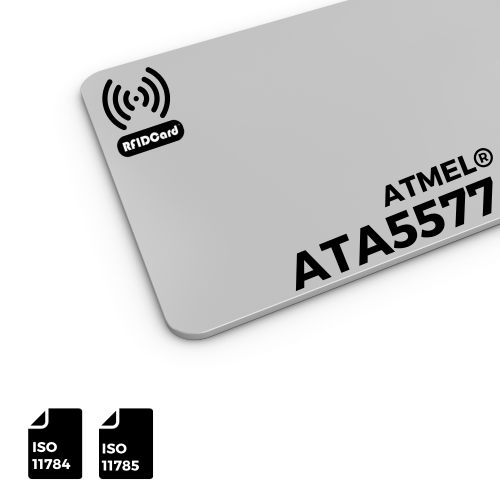
RFID Card Atmel® ATA5577

The ATA5577 RFID cards are made with Photo quality standard PVC sheets in the size of CR80, which are suitable for use with most direct thermal or thermal transfer card printers.. Atmel® ATA5577 is a contactless read/write identification transponder (IDIC®) for applications in the 125kHz frequency band. The total memory on-chip is 363-bit EEPROM (11 blocks with 33 bits each) where 7 × 32 Bits are user memory including 32-bit password memory.