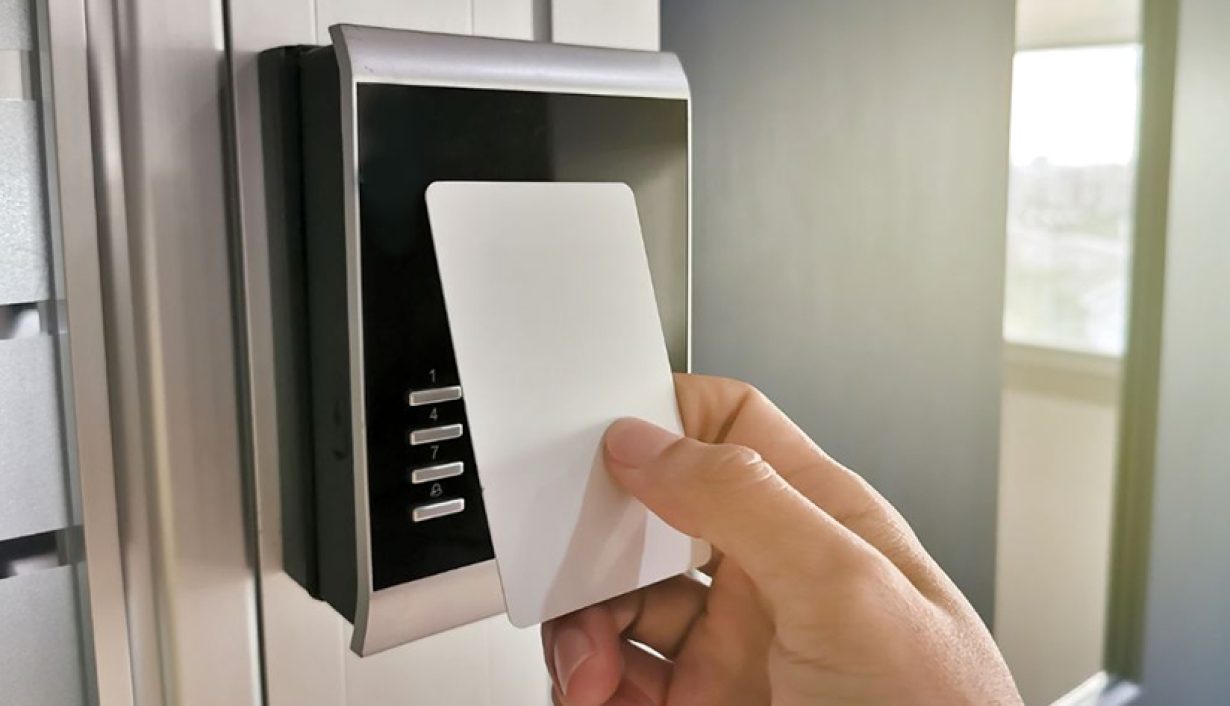

Nowadays, RFID technology is becoming more and more common in our daily lives. Whether it’s access cards, traffic cards, or payment cards, RFID cards are almost everywhere in our daily lives. Although we use RFID cards daily, most of us don’t have an in-depth understanding of how these cards work. This blog will explain in detail the technology behind RFID cards and how they work.
The working principles of RFID technology
RFID is an identification technology that uses radio waves for authentication and data interaction. It is mainly constructed from RFID cards or tags and readers. In this, the RFID card has a microchip and antenna embedded in it. In addition, RFID readers are used to receive and transmit radio signals.
When the RFID reader transmits a radio signal of a specific frequency, the antenna in the RFID tag receives this signal and activates the internal chip. The chip transmits data information to the RFID reader according to preset instructions. In this process, the interaction between the data and information is realized.
What are the types of RFID cards
RFID card types can be categorized based on characteristics such as operating frequency, practical application scenarios and the way power is supplied. Common RFID card types include:
Low frequency RFID card: The operating frequency of this card is usually around 125 kHz and its reading range is usually around a few centimeters. Its main applications are in access control and animal identification.
High frequency RFID card: HF RFID cards operate at a frequency of 13.56 MHz and have a read range of less than one meter. Common applications include public transport cards and access cards.
Ultra-high frequency RFID card: The operating frequency of UHF RFID cards usually stays between 860-960MHz. Its reading range is better than the previous two, the distance can reach several meters or even more than ten meters. This card is widely used in logistics and warehousing industries.
Active RFID card: Firstly, an active RFID card needs to be powered by an inbuilt battery to function. Secondly, it has a long reading distance. However, its production cost is relatively high and its cost-effectiveness is relatively low. Except for some scenarios that require long-distance identification, this kind of card is generally not used.
Passive RFID card: This card does not require an inbuilt battery to power it but is activated for operation by the electromagnetic induction emitted by the reader. It is relatively low cost and has a good lifespan, making it ideal for those looking for value for money.
What is the structure of an RFID card
Although an RFID card may look ordinary, its internal structure contains many key technologies. The following are the main components of an RFID card:
Chip: Chip is the core component of an RFID card, and its function is to store and process data information. Among other things, the chip has a unique identification code and a read-write storage space. This storage space can be used to hold the user’s data information.
Antenna: Another core component in the card is the antenna, which can be used to receive and send radio signals. In addition, the reading performance and range of RFID cards are inextricably linked to the material and design of the antenna.
Substrate: In RFID cards, the substrate is an important material that serves as a support for the chip and antenna. The substrate of the card is usually made of plastic materials such as PVC and PET. For some special usage scenarios, metals or materials may be used to enhance durability.
Capsule layer: In addition to the above parts, RFID cards have a more important part of their packaging layer. The encapsulation layer is used to protect the chip and antenna inside the card from external environmental factors. In addition, it also provides anti-cloning features.
How does the RFID card work
When we use RFID cards, the usual procedure is as follows:
Card induction: When the user brings the RFID card close to the reading range of the reader, the reader emits a radio signal which creates an electromagnetic field.
Electromagnetic induction: The antenna of a passive RFID card receives a radio signal in an electromagnetic field and generates a weak current. This current is what powers the chip and activates its operation.
Data exchange: The chip in the RFID card, when activated, transmits the stored data information back to the reader through the antenna. After receiving the data, the reader will decode the data and perform the corresponding operations. For example, to identify the authentication of identity or authorized access.
Feedback response: After the reader has finished reading the data, it usually gives feedback to the RFID card holder or the system. This feedback can take the form of a green light coming on or a door lock opening, etc., thus making the whole operation a success.
Conclusion
The technology behind RFID cards is more than simple radio wave transmission; it represents one of the core technologies for data collection, transmission and processing in an information-based society. Understanding how these technologies work not only helps us to better apply RFID cards but also provides inspiration and direction for possible new application scenarios in the future. In this highly interconnected era, the role of RFID cards will become more and more important.
After reading this blog, if you are interested in RFID card, you can visit our official website (www.rfidcard.com) to browse more information about RFID card. If you want to get solutions for NFC cards, feel free to contact our sales experts, who will provide you with the suitable solutions and the professional purchase suggestions according to your needs.

RFID Card NXP MIFARE® DESFire® EV3 8K

The NXP MIFARE® DESFire® EV3 8K RFID Card is designed for secure, contactless applications such as access control, public transport, and payment systems. It offers 8KB of storage, advanced AES encryption, and enhanced security features like mutual authentication. Compliant with ISO/IEC 14443 A, this card ensures compatibility with global contactless infrastructure, making it suitable for a variety of secure and efficient applications.