


As electric vehicle adoption accelerates across the United States and Europe, EV charging infrastructure is expanding at an unprecedented pace. Public charging networks, workplace chargers, fleet depots, and residential complexes all require reliable, scalable, and user-friendly access control solutions. In this context, RFID ev charge systems have become a foundational element of modern EV charging operations. While mobile apps and QR codes often receive attention as “digital-first” solutions, RFID cards continue to play a critical role in ensuring consistent access, security, and operational efficiency. Far from being outdated, RFID remains one of the most dependable technologies for EV charging authentication today.
1. How RFID EV Charge Works in Charging Networks
To understand why RFID cards remain indispensable, it is important to first understand how RFID ev charge systems function within a typical charging network.

In an RFID-based EV charging scenario, each user is issued an RFID card encoded with a unique identifier. When the driver taps the card on a charging station’s RFID reader, the charger reads the card’s data and sends an authentication request to the backend management system. The system verifies whether the card is authorized and, if approved, allows the charging session to begin.
Most modern EV chargers support RFID authentication as part of their standard design and are compatible with Open Charge Point Protocol (OCPP)-based backends. This ensures that RFID cards can be easily integrated into existing charging management platforms without complex customization. Whether deployed in public networks, private fleets, or workplace charging environments, RFID offers a standardized and widely accepted access method.
2. Reliability: RFID EV Charge Works When Apps Fail
One of the strongest advantages of RFID ev charge systems is their reliability. Mobile apps depend heavily on smartphones, operating system compatibility, and stable internet connectivity. In real-world charging environments—such as underground parking garages, remote highway rest stops, or industrial sites—network connectivity is often inconsistent.
RFID cards, by contrast, are designed for fast, local authentication. Even in scenarios where chargers temporarily lose backend connectivity, many systems allow for offline authorization based on locally stored card data. This ensures uninterrupted access and minimizes downtime for EV drivers.
For charging operators, this reliability translates directly into improved customer satisfaction and fewer support calls. For drivers, it means they don’t need to troubleshoot app issues while trying to charge their vehicles. RFID’s ability to function under less-than-ideal conditions is a key reason it remains a trusted solution.
3. User Convenience and Speed at Scale
Speed and simplicity are critical in EV charging, especially at busy locations with high user turnover. With RFID ev charge, drivers can initiate a charging session with a single tap—no app login, no scanning codes, and no navigating complex interfaces.

For first-time EV owners or non-tech-savvy users, the simplicity of the card is a major barrier-remover. They do not need to download, register, or learn a new application, which can be a significant source of anxiety for those new to the EV ecosystem. The card provides a familiar, credit-card-like transaction experience that is universally understood.
| Feature | RFID Card Access | Mobile App Access |
| Authentication Speed | Instantaneous tap-and-go | 30-60 seconds (app launch, login, scan) |
| Network Dependency | Low | High |
| Hardware Dependency | Card only | Smartphone, OS, app software |
| User Learning Curve | Very low (familiar card transaction) | Moderate (new app interface) |
| Feature Set | Access and basic billing | Monitoring, reservations, remote control |
4. RFID EV Charge for Fleet and Commercial Use
Fleet operators represent one of the fastest-growing segments in the EV market, and RFID ev charge systems are especially well-suited to fleet environments.
In a fleet context, RFID cards can be issued on a driver-specific or vehicle-specific basis. This allows the fleet manager to precisely track energy consumption down to the individual driver or vehicle level, regardless of where the charging took place (e.g., at a company depot, a public station, or even an employee’s home charger integrated into the network). This level of detail is crucial for simplified cost allocation, enabling businesses to accurately bill departments, track vehicle efficiency, and manage tax reporting for energy usage. While mobile apps can also track usage, the physical card provides a more robust and less error-prone method of ensuring the correct vehicle or driver is authenticated at the point of charge.
The reduced administrative overhead is a significant financial benefit. Managing a fleet of hundreds of drivers and vehicles through individual app accounts, password resets, and device compatibility issues is a major logistical burden. By contrast, RFID cards reduce administrative complexity by centralizing control within the backend system. Lost or stolen cards can be deactivated instantly, and new cards can be issued with minimal effort. This level of control is essential for organizations managing dozens or hundreds of EVs.
5. Cost Efficiency and Long-Term ROI
From a cost perspective, RFID ev charge systems offer excellent long-term value. RFID cards are inexpensive to produce, especially when ordered in volume, and have a long service life. Unlike mobile apps, which require ongoing development, updates, and user support, RFID cards involve minimal maintenance.

Furthermore, the long service life and durability of RFID cards contribute to their excellent ROI. A well-made card can last for years, enduring various weather conditions and physical handling. This durability ensures a stable, long-term access method for the user base. For expanding EV charging networks, the scalability of the RFID system is unmatched. Adding a new user simply involves issuing a new, low-cost card and registering its UID in the backend system. This ease of scaling, combined with the low unit cost and minimal maintenance, makes RFID a financially prudent choice for operators looking to build a sustainable and profitable charging business. The initial investment in the reader hardware is quickly amortized by the reliability and reduced support costs over the lifetime of the charging station.
6. RFID and Mobile Apps: Complementary, Not Competitive
A common misconception is that RFID cards and mobile apps compete with each other. In reality, the most successful EV charging networks treat them as complementary solutions.
RFID cards serve as the baseline access method. They guarantee a charge session can be initiated quickly and reliably, especially in challenging environments or when the user’s digital tools fail. This reliability is the foundation of a positive user experience. The card ensures that the primary function—getting power to the vehicle—is never compromised by digital complexity.
Mobile applications, on the other hand, are essential for providing added features and enhanced user control. These features include:
- Remote Monitoring: Allowing the user to track the charging status, energy consumed, and estimated time of completion from a distance.
- Billing and Payment Management: Providing detailed transaction history, managing payment methods, and accessing invoices.
- Reservations: Enabling users to book a specific charging spot in advance, reducing wait times.
By offering both options, charging operators can accommodate a wider range of user preferences and usage scenarios. RFID serves as the baseline access method, ensuring reliability, while apps enhance the overall user experience.
7. Conclusion
Despite rapid advancements in digital platforms, RFID cards continue to be a cornerstone of EV charging infrastructure. Their reliability, simplicity, security, and cost efficiency make RFID ev charge solutions indispensable for public, commercial, and fleet charging deployments. As charging networks scale and diversify, operators need access control technologies that work consistently across environments and user types. RFID delivers exactly that—proven performance in real-world conditions, backed by global standards and widespread compatibility. Looking to deploy or upgrade an RFID ev charge solution? Request a quote today and discover how our high-quality RFID cards can support your EV charging network with reliability and scalability.
Recommended Product
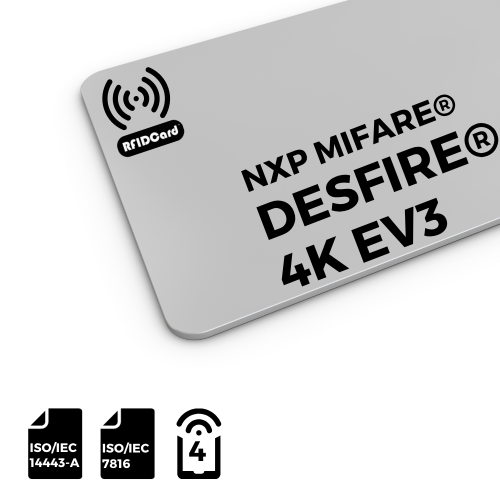
RFID Card NXP MIFARE® DESFire® EV3 4K

Blank or customized printing RFID cards with a choice of dimensions are available. The MIFARE® DESFire® EV3 4K is Common Criteria EAL5+ security certified for smart card IC products. The MIFARE® DESFire® EV3 4K ICs fully comply with NFC Forum Type 4 Tag.



