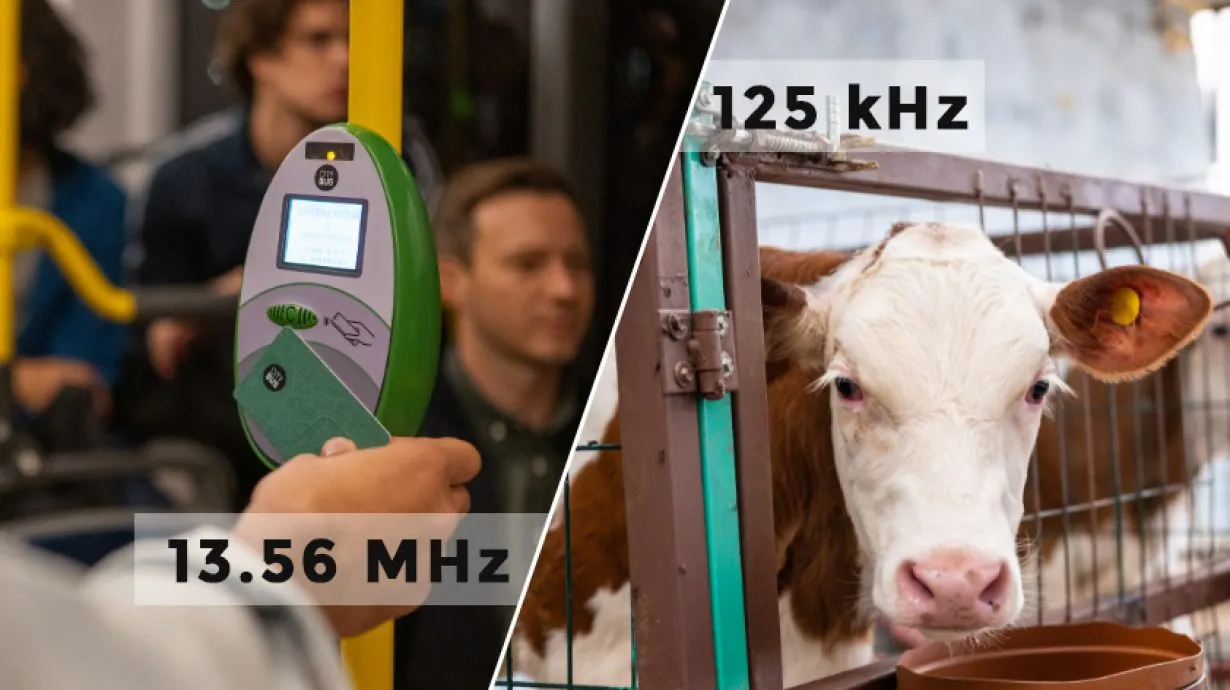

13.56 MHz and 125kHz RFID tags are the most common types on the market. Although they are both widely used in fields such as identity recognition and item tracking, there are significant differences between the two in terms of technical principles, application scenarios, and performance.
Features of 13.56 MHz RFID tags
13.56 MHz RFID tags are high-frequency (HF) tags with an operating frequency of 13.56 MHz. Its working principle is based on electromagnetic induction, and data is transmitted through the induction coil between the tag and the reader. The frequency of 13.56 MHz has the characteristics of strong penetration and high anti-interference ability, and is suitable for use in more complex environments.
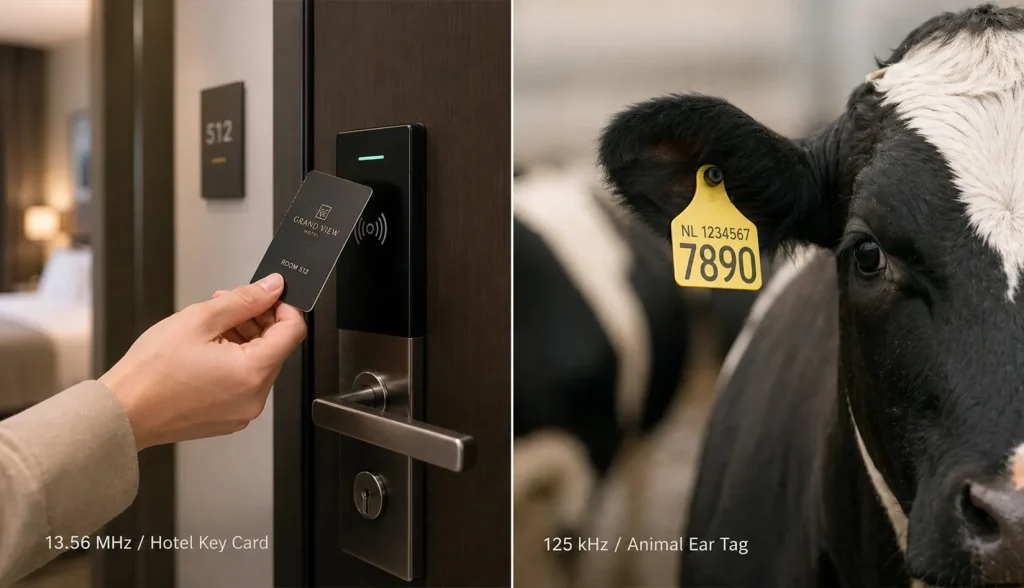
Since the reading distance of 13.56 MHz RFID tags is usually within 1 meter, it is often used in application scenarios that require close distance and high security. For example, access control systems, bus cards, library management, etc. In addition, this tag also supports a high data transmission rate and can read and write data quickly, which is particularly good in applications that require frequent data exchange.

Features of 125kHz RFID tags
125kHz RFID tags are low-frequency (LF) tags with an operating frequency of 125kHz. This tag also transmits data through electromagnetic induction, but due to its low frequency, the transmission distance is usually shorter, usually a few centimeters.
125kHz RFID tags have stronger penetration capabilities, especially in complex media environments such as metal and liquid. This makes it widely used in animal identification, factory automation control, car anti-theft systems and other fields. In addition, 125kHz tags have a lower cost, which makes it the first choice for some projects with limited budgets.
Main differences between 13.56 MHz and 125kHz RFID tags
Operating frequency and transmission distance
13.56 MHz RFID tags have a higher operating frequency and a transmission distance of usually less than 1 meter, while 125kHz RFID tags have a lower operating frequency and a shorter transmission distance. Different transmission distances make them suitable for different application scenarios.
Data transmission rate
13.56 MHz RFID tags have a higher data transmission rate and are suitable for situations that require fast data exchange; while 125kHz RFID tags have a relatively slow data transmission rate and are more suitable for applications that do not require high transmission rates.
Anti-interference ability and adaptability to the environment
13.56 MHz RFID tags have strong anti-interference ability in complex environments, while 125kHz RFID tags perform better in metal and liquid environments.
Cost
125kHz RFID tags are generally less expensive than 13.56 MHz RFID tags, which makes them more attractive in some budget-limited applications.
Application scenario comparison of 13.56 MHz and 125kHz RFID tags
HF and LF RFID technologies are both used across applications such as access control, libraries, transport, animal identification, and industrial identification. However, the suitable choice depends on the specific tag, chip features, reader system, and application requirements. HF systems may support higher data rates and advanced security features when using compatible chips, while LF systems are often selected for simple identification applications and environments where LF technology is preferred.
For example, 125 kHz RFID tags are commonly used for animal identification applications because LF technology has been widely adopted for reliable identification in this field. In transport ticketing systems, 13.56 MHz RFID tags are often selected because HF technology supports higher data rates and can work with contactless smart card standards and security features. The actual choice depends on the tag type, reader system, protocol, and application requirements.
FAQs
Why are the reading distances of 13.56 MHz and 125 kHz RFID tags different?
Read range is not determined by frequency alone. The chip and protocol, reader power, antenna design, tag size, orientation, and operating environment all affect RFID performance. In general, LF and HF RFID systems have different typical operating ranges, but the actual distance should be evaluated based on the specific tag and reader combination.
Which RFID tag is more suitable for use in metal or liquid environments?
The suitable RFID tag depends on the application environment and tag design. LF RFID tags can perform well in some challenging environments, while specialized RFID tags designed for metal or liquid applications may provide better performance. Always select a tag based on the material, installation location, and required read performance.
Does the cost of RFID tags affect the choice?
Yes. Cost can influence RFID tag selection, but it should be evaluated together with performance requirements. Factors such as chip type, memory capacity, antenna design, customization, and order volume can all affect the final price. The lowest-cost option may not always provide the required read performance or durability.
Recommended Products

RFID Card Low Frequency 125 kHz IC EM4200

The EM4200 RFID cards are made with High-quality PVC sheets in the size of CR80. EM4200 is designed to replace EM4100/4102 and EM4005/4105, which the chip provides higher reading range performances Compared to EM4100/4102 and EM4005/4105. EM4200 is a CMOS integrated circuit intended for use in electronic Read Only RF transponders.

NXP MIFARE Classic® EV1 1K (S50) RFID Card ISO14443-A CR80
The NXP MIFARE Classic® EV1 1K (MIFARE® S50) blank RFID Cards are fully comply with ISO/IEC 14443-A. The RFID cards are made with Photo-quality standard PVC/PET in the size of CR80, which are suitable for use with most thermal transfer card printers.