


RFID systems are typically divided into three frequency ranges: Low Frequency (LF), High Frequency (HF), and Ultra-High Frequency (UHF), each serving different identification and communication needs across industries such as access control, smart cards, and logistics.
This guide focuses on Low Frequency RFID (LF), particularly 125 kHz RFID systems. It explains what LF RFID is, how 125 kHz technology works, and why it remains widely used in access control, identity systems, and legacy infrastructures.
1. What is Low Frequency RFID (LF RFID)?
Low Frequency RFID refers to RFID systems operating in the range of 30 kHz to 300 kHz, with 125 kHz being the most commonly used frequency in commercial applications.
Key characteristics:
- Very short read range (typically 2–10 cm)
- Strong performance near water, human body, and non-metal materials
- Low data transmission speed
- Simple chip structure and low cost
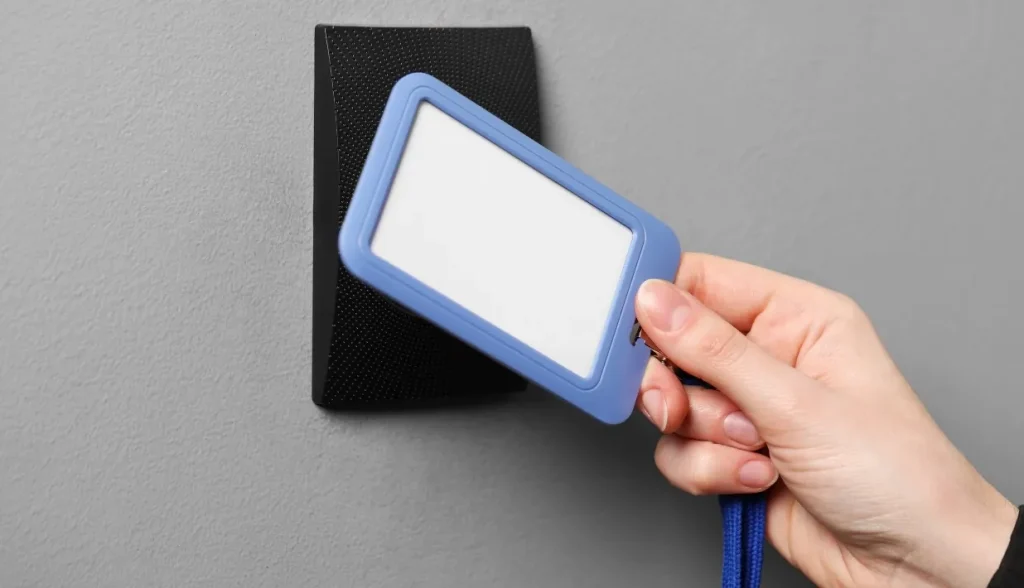
2. What is 125 kHz RFID?
125 kHz RFID is a specific implementation within the low-frequency RFID (LF RFID) category, widely used for access control and identity authentication.
It operates at a fixed frequency of 125 kHz, which allows RFID readers to generate a magnetic field that activates nearby passive tags without requiring a built-in power source.
This technology is primarily designed for short-range identification tasks, where speed and large data capacity are not required, but reliability and consistency are critical.
Typical use environments include:
- Access control systems (doors, gates, secure buildings)
- Identity verification cards (employee badges, membership cards)
- Animal microchip identification systems
- Industrial asset tagging in controlled environments
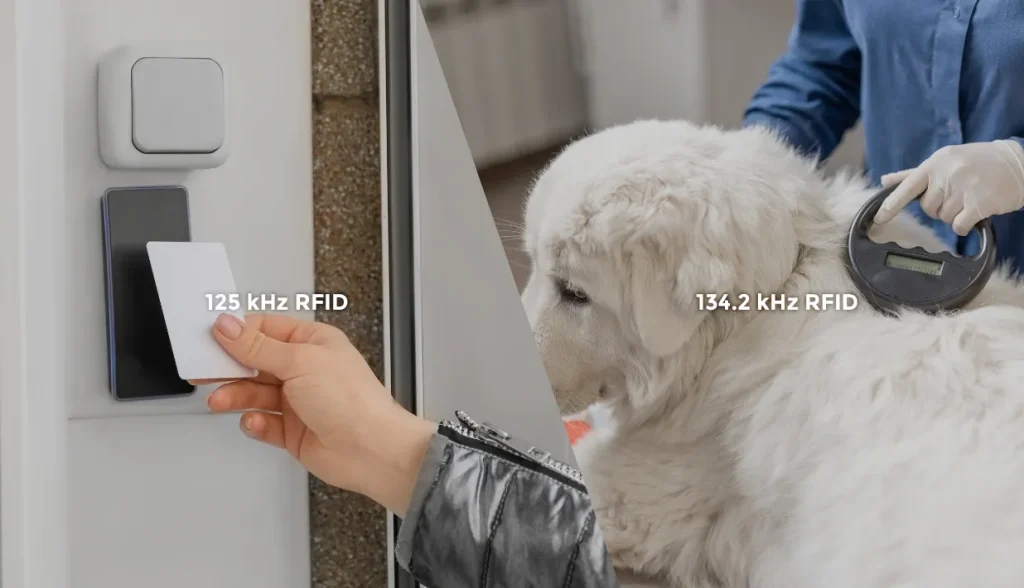
125 kHz vs 134.2 kHz: What is the Difference?
Although both operate in the low-frequency range, they belong to different RFID ecosystems:
- 125 kHz RFID
- Mainly used in access control and ID systems
- Based on proprietary or semi-standard protocols
- Common chips: EM4200, TK4100, T5577, HID Prox
- 134.2 kHz RFID
- Standardized under ISO 11784 / ISO 11785Used for animal identification (pets and livestock)
- Uses FDX-B and HDX communication formats
3. How 125 kHz RFID Works
125 kHz RFID systems operate using inductive coupling, a method where energy is transferred from the reader to the tag through a magnetic field rather than direct electrical contact or long-range radio transmission.
The process is simple but highly effective for short-range identification.
H3: Step 1 – Tag Activation
When a 125 kHz RFID tag enters the electromagnetic field generated by a reader, it does not rely on a battery.
Instead, the tag is passively powered by the magnetic field through inductive coupling.
Once energized, the chip inside the tag becomes active and ready to transmit its stored identification data.
Step 2 – Reader Emits Magnetic Field
The RFID reader continuously emits a low-frequency electromagnetic field at 125 kHz.
This field:
- Creates a localized energy zone
- Activates nearby passive tags
- Defines the maximum reading distance (usually a few centimeters)
Because of the low frequency, this field is highly stable and less affected by environmental interference such as water or human tissue.
Step 3 – Data Transmission via Induction
Once powered, the tag responds by modulating the magnetic field generated by the reader.
This process is known as load modulation via inductive coupling.
Key characteristics:
- Data is transmitted over very short distances (typically 2–10 cm)
- Communication is one-way or simple two-way depending on chip type
- Only one tag is usually read at a time (no strong anti-collision capability)
This is why 125 kHz RFID is ideal for single-user authentication scenarios, such as door access systems or ID verification.

Key Technical Highlights of 125 kHz RFID
- Uses inductive coupling (not far-field RF transmission)
- Extremely short read range ensures high security in controlled environments
- Supports stable single-tag identification
- Optimized for low-power, low-complexity applications
4. Main Standards of Low Frequency RFID
Low frequency RFID systems do not rely on a single unified global standard. Instead, they are divided into internationally standardized systems (mainly for animal identification) and proprietary or manufacturer-specific protocols (mainly for access control and ID cards).
This dual structure is one of the key reasons why 125 kHz RFID remains widely used but highly fragmented across different industries.
ISO 11784 & ISO 11785 (Animal Identification)
The most important international standards in the low-frequency RFID ecosystem are ISO 11784 and ISO 11785, which define how animal identification systems operate at 134.2 kHz.
These standards are primarily used for pet microchipping and livestock tracking, ensuring global compatibility across veterinary and agricultural systems.
Key characteristics of ISO 11784/11785:
- Operates at 134.2 kHz frequency
- Defines animal identification data structure and encoding format
- Ensures global interoperability of pet and livestock microchips
- Works with implantable RFID transponders (microchips)
Communication protocols:
- FDX-B (Full Duplex)
- Most widely used format for pets
- Continuous data transmission while powered by reader field
- HDX (Half Duplex)
- Alternates between energy charging and data transmission
- Often used in livestock management systems
ISO 11784/11785 defines global standards for animal RFID identification systems.
This makes it the only truly global standardized framework within the low-frequency RFID category, ensuring that animal microchips can be read across different countries and veterinary systems.

Proprietary Protocols at 125 kHz
Unlike the standardized 134.2 kHz animal identification systems, most 125 kHz RFID systems are based on proprietary or manufacturer-specific protocols, meaning they are not governed by a single global standard.
These systems are widely used in access control, employee ID cards, hotel key cards, and legacy security infrastructures.
HID Prox (HID Global)
HID Prox is one of the most widely deployed proprietary 125 kHz access control systems.
- Operates at 125 kHz
- Closed proprietary encoding format
- Common in enterprise security systems
- High compatibility with legacy door access infrastructure
EM Microelectronics (EM4200 / EM4100)
EM Microelectronics developed some of the most common low-frequency RFID chips used globally.
- EM4100: early-generation read-only chip
- EM4200: improved version with better performance and lower power consumption
- Widely used in ID cards and access badges
These chips are popular due to their simplicity and low cost, making them a standard choice for mass deployment systems.
TK4100 Clones
TK4100 is a low-cost clone-compatible chip designed to be compatible with EM4100-based systems.
- 125 kHz read-only chip
- Widely used in low-cost access cards
- High compatibility with EM4100 readers
- Common in commercial ID card production
Important note: TK4100 is widely used but not a standardized chip, making it part of the non-standard ecosystem
T5577 / ATA5577 Writable Cards
T5577 (and its upgraded version ATA5577) represents a more flexible category of 125 kHz RFID chips.
- Writable and reprogrammable
- Can emulate multiple low-frequency protocols
- Often used for testing, cloning, or multi-system compatibility
- Supports multiple data formats within one chip
These chips are widely used in scenarios requiring flexibility rather than security, such as system testing or legacy card replacement.
Key Insight: Fragmented but Widely Adopted Ecosystem
Unlike ISO-standardized systems, the 125 kHz RFID ecosystem is largely:
- Non-standardized
- Manufacturer-driven
- Highly fragmented across vendors and use cases
Most 125 kHz RFID systems are based on proprietary protocols rather than global standards, which makes them highly flexible but less interoperable compared to ISO-based systems.
Low Frequency RFID Standards & Protocol Overview
| Category | Protocol / Standard | Frequency | Type | Typical Applications |
| International Standard | ISO 11784 / ISO 11785 | 134.2 kHz | Global standard | Animal identification (pets, livestock) |
| Animal Communication Protocols | FDX-B / HDX | 134.2 kHz | ISO-defined protocols | Pet microchips, livestock tracking |
| Access Control (Proprietary) | HID Prox | 125 kHz | Closed system | High-security door access systems |
| RFID Chip Protocols | EM4200 / EM4100 | 125 kHz | Manufacturer-specific | ID cards, access cards |
| Clonable ID Cards | TK4100 | 125 kHz | EM4100-compatible clone | Low-cost access control cards |
| Writable / Multi-protocol Chips | T5577 / ATA5577 | 125 kHz | Configurable chip | Rewritable RFID cards, system testing |
5. Types of 125 kHz RFID Chips
125 kHz RFID chips are not a single unified technology. Instead, they are divided into several categories based on their functionality, security level, and use cases.
In most real-world applications, chip selection is directly related to whether the system requires read-only identification, reprogrammable functionality, or standardized animal tracking compliance.
Read-only chips
Read-only 125 kHz RFID chips are the most widely used type in access control and identity card systems. Once programmed during manufacturing, their data cannot be modified.
These chips are valued for their simplicity, low cost, and stable performance in large-scale deployment environments such as office buildings, hotels, and employee access systems.
Common read-only chips include:
- EM4200
- One of the most widely used low-frequency RFID chips
- Improved version of EM4100
- Stable performance and low power consumption
- TK4100
- EM4100-compatible clone chip
- Very low cost, widely used in mass-produced ID cards
- Common in commercial access card systems
- HID Prox
- Proprietary chip system developed by HID Global
- Used in high-security enterprise access control systems
- Strong ecosystem compatibility in legacy infrastructure
Read-only chips dominate legacy access control systems because they provide stable identification without configuration complexity.
Writable / programmable chips
Writable 125 kHz RFID chips allow data to be rewritten multiple times, making them more flexible than read-only chips. These chips are often used in system testing, multi-format compatibility, or scenarios requiring reconfiguration.
However, because of their flexibility, they are generally considered less secure than fixed-ID chips.
Common writable chips include:
- T5577
- One of the most popular rewritable 125 kHz RFID chips
- Supports multiple protocol emulation
- Can simulate different RFID formats (including EM4100-compatible systems)
- ATA5577C
- Enhanced version of T5577
- Improved stability and configuration flexibility
- Common in advanced programmable RFID card applications
Writable chips are widely used where flexibility and multi-system compatibility are more important than strict security.
Animal identification chips
Animal identification chips operate under the 134.2 kHz ISO standardized ecosystem, making them fundamentally different from access control chips used at 125 kHz.
These chips are designed for biological implantation and long-term tracking of animals, such as pets and livestock.
Common animal identification chips include:
- EM4305
- Widely used implantable RFID chip
- Supports ISO-compliant animal identification protocols
- Designed for veterinary and livestock tracking applications
- ISO 11784 compliant chips
- Fully compliant with ISO 11784 / ISO 11785 standards
- Operates at 134.2 kHz frequency
- Ensures global interoperability in animal tracking systems
Animal identification chips are based on ISO 11784/11785 standards and operate at 134.2 kHz to ensure global compatibility in pet and livestock tracking systems.
Main Chips Comparison Table
| Chip Type | Chip Model | Frequency | Function | Key Use Case |
| Read-only | EM4200 | 125 kHz | Fixed ID | Access control systems |
| Read-only | TK4100 | 125 kHz | Cloned ID | Low-cost ID cards |
| Proprietary | HID Prox | 125 kHz | Secure ID | Enterprise security |
| Writable | T5577 | 125 kHz | Reprogrammable | Multi-system cards |
| Writable | ATA5577C | 125 kHz | Advanced writable | Configurable applications |
| Animal ID | EM4305 | 134.2 kHz | ISO compliant | Pet microchips |
6. Advantages of 125 kHz RFID
Although newer RFID technologies offer higher data capacity and longer read ranges, 125 kHz RFID continues to be favored in environments where reliability and simplicity are more important than speed or data complexity.
Strong penetration (water / human body / non-metal materials)
One of the key advantages of 125 kHz RFID is its ability to maintain stable performance in environments where higher frequency systems may struggle.
Because it operates using low-frequency magnetic induction, the signal can effectively penetrate:
- Water and moisture-rich environments
- Human body interference
- Non-metallic materials such as plastic, wood, and paper
This makes it particularly suitable for access control cards, animal identification, and industrial environments with variable conditions.
Stable performance in harsh environments
125 kHz RFID systems are highly resistant to environmental interference.
Unlike higher-frequency systems that rely on more sensitive radio wave propagation, 125 kHz systems use a simple and robust inductive coupling mechanism, which reduces signal instability.
As a result, they perform consistently in:
- Industrial facilities
- Outdoor environments
- High-humidity or dusty conditions
- Metal-adjacent but non-metal tagging scenarios
Low cost and easy deployment
Another major advantage is the low production and implementation cost of both chips and readers.
125 kHz RFID systems:
- Require minimal hardware complexity
- Use inexpensive read-only or basic programmable chips
- Do not require complex network infrastructure
This makes them ideal for large-scale deployment scenarios, such as employee access cards or membership systems.
Mature and widely adopted technology
125 kHz RFID is one of the earliest commercial RFID technologies and has been in use for decades.
Its maturity provides:
- Stable supply chain of chips and readers
- Wide system compatibility (especially legacy systems)
- Proven reliability in long-term deployments
125 kHz RFID performs reliably in environments where higher frequency systems may experience interference.
7. Limitations of 125 kHz RFID
Despite its stability and cost advantages, 125 kHz RFID also has several inherent limitations due to its low-frequency design and simplified communication structure.
These limitations make it less suitable for modern applications requiring high-speed data exchange or advanced security features.
Very short reading distance (2–10 cm)
One of the most significant limitations is the extremely short reading range.
Most 125 kHz RFID systems operate within a range of:
- Approximately 2 to 10 centimeters
This short range is intentional, as it improves control and security in access systems, but it limits use in logistics, tracking, or automation scenarios where longer range is required.
Low data transfer speed
125 kHz RFID systems transmit data at a relatively low speed compared to HF and UHF systems.
This results in:
- Slower identification processes
- Limited data capacity per tag
- Unsuitability for complex data applications
As a result, it is mainly used for simple ID verification rather than data-rich applications.
No multi-tag reading capability
Another key limitation is the lack of strong anti-collision or multi-tag reading support.
In most cases:
- Only one tag can be read at a time
- Simultaneous scanning of multiple tags is not efficient
- Performance drops in dense tag environments
This makes it unsuitable for inventory management or bulk scanning scenarios.
Weak encryption and security risks
Security is another major concern for 125 kHz RFID systems.
Many commonly used chips (such as TK4100 or EM4200-compatible systems):
- Do not support advanced encryption
- Can be cloned or duplicated in certain configurations
- Rely on static identifiers rather than dynamic authentication
This is why 125 kHz RFID is generally not recommended for high-security or payment-related applications.
8. Applications of 125 kHz RFID
125 kHz RFID is widely used in short-range identification and access control systems, especially in environments requiring stable and low-cost authentication.
Access Control Systems
- Office building access cards
- Hotel room key cards
- Residential and apartment entry systems
- Employee ID badges (EM4200 / TK4100 / HID Prox systems)
Animal Identification
- Pet microchip identification (dogs, cats)
- Livestock tracking (cattle, sheep, pigs)
- Veterinary identification and vaccination records
- ISO 11784 / 11785-based animal systems (134.2 kHz ecosystem)
Industrial ID Systems
- Worker attendance and identification
- Tool and equipment tracking
- Restricted area access control
- Factory floor identification systems
Legacy Systems
- Existing HID Prox access control infrastructure
- Older enterprise security systems
- Installed building access networks
- Long-life deployed RFID card systems
9. 125 kHz RFID vs 13.56 MHz RFID
This comparison is one of the most searched topics in the RFID industry, especially for users evaluating access control, NFC compatibility, and system upgrades.
The key difference between these two technologies lies in their frequency range, communication capability, and application focus.
| Feature | 125 kHz RFID | 13.56 MHz RFID |
| Frequency | Low frequency | High frequency |
| Reading Range | Very short (2–10 cm) | Medium (up to ~10 cm or more depending on system) |
| Data Capacity | Low | Higher |
| Security Level | Basic / low encryption | Higher security options available |
| Multi-tag Reading | Limited / weak | Supported in many systems |
| Typical Use Cases | Access control, ID cards, legacy systems | NFC payments, smart cards, mobile interactions |
125 kHz RFID is widely used for access control and identification systems, while 13.56 MHz RFID is more suitable for NFC-enabled applications and higher-security environments.
10. Security Risks of 125 kHz RFID
Although 125 kHz RFID is widely used in access control and identification systems due to its stability and low cost, it also presents several inherent security limitations, especially when deployed in environments that require strong authentication protection.
These risks are primarily associated with the simplicity of low-frequency chip architecture and the lack of advanced encryption mechanisms in many legacy systems.
Card cloning risk (T5577 / TK4100)
One of the most well-known security issues in 125 kHz RFID systems is the risk of card duplication or cloning.
Certain chip types, especially:
- T5577
- TK4100
are widely recognized for their ability to be replicated or emulated under specific conditions.
This is because these chips often rely on static identifiers rather than dynamic encryption, making them vulnerable in low-security environments.
In practical terms, this means that access credentials based solely on these chips may be duplicated if proper system-level protections are not implemented.
Lack of encryption in low-end chips
Many low-cost 125 kHz RFID chips do not support advanced cryptographic authentication.
Key limitations include:
- No dynamic encryption or rolling codes
- Fixed UID (unique identifier) structure
- Limited authentication mechanisms
As a result, these systems are generally suitable for low to medium security applications, but not recommended for high-security environments such as financial systems or sensitive data access control.
HID Prox vulnerabilities
HID Prox systems, while widely used in enterprise access control, are also based on older 125 kHz technology frameworks.
Although they offer strong ecosystem integration, they inherit the limitations of low-frequency RFID, including:
- Static credential structure
- Limited cryptographic flexibility
- Dependence on legacy system architecture
This makes them more vulnerable compared to modern high-frequency or encrypted smart card systems.
Overall, the security limitations of 125 kHz RFID are not due to poor implementation, but rather the technological design constraints of early-generation RFID systems.
They remain suitable for controlled environments, but require additional security layers in higher-risk applications.
11. Future of Low Frequency RFID
125 kHz RFID will continue to play a stable role in existing access control and identification systems, especially in legacy infrastructures where reliability, cost efficiency, and system compatibility are more important than advanced data capabilities.
While newer RFID technologies such as HF and UHF systems continue expanding into new applications, 125 kHz RFID remains widely used due to its simplicity, long-term deployment stability, and strong compatibility with existing access control ecosystems.
In many real-world deployments, the future of 125 kHz RFID is not replacement, but system coexistence, where LF, HF, and UHF technologies are selected based on security level, infrastructure condition, and cost structure.
System Considerations for Implementation
When selecting a 125 kHz RFID solution, system performance is typically determined by three key factors:
- Compatibility with existing access control infrastructure (HID / EM systems)
- Chip architecture (read-only vs writable vs secure ID formats)
- Security requirements and risk of credential duplication
These factors directly affect system stability, upgrade cost, and long-term maintenance strategy.
Solution Guidance
For system integrators and enterprises managing access control or identification systems, selecting the correct chip type is critical to ensure smooth deployment and long-term compatibility.
We support full-range 125 kHz RFID solutions including:
- Access control cards for legacy HID / EM systems
- Writable and programmable RFID cards for flexible deployment environments
- Industrial-grade ID solutions for controlled environments
- Custom chip configuration for system migration and compatibility matching
Each solution is designed to support different levels of security, system complexity, and infrastructure requirements.
Talk to an RFID Specialist
If you are upgrading an existing access control system or planning a large-scale RFID deployment, selecting the right 125 kHz RFID architecture can significantly reduce integration risk and long-term maintenance costs.
Contact us to discuss your system requirements and receive a tailored RFID solution based on your infrastructure, chip compatibility, and security needs.
FAQs
Q1: What is 125 kHz RFID used for?
125 kHz RFID is mainly used for short-range identification and access control.
Common applications include office access cards, hotel key cards, employee ID systems, and basic identity verification systems.
Q2: Can 125 kHz RFID be cloned?
Yes, some 125 kHz RFID cards can be cloned, especially those using static ID or non-encrypted chip types such as TK4100 or certain T5577 configurations.
This is due to the lack of advanced encryption in basic low-frequency RFID systems.
Q3: What is the difference between 125 kHz and 13.56 MHz RFID?
125 kHz RFID is a low-frequency system designed for simple identification with very short read range.
13.56 MHz RFID supports higher data capacity, better security, and applications such as NFC and smart cards.
Q4: Is 125 kHz RFID secure?
125 kHz RFID is suitable for low to medium security applications, such as access control systems.
However, it has limited encryption capabilities compared to higher-frequency RFID technologies.
Q5: What chips are used in 125 kHz RFID cards?
Common chips include:
- EM4200
- TK4100
- HID Prox
- T5577 / ATA5577
- EM4305 (animal identification systems)
Recommended Products

RFID Card Low Frequency 125 kHz IC EM4200

The EM4200 RFID cards are made with High-quality PVC sheets in the size of CR80. EM4200 is designed to replace EM4100/4102 and EM4005/4105, which the chip provides higher reading range performances Compared to EM4100/4102 and EM4005/4105. EM4200 is a CMOS integrated circuit intended for use in electronic Read Only RF transponders.


RFID Card Low Frequency IC EM4205/4305
Blank or customized printing RFID card with choice of dimensions available. EM4205/4305 contains a factory programmed 32 bit UID (unique identifier number). The communication protocol of EM4205/4305 is compatible with EM4469/4569 family.



