
For event organizers, contactless event payments are about more than reducing queues. The right identification technology must also protect attendee accounts, support reliable access control and provide a smooth experience for guests, vendors and staff. RFID and NFC cards can help events manage payments, entry, VIP access and attendee data through a single physical credential—but their security depends on more than the card itself.
In this guide, we explain how RFID and NFC event cards work, examine their main security risks and compare them with other identification technologies. We also outline what event managers should ask before choosing an RFID or NFC payment and access-control solution.
What Are RFID and NFC Event Cards?
RFID, or radio-frequency identification, uses radio waves to exchange data between a chip and a reader. It covers several frequency ranges and applications. Some RFID systems are designed for close-range card interactions, while others support faster identification at selected entry points.
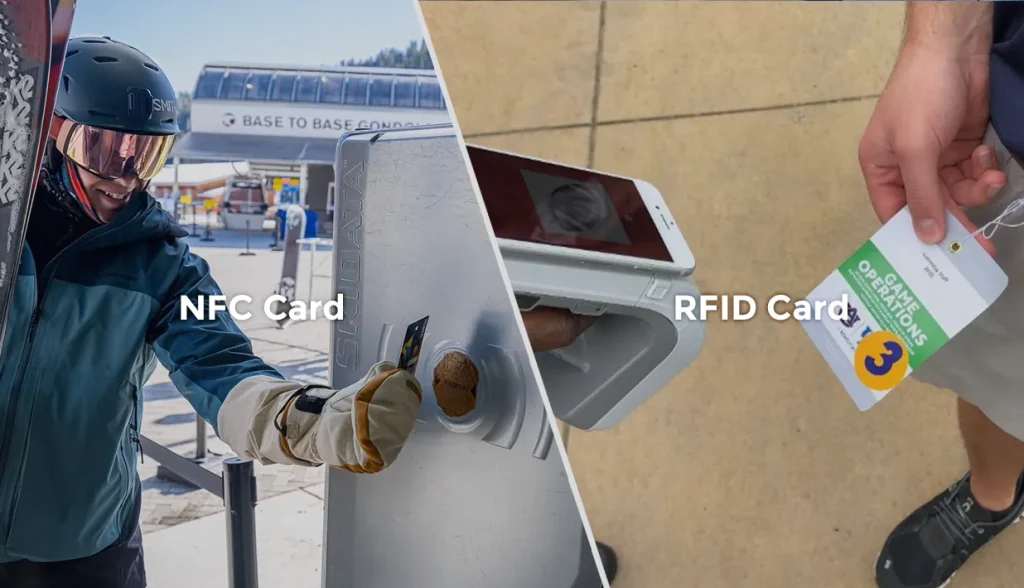
NFC, or near-field communication, is a short-range form of high-frequency RFID. It is designed for close, intentional interactions, usually within a few centimetres of a reader. NFC is widely used in smartphones, contactless bank cards and tap-based experiences.
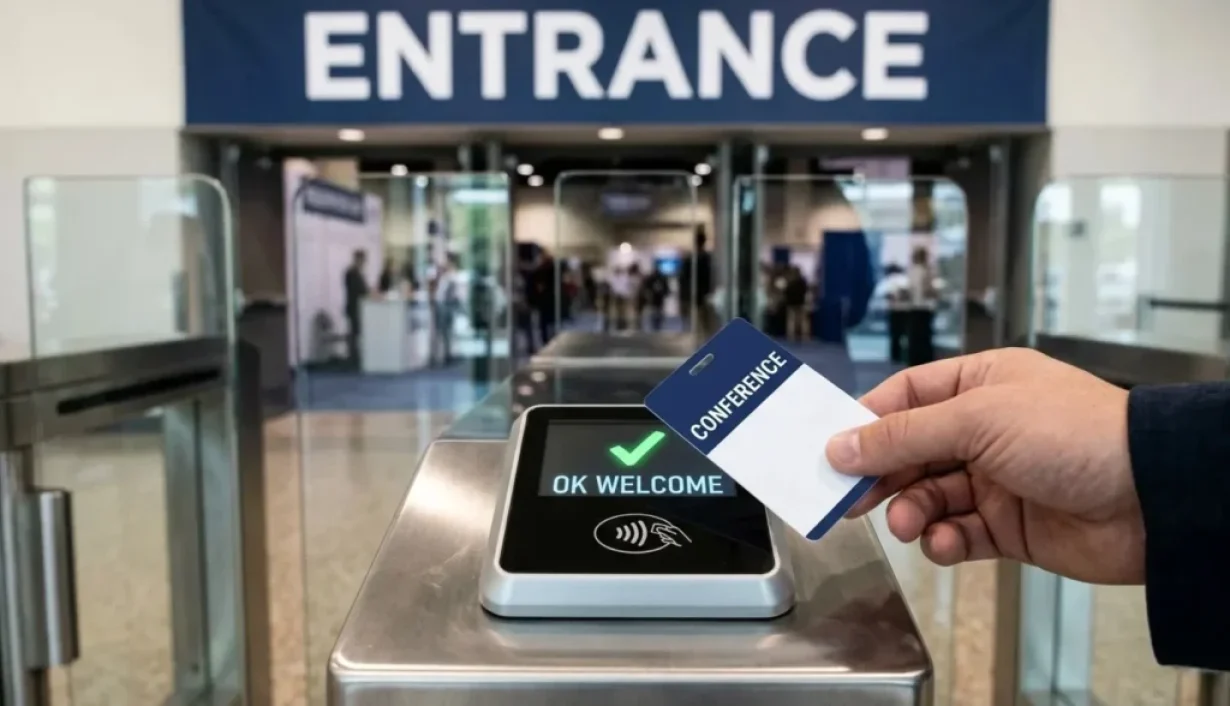
At an event, the chip of event cards may be embedded in a PVC card, badge, lanyard, ticket, sticker or wristband. It can identify an attendee, reference a ticket or account, authorise access to a zone or support a closed-loop payment transaction.
This distinction matters. A prepaid RFID or NFC event card used at a festival is not the same as a bank-issued EMV contactless card used at a conventional payment terminal. Both may involve a tap or wave, but their payment architecture and security responsibilities are different.
How RFID Cards Work at Events
An RFID event card contains a chip and antenna. When it is presented to a compatible reader, the reader identifies the credential and sends the relevant information to an event-management or payment platform.
The system may then check whether the attendee is allowed to enter, access a VIP area, purchase a product or use a particular service. In many cases, the card does not store full bank-card details. It may instead contain a unique identifier linked to an account in the backend.
How NFC Differs from RFID
NFC is a specialised short-range form of RFID. Its limited range encourages an intentional interaction, which is useful for point-of-sale payments, controlled access and interactive marketing. RFID is a broader term, so its read range and behaviour depend on the frequency, chip, antenna and reader being used.
For this reason, event organisers should not choose a card simply because it is labelled “RFID” or “NFC”. They should first define the event workflow and then select the chip and system that support it.
How Secure Are RFID and NFC Cards for Event Payments?
RFID and NFC cards can support secure contactless event payments when they are deployed as part of a properly designed system. However, it is misleading to describe any card as secure simply because it uses contactless technology.
Technical Readability Does Not Mean Easy Payment Fraud
A card may be technically readable, but that does not mean an attacker can automatically complete a payment. The practical risk depends on the card type, authentication method, transaction design, reader distance, encryption and backend controls.
A captured identifier may be useless without the correct keys, account permissions or transaction authorisation. Conversely, a system that relies only on a static identifier may be more vulnerable to copying or misuse.
The Main Security Risks for Event Payment Systems
Event organisers should consider five main categories of risk:
1.Unauthorised reading: someone attempts to read card data without permission.
2.Card cloning: a copied identifier is used to imitate a legitimate credential.
3.Lost or stolen cards: another person uses an attendee’s credential before it is disabled.
4.Replay or duplicate transactions: captured data is reused when a system does not validate each transaction correctly.
5.Backend and operational weaknesses: weak administrator accounts, exposed interfaces, incorrect refund permissions or untested offline modes create risks beyond the physical card.
The strongest protection comes from using appropriate chips with authentication and encryption, limiting the information stored on the card, linking each credential to a controlled account and providing a fast way to deactivate a lost card.

What Can Event Organisers Learn from Contactless Card Security?
Modern bank-issued contactless cards show that secure payment is not achieved by radio technology alone. EMV payment systems use authentication, transaction-specific data and controls across the card, payment terminal, issuing bank and payment network.
Bank-Issued Contactless Cards Use a Different Security Model
A bank card usually operates within a regulated payment ecosystem. The transaction may involve dynamic data, cryptographic checks, issuer approval and established payment-security requirements. These protections are not automatically present in every RFID or NFC event card.
Event managers should therefore avoid applying the security characteristics of an EMV bank card to a custom event credential without checking the actual system design.
Event RFID Cards May Use Closed-Loop Accounts
Many festivals and venues use a closed-loop payment model. Attendees add credit to an event account and use an RFID card or wristband to pay for food, drinks and merchandise. The credential may identify the account or authorise a transaction rather than transmit full bank-card information.
This model can help organisers manage top-ups, spending limits, vendor permissions, refunds and transaction reporting. Some systems can also continue processing selected transactions during temporary network interruptions, but offline operation must be designed and tested by the platform provider.
Security Depends on the Complete System
An RFID or NFC card is only as secure as the complete identification technology and payment infrastructure behind it. This includes the chip, reader, POS device, payment platform, administrator accounts, data transmission, transaction monitoring and lost-card procedures.
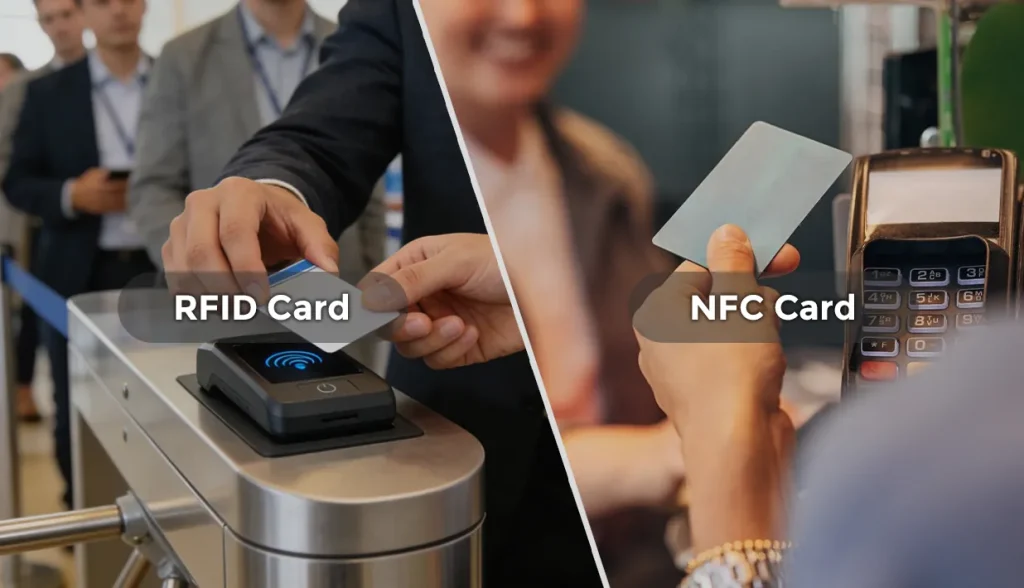
RFID vs NFC for Contactless Event Payments
RFID and NFC are not always competing technologies. They can be selected for different parts of the same event.
When RFID Is the Better Choice
RFID is often useful when organisers need to process large numbers of people quickly. Depending on the frequency and system design, it can support fast entry, staff identification, zone management and real-time attendance information.
RFID can be a strong option for festivals, stadiums, exhibitions and attractions where throughput and operational visibility are important. It may also support anti-passback rules that help prevent a ticket or credential from being used more than once.
When NFC Is the Better Choice
NFC is well suited to deliberate, close-range interactions. Attendees can tap an NFC card or wristband at a payment terminal, VIP access point, information display or brand activation.
Its short range can be an advantage because it encourages an intentional interaction. NFC also works well with smartphones, creating opportunities for digital content, registration, loyalty programmes and interactive experiences.
Comparing RFID and NFC with Other Identification Technologies
RFID and NFC are not the only options for event identification. The best identification technology depends on the event’s risk, budget, environment and user experience requirements.
Barcodes and QR codes
Barcodes and QR codes are inexpensive and easy to distribute through tickets and mobile apps. They work well for one-time admission, registration and simple validation. Their disadvantages include screen brightness issues, damaged print, slower manual scanning and the possibility of screenshots or duplicated tickets if the backend controls are weak.
Biometrics
Facial recognition, fingerprints and other biometric systems can provide strong identity verification and reduce the need for physical credentials. They may suit high-security venues or restricted facilities. However, biometrics involve privacy, consent, data governance and regulatory considerations. They also require specialised equipment and careful handling of false matches.
OCR
Optical character recognition can read names, passport numbers, licence plates or printed ticket information. It is useful for registration desks, vehicle access and identity document workflows. OCR accuracy depends on image quality, lighting, document condition and language support, so it is usually better as part of a broader process than as the only access method.
Magnetic stripe cards
Magnetic stripe cards are familiar and inexpensive, but they store static data and are more vulnerable to wear, copying and direct contact with a reader. They may still appear in legacy access or membership systems, but they are generally a weaker choice for new event payment and access-control projects.
Why RFID and NFC Often Offer the Best Balance
RFID and NFC cards combine contactless convenience, custom branding, fast identification and system integration. They can support access control, event payments, staff credentials, loyalty programmes and attendee experiences through one physical product.
For many events, this balance makes RFID or NFC more practical than using a separate ticket, payment token and access pass.

How Event Organisers Can Improve Payment Security
Choose Secure Chips and Authentication Methods
Confirm the exact chip model and ask whether it supports authentication, encryption and unique credentials. Avoid selecting a card based only on the general label “RFID”.
Limit the Data Stored on the Card
Do not store unnecessary personal or payment information on the physical card. Where possible, use a controlled account reference or token and protect sensitive data in the appropriate backend system.
Provide Fast Lost-Card Deactivation
The platform should support card blocking, account freezing, balance transfer and credential replacement. This is especially important for prepaid cards, VIP passes and staff credentials.
Test Offline Payments and Network Failures
Before the event, test how readers behave when connectivity is interrupted. Confirm transaction limits, synchronisation rules, duplicate-payment protection and reconciliation procedures.
Protect Readers and Backend Systems
Use administrator access controls, separate refund permissions, secure reader placement, staff training and transaction monitoring. A technically strong card cannot compensate for a poorly protected payment platform.

What Should Event Managers Ask an RFID Card Supplier?
Before ordering custom cards, ask the supplier:
•Which frequency and chip type suit the entry and payment use cases?
•Does the chip support authentication, encryption or secure transactions?
•Is sensitive data stored on the card, or only an account reference?
•How are lost, stolen or duplicated credentials deactivated?
•What happens if the venue loses connectivity, and how are transactions reconciled?
•Is the solution compatible with existing readers, POS devices and event software?
Also request samples before mass production. Card material, antenna placement, print quality, read performance and durability can affect the event as much as the software.
Conclusion: Choosing Secure Identification Technology for Your Event
RFID and NFC cards can support secure contactless event payments when they are backed by appropriate chip security, reliable readers, controlled accounts and well-managed operating procedures. They can also improve entry speed, reduce cash handling, simplify zone access and give organisers better visibility into event activity.
The most useful question is not whether RFID or NFC is simply secure or insecure. The better question is whether the complete identification technology has been designed for your payment model, venue conditions, attendee volume and risk profile.
Planning a festival, conference, exhibition, sports event or venue programme? Contact our team to discuss custom RFID and NFC event cards, chip selection, printing, encoding and compatibility with your payment or access-control system.
FAQs
Can RFID event cards support different access levels?
Yes. The backend platform can assign different permissions to general attendees, VIP guests, staff, vendors and media. The physical card acts as a credential, while the system determines which areas or services the credential can access.
Are RFID event cards reusable after an event?
Some durable PVC cards and silicone wristbands can be reused if the chip, physical format and backend system support re-enrolment. Disposable paper, Tyvek or tamper-evident wristbands are normally intended for one event.
Recommended Products

SONY Felica™ Lite-S NFC Type 3 Card CR80

The FeliCa™ Lite-S: RC-S966 product is a small-size contactless IC chip fully comply to NFC Forum Type 3 Tag and ISO/IEC 18092 specifications. The card made with photo quality standard PVC sheets into the size of CR80, that are suitable for use with most direct thermal or thermal transfer card printers.