Introduction
In the rapidly evolving retail landscape, pop-up stores have emerged as a favored channel for brands to engage consumers, thanks to their unique flexibility and innovation. These temporary retail spaces demonstrate significant market potential, whether used to test new products, boost brand awareness, or capitalize on sales opportunities during specific holidays. However, pop-up store success is not without challenges, with the payment experience being a critical factor. Traditional payment methods are often constrained by fixed equipment and network connections, struggling to meet the pop-up store’s demands for efficiency, convenience, and mobility. It is precisely in this context that the mobile credit card RFID reader has emerged, revolutionizing pop-up stores by enabling them to transcend the limitations of traditional terminals and deliver a seamless, modern shopping experience to customers.
1. The Rise of Pop-Up Stores and Payment Pain Points

The appeal of pop-up stores lies in their low cost, high flexibility, and powerful marketing impact. Brands can rapidly enter the market, engage with target customer groups for short-term interactions at popular locations, gather real-time feedback, and create unique brand experiences. According to market research, the global mobile payment market is projected to maintain rapid growth, reaching a scale of trillions of dollars by 2030. This undoubtedly presents significant opportunities for payment innovation in pop-up stores.
However, the temporary nature of pop-up stores also presents inherent payment challenges:
Equipment Limitations: Traditional POS systems are bulky and require complex installation, making them unsuitable for the rapid deployment and dismantling demands of pop-up environments.
Network Dependency: Stable wired networks are often difficult to guarantee in temporary venues, while mobile network signals may be unstable, impacting transaction speed.
Transaction Speed: During high-traffic pop-up events, slow payment processes lead to queues, reduce customer satisfaction, and may even result in lost sales.
Data Security: Temporary payment solutions must ensure transaction data security and compliance.
2. Mobile Credit Card RFID Reader: The Ideal Choice for Pop-Up Stores

Mobile Credit Card RFID Reader, as an innovative application of RFID technology in the payment sector, offers a perfect solution for pop-up stores. It combines the advantages of RFID (Radio Frequency Identification) and mobile payments, making the transaction process more efficient, secure, and convenient.
Introduction to RFID Technology
RFID technology uses radio waves to identify specific targets and read their stored data without requiring physical contact or line-of-sight alignment. In payment scenarios, RFID chips are typically embedded in credit cards, debit cards, smartphones (via NFC, or Near Field Communication, a subset of RFID), or wearable devices. When these devices come into proximity with an RFID reader, the reader emits radio frequency signals to activate the chip and retrieve payment information, thereby completing the transaction.
Core Advantages of Mobile Credit Card RFID Readers
Ultimate Portability: These readers are typically compact and lightweight, easily pairing with smartphones or tablets to enable true mobile payments. Sales staff can process transactions anywhere within a store or even adapt flexibly during outdoor events.
Fast Transactions: RFID payments are “tap-and-go”—customers simply touch their card or device, and the transaction completes instantly, significantly reducing queue times and enhancing customer experience.
Enhanced Security: Mobile RFID readers often employ encryption and tokenization to safeguard sensitive payment data, reducing data breach risks. Each transaction generates a unique encrypted code for added security.
Wide Compatibility: They support multiple payment methods, including traditional chip cards, magnetic stripe cards, and increasingly popular contactless payments (e.g., Apple Pay, Google Pay, UnionPay QuickPass).
Inventory Management Integration: For RFID product manufacturers like RFIDlabel, mobile readers not only process payments but also seamlessly integrate with RFID tags and inventory management systems. This enables real-time inventory updates during sales, improving stock accuracy and reducing the hassle of manual inventory counts.
3. Comparison of Mobile Credit Card RFID Readers with Traditional Payment Methods
To clearly demonstrate the advantages of mobile credit card RFID readers, the following table compares them with traditional POS terminals and pure software-based mobile payments:
| Features | Mobile Credit Card RFID Reader | Traditional POS Terminal | Pure Software Mobile Payment (e.g., QR Code Payment) |
| Portability | Extremely High (Pocket-sized, pairs with phone/tablet) | Low (Bulky, fixed installation) | Extremely High (Requires only a phone) |
| Deployment Difficulty | Extremely Low (Plug-and-play, Bluetooth connection) | High (Requires wiring, network configuration) | Extremely Low (app download required) |
| Transaction Speed | Extremely fast (contactless, completed within seconds) | Fairly fast (swipe/insert card, PIN required) | Fairly fast (scan code, amount confirmation needed) |
| Supported Payment Types | Chip cards, magnetic stripe cards, contactless cards, mobile payments | Chip cards, magnetic stripe cards, limited contactless support | QR code payments (WeChat Pay, Alipay, etc.) |
| Network Dependency | Requires mobile data or Wi-Fi | Requires wired network or Wi-Fi | Requires mobile data or Wi-Fi |
| Security | High (encryption, tokenization) | High (PCI DSS compliant) | Moderate-high (relies on platform security, requires user confirmation) |
| Cost | Low (low device cost, transaction-based fees) | High (high device cost, monthly subscription) | Extremely low (no device cost, transaction-based fees) |
| Inventory Integration | Can integrate with RFID tag systems for real-time inventory updates | Typically requires additional integration | Challenging to integrate |
4. Beyond Payments: More Applications of RFID Technology in Pop-Up Stores
While payment is its core function, RFID technology’s applications extend far beyond this. For brands seeking to further enhance operational efficiency, RFID tags can integrate with reader systems to enable advanced capabilities:
Rapid Inventory Counting: By attaching RFID tags to each item, store staff can complete a full inventory count in minutes simply by walking through the store with a handheld RFID reader—achieving far greater accuracy than manual counting.
Seamless Checkout Experience: Customers can place all selected items into a single shopping basket and pass through an RFID-enabled checkout lane. The system automatically identifies every item and calculates the total price, requiring customers to complete just one payment transaction—delivering truly “seamless checkout.”
Data Analysis and Insights: The system tracks which items customers pick up (but do not purchase) and identifies the most popular products. This data provides invaluable guidance for optimizing product selection and display strategies in pop-up stores.
Conclusion
For pop-up stores seeking flexibility, efficiency, and exceptional customer experiences, mobile credit card RFID readers have evolved from an “option” to an “essential.” Not only do they solve the most challenging payment issues in temporary retail environments, but their portability, high-speed transactions, and low cost also create significant competitive advantages for brands.
More importantly, when integrated with technologies like RFID tags, they empower inventory management and data analytics, elevating pop-up store operations to new heights. For any brand aiming to stand out in today’s fiercely competitive retail landscape, investing in mobile RFID payment solutions is undoubtedly a crucial step toward success.
RFIDCard is dedicated to providing global customers with top-tier products, including RFID cards and customized solutions. We understand the unique demands of modern business models like pop-up stores and offer flexible wholesale services with low minimum order quantities. If you’re seeking reliable RFID solutions for your project, we invite you to contact us to explore how technology can empower your business.
Recommended Product
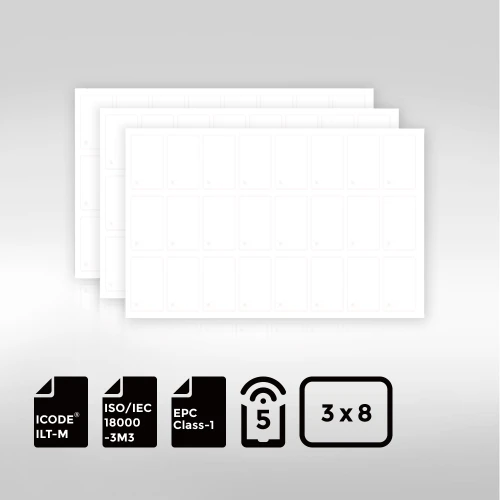
BioPoly™ Vinyl RFID Inlay Sheet NXP® ICODE® ILT-M

The NXP® ICODE® ILT-M BioPoly™ Vinyl RFID Inlay Sheet combines cutting-edge high-frequency RFID performance with a commitment to sustainability. Featuring the advanced ICODE® ILT-M chip and compliant with ISO/IEC 18000-3 Mode 3, it delivers ultra-fast data transfer, high memory capacity, and superior reading distances, making it ideal for applications such as supply chain management, asset tracking, logistics, and industrial automation.
Made from eco-friendly BioPoly™ vinyl, this inlay sheet helps your business reduce its environmental footprint while maintaining exceptional durability and printability. Whether used in custom labels, smart packaging, or intelligent inventory systems, the ILT-M BioPoly™ enables your brand to achieve operational efficiency, environmental responsibility, and a stronger connection with customers—all in one smart solution.