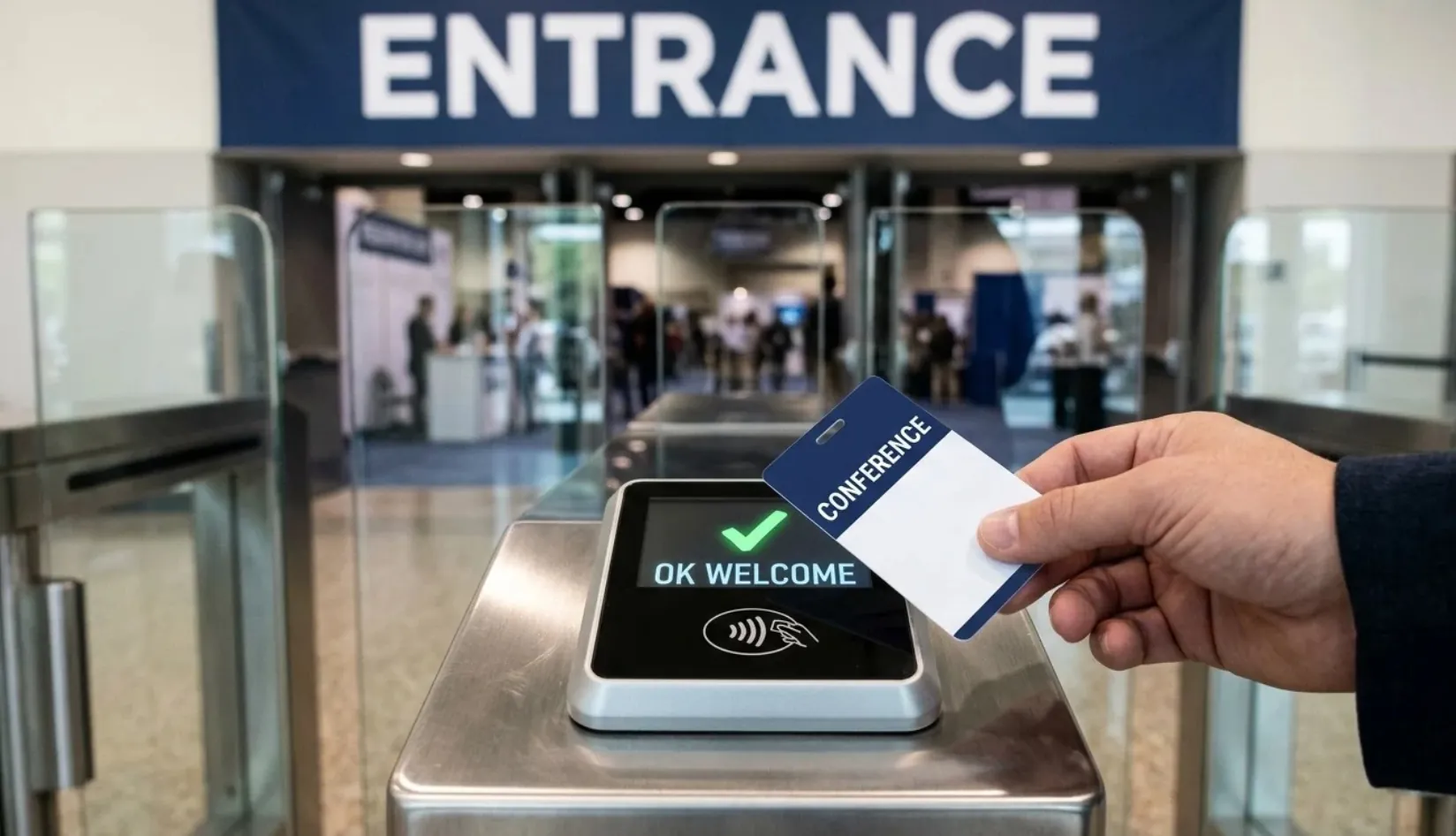

RFID cards communicate wirelessly with compatible readers, which raises a common concern: Can someone scan your RFID card without your knowledge or permission?
The answer is yes, in some cases. A compatible reader may detect a card or retrieve certain information without the cardholder actively presenting it. However, what can be accessed depends on the card’s chip, communication protocol, security features and the data it makes available.
Being able to detect or read an RFID card does not automatically mean someone can access sensitive data, duplicate the credential or use it to gain unauthorized access.
How Far Can an RFID Card Be Read?
The distance at which an RFID card can be detected or read depends on its operating frequency, card and antenna design, reader power, communication protocol and surrounding environment. Different RFID frequency bands have different communication characteristics and typical reading ranges.
| RFID Frequency | Typical Applications | Communication Characteristics |
| LF (125–134.2 kHz) | Animal identification, certain access-control systems | Generally short-range, with range depending on the tag and reader. |
| HF (13.56 MHz) | NFC, contactless cards, hotel key cards, transit cards | Commonly used for close-range communication, with capabilities varying by card and reader. |
| UHF (typically 860–960 MHz, depending on region) | Inventory, logistics, retail and asset tracking | Often supports longer reading distances, depending on the system and operating conditions. |
Higher reading ranges may increase the distance at which a card can be detected or read, but actual performance depends on the reader, antenna, card design and operating conditions.
Frequency alone does not determine a card’s security. Unauthorized access depends on the chip’s capabilities, authentication mechanisms, access permissions and how the card is used within the system.
What Information Can an RFID Card Reveal?
RFID cards do not all store or reveal the same information. A reader may encounter several different types of data, depending on the card’s design and configuration.
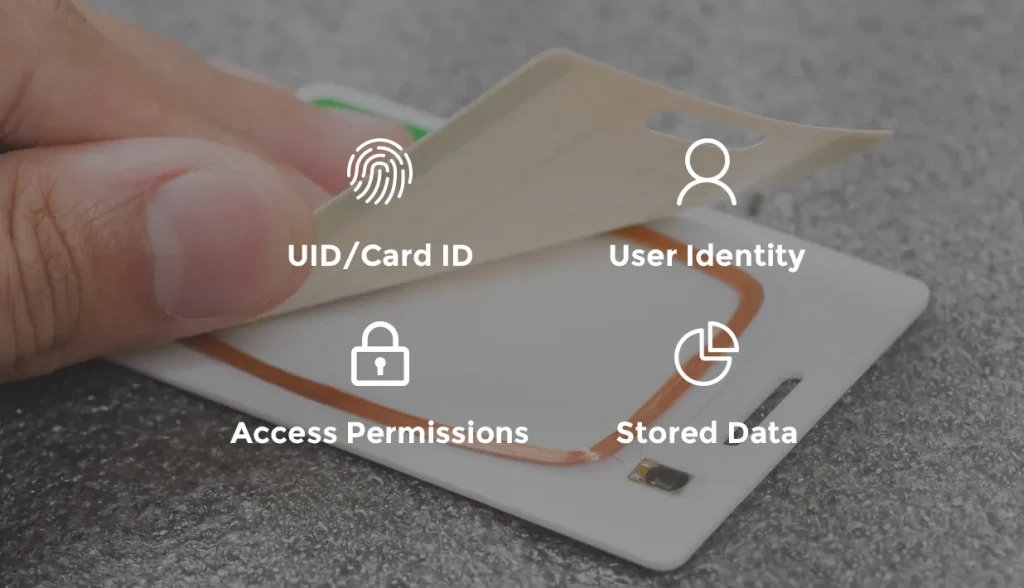
UID or Card Identifier
A UID, serial number or card identifier allows a system to distinguish one card from another. In some low-security systems, this identifier is treated as the credential itself. If the reader accepts a card based only on its UID, the system may be exposed to replay or emulation risks.
However, a UID is not automatically personal information. It may be a random or manufacturer-assigned value with no visible connection to the cardholder’s name. It is also not equivalent to a complete copy of the card.
Publicly Accessible Data
Some RFID and NFC tags intentionally store data that any compatible reader can access. Examples include a product code, event information, a URL, a library reference or basic asset details.
This data may be harmless when designed for public use, but organizations should avoid placing confidential information in openly readable memory.
Stored Application Data
Other cards contain data used by a specific application. An access card may contain a credential reference, while a membership or transit card may contain application records. Whether a reader can access this information depends on memory permissions and the card’s communication protocol.
Data Protected by Authentication
More secure cards require authentication before releasing protected data or performing a transaction. The reader may need to prove that it is authorized, and the card may also need to prove its authenticity.
Encryption can protect data during communication, while cryptographic keys help prevent unauthorized readers from accessing protected card functions.
The information a reader can retrieve depends on the card’s memory structure, access permissions, communication protocol and security mechanisms. Detecting a card or reading an accessible identifier does not necessarily allow a reader to access protected memory, retrieve sensitive information or perform an authenticated transaction.
Can RFID Cards Be Cloned?
RFID card cloning involves creating another card, tag or device that imitates some or all of the original card’s behavior. The difficulty depends on the card’s technology, the information available to a reader and the security mechanisms used by the system.
Cards that rely on a static, unprotected identifier may be easier to imitate if the reader accepts that identifier as sufficient proof of authorization. In such systems, reproducing the card number may be enough to pass the reader’s verification.
However, cards that use cryptographic authentication offer stronger protection. A reader may need to verify a cryptographic response rather than simply compare a card’s identifier. Copying publicly readable information alone is generally insufficient to reproduce these authentication functions.
RFID cloning can involve different levels of duplication:
- UID copying: Reproducing a card identifier.
- Partial emulation: Imitating selected responses or readable data.
- Full functional duplication: Reproducing the data and behavior required to impersonate the original credential within a particular system.
Copying a UID does not automatically reproduce encrypted memory, cryptographic keys, transaction counters or authentication behavior. For security-critical applications, a UID should not be the sole factor used to authorize access.
The security of an RFID system therefore depends on how the card, reader and backend application verify credentials, rather than on the card identifier alone.
For a broader discussion of RFID cloning, relay attacks, communication security and system-level vulnerabilities, see our guide to RFID Card Security Explained: How Secure Are RFID Cards?.
How Can You Protect RFID Cards from Unauthorized Access?
Protecting RFID cards from unauthorized access involves more than the card itself. The appropriate measures depend on how the card is used and the information or permissions it carries.
For Businesses
Select cards with security features appropriate to the application. An inventory tag may have different requirements from an employee access badge, payment credential or government identity card. High-risk systems should use cards that support authentication and should not rely on a visible UID alone.
Secure the complete reader and backend environment. Restrict administrative access, change default settings, protect cryptographic keys, update reader firmware and monitor unusual transactions. Maintain an accurate record of issued credentials and revoke cards promptly when they are lost, stolen or no longer required.
Test the end-to-end system rather than evaluating the card in isolation. A secure chip can still be exposed by weak reader settings, insecure integration software or excessive permissions in the connected application.
For Consumers
Keep access cards and contactless payment cards under control and report lost credentials quickly. Avoid sharing card photographs or printed identifiers when those details are used by an access or membership system.
Shielding may be appropriate when there is a specific concern about unwanted contactless communication. A purpose-designed RFID-blocking sleeve can reduce the chance of a reader communicating with a card while it is stored, but its effectiveness depends on the card frequency and shielding quality.
However, RFID blocking protection is not necessary for every card. The potential risk depends on the card’s purpose, technology, accessible data and security configuration. For many applications, authentication, access permissions and system security are more important than shielding alone.
Conclusion
Some RFID cards can be read without permission, but reading a card does not necessarily mean that sensitive personal information or a complete credential has been exposed. A reader may obtain a UID or public data while being unable to access protected memory or perform an authenticated transaction.
The right security decision depends on the complete identification technology system. Businesses should assess the card chip, frequency, read range, communication protocol, authentication, encryption, reader configuration and backend credential management together.
RFID remains a valuable technology for contactless access, inventory visibility, asset tracking and supply-chain automation. When it is supported by appropriate authentication and system controls, it can provide operational efficiency without treating convenience as a substitute for security.
FAQs
Can an RFID card reveal my name or personal information?
Not necessarily. Many RFID cards use identifiers that do not directly reveal the cardholder’s name or other personal details. However, some cards may store application data or information associated with an account. The information available depends on the card’s design, memory configuration and access permissions.
Can RFID cards be tracked by someone with a reader?
An RFID card may be detected or identified by compatible readers within their communication range. However, whether a card can be tracked across different locations depends on its identifier, communication behavior, reader infrastructure and the system using the card. Reading a card does not automatically provide continuous tracking or location history.
Can someone write to or change the data on an RFID card without permission?
Some RFID cards support writable memory, but modifying their data depends on the card’s memory permissions, authentication requirements and security configuration. A card that allows unrestricted writing to certain memory areas may be more vulnerable to unauthorized changes than one with protected memory and access controls.
Does RFID shielding work for every RFID card?
RFID shielding can reduce or block radio communication when a card is inside a properly designed shielding product. However, its effectiveness depends on the operating frequency, shielding materials, construction and quality. A shielding sleeve should not be treated as a substitute for secure authentication, access management or reporting a lost card.
Recommended Products

RFID Card CR80 MIFARE® DESFire® EV1 4K

The MIFARE® DESFire® EV1 4K RFID card is a secure, high-capacity contactless smart card ideal for various applications like access control, transportation, and payment systems. It features 4KB of integrated memory, advanced encryption standards for security, and is compatible with existing MIFARE® systems.