In today’s world, secure and reliable contactless identification is essential for access control, transportation, and payment systems. Among the leading technologies in this field, MIFARE DESFire stands out as a high-security, scalable solution designed to meet modern requirements. However, many organizations still use MIFARE Classic or are considering MIFARE Plus as a cost-effective upgrade. Choosing the right MIFARE card is critical to ensure system security, future scalability, and efficient operation. This blog will guide you through the differences between MIFARE Classic, MIFARE Plus, and MIFARE DESFire, helping you make an informed decision for your project.
1. MIFARE Classic: The Foundation of Contactless Smart Cards
The MIFARE Classic family represents the first generation of MIFARE technology and remains one of the most widely deployed contactless smart card solutions globally. Introduced decades ago, it laid the groundwork for the modern tap-and-go experience. MIFARE Classic cards operate at the standard 13.56 MHz frequency and are available in 1K and 4K memory configurations. The card’s memory is organized into sectors, each protected by two cryptographic keys (Key A and Key B). The primary encryption algorithm used is Crypto-1, a proprietary stream cipher developed specifically for this technology.

1.1. Advantages
The main advantages of MIFARE Classic are its affordability, wide compatibility, and ease of integration. Due to its long history and massive deployment, virtually all existing RFID readers are compatible with MIFARE Classic, making it a cost-effective choice for simple, closed-loop systems.
1.2. Typical Applications
MIFARE Classic uses in applications where the risk is low and cost is the primary driver:
- Small Office Access Control: Simple door access where the card is not tied to high-value assets.
- Loyalty and Membership Cards: Basic identification for gym memberships or library cards.
- Early Transport Systems: Systems that have not yet been upgraded, though this is rapidly changing.
2. MIFARE Plus: The Bridge Between Classic and DESFire
MIFARE Plus was designed as a transitional solution to bridge the gap between MIFARE Classic and MIFARE DESFire. It offers stronger security while maintaining backward compatibility, allowing organizations to upgrade their systems without replacing all hardware immediately.
2.1. Four distinct security levels (SL):
- SL0 (Initial State): Used for configuration and personalization.
- SL1 (MIFARE Classic Compatible): The card operates using the Crypto-1 algorithm, allowing it to function seamlessly with existing MIFARE Classic infrastructure. This is the “backward compatibility” mode.
- SL2 (Secure Mode): The card begins to use AES encryption for authentication and data transfer, significantly enhancing security while maintaining the same memory structure as Classic.
- SL3 (Highest Security Mode): Full AES security is enforced for all operations, offering a high level of protection against sophisticated attacks.
2.2. Advantages and Typical Applications
The primary advantage of MIFARE Plus is the smooth migration path it offers. A system operator can replace their Classic cards with Plus cards and run them in SL1 mode, ensuring immediate compatibility with all existing readers. They can then upgrade their readers over time and switch the cards to SL2 or SL3 mode, gradually transitioning the entire system to AES security without a disruptive, one-time overhaul.
Typical applications for MIFARE Plus include:
- Campus Upgrades: Transitioning from a legacy student ID system to a more secure one.
- Mid-level Transport Systems: Where security is a concern, but the cost of a full DESFire system is prohibitive or a phased rollout is required.
- Corporate Access Control: Providing enhanced security over Classic for employee badges.
3. MIFARE DESFire: The Premium, Secure, and Scalable Solution
For applications that demand the highest level of security, flexibility, and multi-application support, the clear choice is the MIFARE DESFire family. This product line is fundamentally different from its predecessors, built on a secure microcontroller platform rather than a simple memory chip. These cards are compliant with the ISO/IEC 14443 Type A standard, ensuring global interoperability.

3.1. Key Feature:
- Multi-Application Support: A single card can host up to 28 different applications, each with its own set of files, access rights, and cryptographic keys. This allows a single card to function as a corporate ID, a public transport pass, a cashless payment tool, and a loyalty card, all completely isolated from one another.
- Security and Integrity: Beyond AES encryption, DESFire offers advanced features like Secure Dynamic Messaging (SDM) for confidential data exchange without prior authentication, and Transaction MAC (TMAC) to ensure the integrity of data during transactions. The microcontroller architecture provides superior protection against physical and logical attacks.
- Memory: Available in larger memory sizes (2K, 4K, and 8K), accommodating complex data structures and multiple applications.
3.2 Advantages and Typical Applications
The advantages of MIFARE DESFire are centered on security, scalability, and future-proofing. Its high-level security makes it suitable for sensitive data and high-value transactions, while its multi-application capability offers unparalleled flexibility and a strong return on investment (ROI) by consolidating multiple cards into one.
Typical applications that leverage the power of MIFARE DESFire include:
- Government IDs and e-Passports: Requiring the highest level of security and data integrity.
- Public Transport Systems: Used globally for secure fare collection and ticketing.
- Corporate Access and IT Security: Integrating physical access with logical access to networks and systems.
- Smart Cities: Serving as the central credential for various city services, from parking to library access.
4. Feature Comparison Table
To summarize the key differences, the following table provides a side-by-side comparison of the three MIFARE families across critical technical and functional parameters.
| Feature | MIFARE Classic | MIFARE Plus | MIFARE DESFire |
| Architecture | Sector-based memory | Sector-based memory | File-based OS (Microcontroller) |
| Primary Encryption | Crypto-1 (Proprietary) | AES (in SL2/SL3) | AES 128-bit / 3DES |
| Security Level | Basic (Compromised) | Medium (AES Upgrade Path) | High (EAL 5+ Certified) |
| Memory Options | 1K / 4K | 2K / 4K | 2K / 4K / 8K |
| Multi-Application | Limited (Sector Isolation) | Moderate (Sector Isolation) | Yes (Application Isolation) |
| Standard Compliance | Proprietary | ISO/IEC 14443 Type A | ISO/IEC 14443 Type A |
| Ideal Use Case | Entry-level, low-risk access | Phased migration from Classic | High-security, multi-application environments |
| Cost | Low | Medium | High |
5. How to Choose the Right MIFARE Card for Your Project
Selecting the correct MIFARE technology is a structured decision process that should be guided by four key considerations: security, existing infrastructure, long-term scalability, and cost.
Step 1: Define Your Security Level Needs
The first and most critical step is to honestly assess the security risk associated with your application.
- Low Security Requirement: If the card is only used for basic identification in a closed, low-risk environment (e.g., a simple locker key), MIFARE Classic may suffice, provided you accept the inherent security risks.
- Medium Security Requirement: If you need to secure access to corporate assets or store non-critical personal data, but you are currently running a Classic system, MIFARE Plus offers the best balance of improved security (via AES) and compatibility.
- High Security Requirement: If your application involves financial transactions, sensitive personal data, government identification, or mass transit fare collection, you absolutely require the highest level of protection. MIFARE DESFire is the mandatory choice, as its EAL (Evaluation Assurance Level) certified microcontroller and advanced cryptographic features provide the necessary defense against sophisticated attacks.
Step 2: Consider Existing Infrastructure
Your current hardware setup plays a major role in the decision.
- Already using MIFARE Classic readers? If a full reader replacement is not immediately feasible, MIFARE Plus is the most practical choice. It allows you to deploy new, secure cards that still work with your old readers (in SL1 mode) while you gradually upgrade the reader hardware to support the full AES security of SL2/SL3.
- Starting a new system or planning a full overhaul? If you are building from scratch, there is no reason to consider MIFARE Classic. You should choose between MIFARE Plus (if you anticipate future backward compatibility needs) or, preferably, MIFARE DESFire for maximum performance and security.
Step 3: Balance Cost vs. Performance and ROI
While MIFARE Classic is the cheapest option on a per-card basis, it is crucial to look at the total cost of ownership and the potential cost of a security breach.
- MIFARE Classic: Low initial cost, but high long-term risk and zero scalability for new applications.
- MIFARE Plus: Medium cost, offering a strong ROI for systems that need a phased security upgrade.
- MIFARE DESFire: Higher initial cost, but the best long-term ROI. By enabling multiple applications on a single card, it reduces the need for multiple credentials, simplifies management, and provides the highest level of security, mitigating the potentially catastrophic costs associated with a system compromise.
6. Conclusion
The decision of choosing the right MIFARE card hinges on a careful evaluation of your security requirements, your existing hardware, and your vision for future scalability. Looking for genuine MIFARE DESFire cards or complete RFID solutions? We supply a full range of MIFARE Classic, Plus, and DESFire cards tailored to your project needs. Contact us today for free consultation, customization, and bulk pricing.
Recommended Product
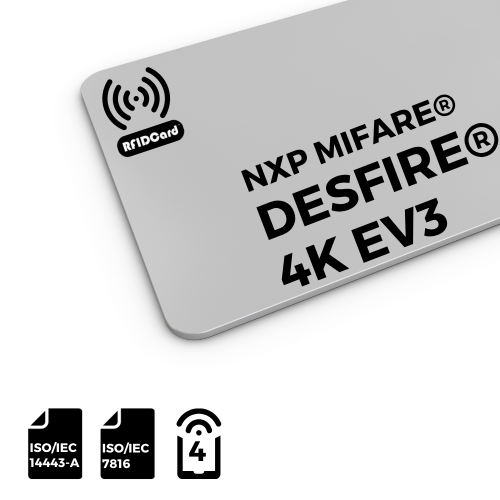
RFID Card NXP MIFARE® DESFire® EV3 4K

Blank or customized printing RFID cards with a choice of dimensions are available. The MIFARE® DESFire® EV3 4K is Common Criteria EAL5+ security certified for smart card IC products. The MIFARE® DESFire® EV3 4K ICs fully comply with NFC Forum Type 4 Tag.