Introduction
In today’s rapidly evolving business landscape, efficiency and precision are critical to corporate success. Radio Frequency Identification (RFID) technology, as a powerful automated identification tool, has found widespread adoption across diverse industries. From inventory management in retail to asset tracking in healthcare, RFID tags are transforming how we monitor and manage physical items. Yet, among the many advantages of RFID technology, one core concept is often overlooked: while the physical RFID tag itself is important, the electronically encoded data stored within it is the true driver of value. This article will delve into the electronic encoding of RFID tags and explain why this data holds greater significance than the tag itself.
1. The Composition of RFID Tags: More Than Just a Physical Carrier
An RFID tag, regardless of its appearance, is more than just a simple physical carrier. It typically consists of three fundamental components: a tiny integrated circuit (IC) or chip, an antenna, and a protective substrate that encapsulates them together. The antenna handles the reception and transmission of radio frequency signals, while the chip serves as the tag’s “brain,” storing data and managing communication with RFID readers. It is this chip, through its internal electronic encoding, that endows RFID tags with capabilities far exceeding those of traditional identification tools. Electronic encoding is the process of writing information in digital form into the chip’s memory, enabling data to be wirelessly read, modified, and managed.
2. The Core of Electronic Coding: An Analysis of RFID Tag Memory Structure
The memory within an RFID tag’s chip is not a single storage area but is divided into several regions with specific functions. Understanding these regions is crucial for fully leveraging RFID technology. According to the EPCglobal Gen2 UHF RFID standard, tag memory typically includes the following key components:
Tag Identifier Memory (TID): The TID is the tag’s unique serial number, typically 20 bytes or 160 bits. It is written by the chip manufacturer during production and is non-modifiable. Similar to a device’s “DNA,” the TID ensures the uniqueness of each physical tag and is primarily used for basic tag identification and management.
Electronic Product Code Memory (EPC): The EPC is a code used to identify products or items, typically 12 bytes long, though its length and format can be configured for specific applications. Unlike the TID, the EPC is user-editable and designed to replace traditional barcodes, offering a more flexible and comprehensive product identification method. For instance, in retail settings, EPC can store a product’s SKU (Stock Keeping Unit) or batch number, enabling systems to rapidly identify item types.
User Memory: User Memory is the most flexible storage area on a tag, ranging from 0 to 64 bytes depending on the tag type and cost. This area is user-editable and can store specific additional information related to individual items, such as production dates, expiration dates, temperature logs, maintenance history, or specific user settings. It provides finer-grained information storage capabilities than the EPC, enabling each item to carry its unique lifecycle data.
Password Area: To safeguard the security and integrity of tag data, RFID tags also incorporate a password area. This includes an access password, preventing unauthorised tag reconfiguration, and a destroy password, enabling permanent and irrevocable tag deactivation. These passwords ensure only authorised users can modify or disable tags, thereby enhancing data security.
The table below summarises the primary functions and characteristics of RFID tag memory areas:
| Memory Area | Characteristics | Primary Function | Editable | Example Application |
| TID | Unique, Fixed | Physical identification of the tag | Not editable | Chip manufacturer’s serial number |
| EPC | Programmable, standardized | Product type, batch identification | Editable | Product SKU, batch number |
| User Memory | Flexible, variable | Stores application-specific data | Editable | Production date, temperature logs, maintenance history |
| Password Area | Security control | Protects data, disables tag | Editable | Access control, tamper resistance |
3. Data Empowerment: The Commercial Value of Electronic Coding Far Exceeds That of Physical Labels

The true value of RFID tags lies in the electronic coding data they carry internally, which delivers unprecedented business insights and operational efficiency to enterprises. By providing rich, real-time data, electronic coding is reshaping how industries operate.
Enhancing Inventory Management Efficiency
Electronic coding data enables businesses to achieve real-time inventory visibility, precisely tracking the location and quantity of every item. This significantly reduces the time and cost required for manual inventory counts while markedly lowering the risk of stockouts and overstocking. Consequently, it optimises inventory levels and boosts sales. For instance, retailers can accurately determine the quantity of goods on shelves, replenish stock promptly, and avoid lost sales.
Optimising Supply Chain Visibility
Through the electronic codes on RFID tags, businesses can achieve end-to-end tracking of products from production to sale. This not only enhances supply chain anti-counterfeiting and traceability capabilities, ensuring product authenticity and safety, but also significantly improves logistics efficiency by enabling rapid sorting, warehousing, and distribution. For instance, pharmaceutical companies can track medications throughout the supply chain, ensuring compliance during transit and preventing counterfeit products from entering the market.
Enhanced Customer Experience and Personalised Services
Electronic coding data also creates opportunities to elevate customer experiences and deliver personalised services. In retail stores, RFID enables smart shopping experiences like self-checkout and personalised product recommendations. In hospitality, RFID chips embedded in hotel key cards store guest access permissions and personalised service preferences, delivering seamless check-in experiences. Subway companies can leverage RFID cards or key fobs for rapid payment and access, boosting commuting efficiency.
Data-Driven Decision Making
Ultimately, by collecting and analysing RFID tag data, businesses gain valuable insights into market trends, consumer behaviour, and operational bottlenecks. These data-driven decisions help optimise operational strategies, uncover new business opportunities, and maintain competitive advantages.
4. Case Study: How Data Transforms Industries

Leading global enterprises have recognized the immense potential of RFID electronic coding data and are applying it to their daily operations:
Retail: Fashion retail giants like Zara and Macy’s leverage RFID tags to precisely manage inventory across their global stores. Real-time data enables them to swiftly respond to market demand, reduce stockouts, and optimise supply chains, significantly enhancing operational efficiency and customer satisfaction.
Manufacturing: Within complex production processes, RFID tags track components and semi-finished goods along assembly lines. This data facilitates real-time production monitoring, identifies bottlenecks, and ensures quality control, ultimately boosting overall manufacturing efficiency.
Healthcare: Hospitals and medical institutions utilise RFID technology to track medical equipment, pharmaceuticals, and patients. This not only improves asset utilisation and reduces equipment loss but also ensures medication safety and optimises care processes.
Hospitality: Leading hotel brands widely employ RFID key cards. The embedded electronic codes not only control room access but also integrate payment functions, loyalty points, and personalised service preferences, delivering convenient and secure smart experiences for guests.
5. RFID Tags vs. Barcodes: The Fundamental Difference in Data Capabilities
To better understand the unique value of RFID electronic coding, comparing it with traditional barcode technology is helpful. While both are used for item identification, they exhibit significant differences in data capacity and application scenarios:
| Characteristics | RFID Tag | Barcode |
| Data Storage Capacity | Large (up to kilobytes), stores rich information | Small (typically tens of bytes), stores only basic identification codes |
| Reading Method | Wireless, non-line-of-sight, simultaneous reading of multiple tags | Contact-based, line-of-sight, single-tag reading |
| Data Modifiability | Read/write, data can be updated | Read-only, data is fixed |
| Uniqueness | Enables globally unique identification for tracking individual items | Typically identifies product types only; cannot track individuals |
| Automation Level | High, requires no manual intervention | Low, requires manual scanning |
| Environmental Adaptability | Strong, penetrates non-metallic materials; resistant to contamination | Weak, susceptible to contamination and obstruction |
| Cost | Higher | Lower |
As shown in the table above, RFID tags’ electronic coding far surpasses barcodes in data storage capacity, reading methods, modifiability, and automation levels. This enables RFID to support more complex and dynamic application scenarios while delivering deeper data insights.
Conclusion
In summary, the core value of RFID technology lies not merely in the physical tags themselves, but in the electronically encoded data they carry. This data forms the foundation for achieving efficient inventory management, optimising supply chain visibility, enhancing customer experiences, and driving data-driven decision-making. A well-designed, accurately encoded RFID tag can deliver significant competitive advantages and return on investment for businesses.
If you are seeking reliable RFID solutions and wish to enhance your business efficiency and data insights through customised electronic coding, please feel free to contact us. We at RFIDCard look forward to collaborating with you to explore the future of smart identification.
Recommended Product
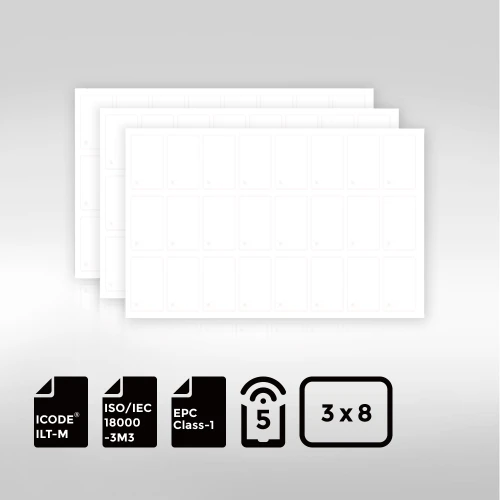
BioPoly™ Vinyl RFID Inlay Sheet NXP® ICODE® ILT-M

The NXP® ICODE® ILT-M BioPoly™ Vinyl RFID Inlay Sheet combines cutting-edge high-frequency RFID performance with a commitment to sustainability. Featuring the advanced ICODE® ILT-M chip and compliant with ISO/IEC 18000-3 Mode 3, it delivers ultra-fast data transfer, high memory capacity, and superior reading distances, making it ideal for applications such as supply chain management, asset tracking, logistics, and industrial automation.
Made from eco-friendly BioPoly™ vinyl, this inlay sheet helps your business reduce its environmental footprint while maintaining exceptional durability and printability. Whether used in custom labels, smart packaging, or intelligent inventory systems, the ILT-M BioPoly™ enables your brand to achieve operational efficiency, environmental responsibility, and a stronger connection with customers—all in one smart solution.