When it comes to contactless communication, HF RFID (High-Frequency Radio Frequency Identification) and NFC (Near Field Communication) are two closely related technologies that often get mixed up. Both operate at 13.56 MHz, use similar tags, and rely on electromagnetic coupling. However, their design goals, communication methods, and real-world applications differ significantly. In this article, we’ll clarify the key differences between HF RFID and NFC, explain where each technology excels, and help you decide which one fits your project or business best.
1. What is HF RFID?

HF RFID operates in the 13.56 MHz frequency band, offering a balance between read range and data speed. It typically supports read ranges of up to 1 meter, depending on antenna design and power output. HF RFID systems usually comply with ISO 15693 and ISO 14443 (Type A and B) standards. HF RFID is widely used in access control cards, library book tracking, event ticketing, and industrial asset management due to its stability, medium range, and strong anti-interference capability.
2. What is NFC?

NFC (Near Field Communication) is actually a subset of HF RFID technology. It also operates at 13.56 MHz but includes additional communication protocols defined by the NFC Forum, enabling two-way (peer-to-peer) data exchange between devices. Unlike traditional HF RFID, which is mostly one-way (reader to tag), NFC allows smartphones, tablets, and other smart devices to both read and emulate RFID tags. That’s why NFC powers mobile payments (Apple Pay, Google Pay), digital business cards, smart posters, and IoT device pairing.
3. Technical Differences Between HF RFID and NFC
While NFC is a derivative of HF RFID, several technical distinctions are crucial for understanding their respective strengths and appropriate use cases. The following table summarizes these key differences:
| Feature | HF RFID | NFC |
| Frequency | 13.56 MHz | 13.56 MHz |
| Communication Range | Up to 1 meter (vicinity) | Less than 10 cm (proximity) |
| Standards | ISO 15693 / ISO 14443 | ISO 14443 + NFC Forum Protocols |
| Communication Type | One-way (Reader → Tag) | Two-way (Peer-to-peer) |
| Hardware | Reader + Passive Tag | Smartphones, Tags, Readers |
| Data Transfer Rate | Moderate | Faster for small data |
| Power Source | Passive | Passive or Active |
| Compatibility | Not all HF RFID tags work with NFC | All NFC can read ISO 14443 tags |
(Learn more about RFID vs NFC: Similarities and Differences to understand how these technologies work and where they are used.)
4. Applications Comparison
The technical distinctions between HF RFID and NFC naturally lead to different primary application domains. Understanding these differences is key to selecting the appropriate technology for a given problem.
HF RFID is predominantly utilized in industrial, commercial, and institutional settings where efficient tracking, identification, and access control are paramount. Its longer read range and ability to read multiple tags simultaneously (anti-collision) make it highly effective for managing large inventories or high-volume transactions.
- Library Book Tracking: Libraries worldwide use HF RFID tags embedded in books to streamline check-out/check-in processes, inventory management, and anti-theft systems. The ability to read multiple books at once significantly reduces staff workload and improves accuracy.
- Event Ticketing: For concerts, sports events, or conferences, HF RFID-enabled wristbands or cards provide quick and secure access control, reducing queues and preventing fraudulent entries.
- Employee Badges: Many organizations employ HF RFID in employee ID cards for secure building access, time and attendance tracking, and even cafeteria payments.
- Asset Tracking: In manufacturing, logistics, and healthcare, HF RFID helps track valuable assets, tools, or medical equipment, improving operational efficiency and reducing loss.
Conversely, NFC is primarily geared towards consumer-oriented and smartphone-centric applications, leveraging its short range and peer-to-peer capabilities for intuitive and secure interactions.
- Mobile Payments: As mentioned, contactless payment systems like Apple Pay, Google Pay, and Samsung Pay are prime examples of NFC in action, offering a convenient and secure way to conduct transactions.
- Digital Business Cards: Instead of exchanging physical cards, two NFC-enabled phones can tap to share contact information instantly.
- IoT Device Pairing: NFC simplifies the setup of smart home devices, Bluetooth speakers, or Wi-Fi routers by allowing a quick tap to initiate pairing or configuration.
- Digital Access: Beyond traditional employee badges, NFC allows smartphones to act as digital keys for hotel rooms, car sharing services, or smart locks.
5. Choosing Between HF RFID and NFC
The decision to implement either HF RFID or NFC, or even a combination of both, depends heavily on the specific requirements of the application. Several key factors should be considered during the decision-making process:
- Use Case: Is the application primarily industrial (e.g., supply chain, asset management, large-scale inventory) or consumer-facing (e.g., mobile payments, smart posters, device pairing)? HF RFID typically shines in the former, while NFC dominates the latter.
- Distance Needed: What is the required communication range? If tags need to be read from a distance of up to a meter, HF RFID is the clear choice. If interactions must be very close and deliberate (a few centimeters), NFC is more appropriate.
- Device Ecosystem: Will the solution primarily involve dedicated readers and passive tags, or will it integrate with existing consumer devices like smartphones? NFC’s strength lies in its smartphone compatibility, whereas HF RFID often requires specialized reader hardware.
- Security & Cost Considerations: While both offer security features, the close-proximity nature of NFC inherently adds a layer of physical security for sensitive transactions. Cost can also be a factor, with tag and reader costs varying between the two technologies and specific standards.
6. Conclusion
In summary, while HF RFID and NFC both operate at the 13.56 MHz frequency and share common roots, they are distinct technologies optimized for different purposes. The fundamental takeaway is that all NFC is HF RFID, but not all HF RFID is NFC. NFC can be thought of as a specialized, enhanced version of HF RFID, designed for intuitive, short-range, peer-to-peer interactions, particularly with mobile devices. HF RFID, in its broader sense, encompasses a wider range of applications, including those requiring longer read ranges and robust industrial tracking capabilities. Choosing between these technologies requires a careful evaluation of the specific application needs, desired communication range, existing device ecosystem, and security requirements.
Recommended Product
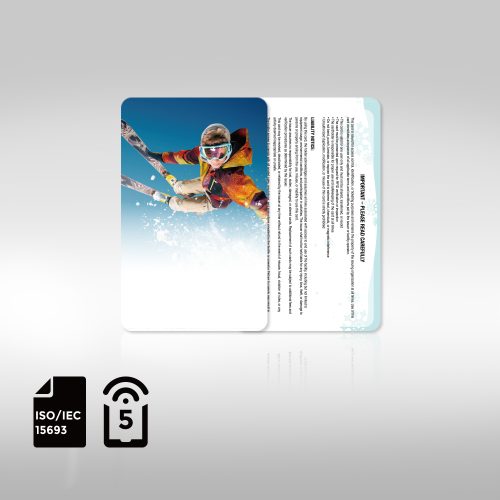
RFID Ski Pass Card NXP ICODE® SLIX2

The NXP ICODE® SLIX2 RFID Ski Pass Card is a high-performance HF smart card designed for ski resorts, mountain attractions, and outdoor access applications. Embedded with the NXP ICODE® SLIX2 chip, this card operates at 13.56 MHz and complies with ISO/IEC 15693 and NFC Forum Type 5 standards, providing reliable contactless identification and fast access validation. With long read range capability, anti-collision support, and sufficient user memory, it is suitable for lift access control, season passes, guest identification, and resort ticketing systems.