Introduction
Radio Frequency Identification (RFID) technology has been widely adopted in modern supply chain management, asset tracking, and access control systems. The core of an RFID card lies in its tiny chip, which stores critical data. For enterprises seeking to maximize the value of RFID solutions, understanding how this data is organized and stored is a crucial step. This article aims to provide an in-depth analysis of the data storage mechanisms inside RFID card chips, focusing on their primary memory areas: TID (Tag Identification Number), UID (Unique Identifier), and EPC (Electronic Product Code).
Basic Structure of RFID Card Memory Banks
The memory of a typical ultra-high frequency (UHF) RFID card chip is usually divided into four independent storage areas (banks). Each of these areas performs specific functions and is designed for different purposes.
| Memory Zone Name | English Abbreviation | Primary Function | Read/Write Permissions |
| Reserved Zone | Reserved | Stores the Access Password and Kill Password for tag security control. | Read/Write (password required), Lockable |
| Electronic Product Code Area | EPC | Stores variable product identification codes, the most frequently used data at the application layer. | Read/Write, Lockable |
| Tag Identification Number Area | TID | Stores a unique serial number written by the chip manufacturer to identify chip type and batch. | Read-Only, Non-Modifiable |
| User Area | User | Stores user-defined data such as serial numbers, maintenance records, or sensor data. | Read/Write, Lockable |
TID, UID, and EPC: Decoding Core Identification Data

Within RFID systems, TID, UID, and EPC are the three most frequently referenced identification codes. Although all are used to “identify” tags, their origins, applications, and modifiability differ fundamentally.
TID(Tag Identifier)
The TID area is a read-only memory region whose data is permanently fixed during chip manufacturing.
- Data Source and Uniqueness: Written by the chip manufacturer, the TID identifies the chip type, manufacturer information, and a unique serial number. Its length is typically 32 or 64 bits.
- Core Purpose: The TID serves as the chip’s “fingerprint.” It is primarily used for low-level protocol communication and chip type identification. In certain advanced applications, the TID also functions as the foundation for anti-counterfeiting and traceability of the EPC code, as it is immutable.
- Read/Write Permissions: Data within the TID zone cannot be modified, ensuring its reliability as a unique identifier for the chip.
UID(Unique Identifier)
UIDs are commonly used in high-frequency (HF) and low-frequency (LF) RFID tags, such as hotel key cards and access control cards.
- Data Source and Uniqueness: The UID is a globally unique serial number written into the chip during manufacturing, similar to a TID, and is also non-modifiable. UID length is typically 4 bytes (32 bits) or 8 bytes (64 bits).
- Core Function: In HF and LF systems, UID serves as the primary identifier for tags. It is used in anti-collision mechanisms and functions as the unique key value in database records.
- Difference from TID: TID is primarily used for UHF tags, while UID is mainly used for HF/LF tags. Although functionally similar (both being immutable with unique serial numbers), they exist within different technical standards and application scenarios.
EPC(Electronic Product Code)
The EPC zone is the most flexible and frequently utilized memory area within RFID tags.
- Data Source and Uniqueness: The EPC code is programmable, meaning it can be written and modified according to application requirements. It is designed to identify individual items, similar to a barcode but with greater information capacity and uniqueness.
- Core Purpose: The EPC code represents application-layer data. It is used for inventory management, asset tracking, supply chain visibility, and more. For example, an EPC code on a garment may contain the manufacturer code, product type, and a unique serial number, enabling item-level tracking.
- Read/Write Permissions: Data in the EPC zone can be written multiple times. However, to prevent malicious tampering, it is typically locked after writing, rendering it read-only.
EPC Coding Standards: The Cornerstone of Structured Data
The value of EPC codes lies not only in their uniqueness but also in their structured nature. The EPCglobal organization has established multiple coding schemes to ensure global interoperability.
- SGTIN (Serialized Global Trade Item Number): Identifies individual trade items, such as each product in retail. It combines the Global Trade Item Number (GTIN) with a unique serial number.
- GRAI (Global Returnable Asset Identifier): Identifies reusable transport assets like pallets and containers.
- GIAI (Global Individual Asset Identifier): Used to identify fixed assets within an enterprise, such as computers or machinery.
By adhering to these standards, data from RFID systems can be interpreted and managed uniformly worldwide.
Comparative Analysis of EPC, TID, and UID
To clarify the roles of these three identifiers within RFID systems, the following table provides a detailed comparison:
| Characteristics | TID (Tag Identification Number) | UID (Unique Identifier) | EPC (Electronic Product Code) |
| Primary Application Technologies | Ultra-High Frequency (UHF) | High Frequency (HF)/Low Frequency (LF) | Ultra-High Frequency (UHF) |
| Data Source | Fixed by chip manufacturer | Fixed by chip manufacturer | Written by user or system |
| Modifiability | Non-modifiable (read-only) | Non-modifiable (read-only) | Modifiable (programmable) |
| Uniqueness | Unique at chip level | Unique at chip level | Unique at application level (rewritable) |
| Primary Functions | Chip identity verification, anti-counterfeiting traceability | Primary tag identification, anti-collision | Item identity verification, application data |
| Analogies | A “fingerprint” for chips | A “ID number” for chips | A “barcode” for items |
Value of User Memory

Beyond the TID and EPC zones, the User Bank provides enterprises with additional flexibility.
- Data Storage: User memory is specifically designed to store application-specific data. For example, in apparel retail, it can store information such as the last inventory date, sales regions, or maintenance history.
- Data Capacity: User Bank size ranges from hundreds to thousands of bits, depending on the specific chip model (e.g., certain “high-memory” chips offer up to 64k bits of storage).
- Application Advantages: Storing application data directly on the tag reduces reliance on backend databases, enabling offline data reading and faster field processing. For instance, in medical asset management, the tag’s User Area can store the last calibration date for quick access without network queries.
Reserved Area and Tag Security
The Reserved Area forms the core of the tag’s security mechanism.
- Password Protection: This area stores two critical passwords: the Access Password and the Kill Password.
- Access Control: The Access Password protects data in the EPC and User areas, preventing unauthorized read or write operations. Only by providing the correct Access Password can these areas be modified or locked.
- Tag Destruction: The Kill Password is used to permanently disable a tag. Once a tag is “destroyed,” it can no longer be read, which is critical when handling sensitive information or disposing of products.
Comparison of Different Memory Zones in Applications
To better illustrate the roles of these memory zones in practical applications, the table below compares their application focuses across several typical industries:
| Industry/Application | Core Identifier | Memory Zone Focus | Typical Application Scenarios |
| Retail/Apparel | EPC (SGTIN) | EPC Area, User Area | Individual item inventory tracking and anti-theft in supply chains |
| Asset Management | EPC (GIAI) | EPC Area, User Area | Tracking maintenance history of IT equipment, tools, or reusable assets |
| Access Control/Payment | UID | UID Area (HF/LF) | Hotel key cards, transit passes, employee access cards |
| Anti-Counterfeiting & Traceability | TID | TID Area, Reserved Area | Verify EPC code authenticity by reading immutable TID |
| Logistics/Warehousing | EPC (GRAI) | EPC Area | Streamline inbound/outbound management of transport units (pallets, containers) |
Conclusion
The memory structure of an RFID tag chip is a meticulously designed system that achieves a perfect balance of security, uniqueness, and application flexibility through four distinct regions: Reserved, EPC, TID, and User.
- The TID/UID provides immutable hardware-level uniqueness, forming the foundation for anti-counterfeiting and underlying identification.
- The EPC offers application-level programmability, serving as the core for efficient supply chain and asset management.
- The User area provides additional storage space to meet specific application requirements.
For enterprises seeking efficient, reliable RFID solutions, understanding the functions and distinctions of these memory areas will help optimize data strategies and ensure selected RFID tags fully meet business needs. RFIDCard offers customized data writing services for the EPC and User areas based on your specific requirements. Contact us anytime to find the most suitable RFID solution for your next project.
Recommended Product
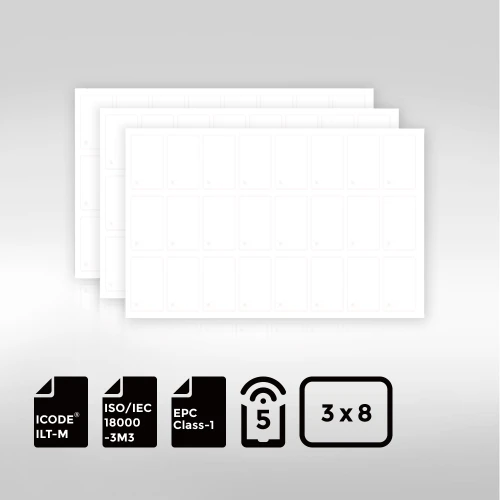
BioPoly™ Vinyl RFID Inlay Sheet NXP® ICODE® ILT-M

The NXP® ICODE® ILT-M BioPoly™ Vinyl RFID Inlay Sheet combines cutting-edge high-frequency RFID performance with a commitment to sustainability. Featuring the advanced ICODE® ILT-M chip and compliant with ISO/IEC 18000-3 Mode 3, it delivers ultra-fast data transfer, high memory capacity, and superior reading distances, making it ideal for applications such as supply chain management, asset tracking, logistics, and industrial automation.
Made from eco-friendly BioPoly™ vinyl, this inlay sheet helps your business reduce its environmental footprint while maintaining exceptional durability and printability. Whether used in custom labels, smart packaging, or intelligent inventory systems, the ILT-M BioPoly™ enables your brand to achieve operational efficiency, environmental responsibility, and a stronger connection with customers—all in one smart solution.