In today’s fast-paced world of global trade, billions of containers move through ports, ships, trucks, and warehouses every year. Managing this enormous flow of goods demands real-time visibility, accuracy, and efficiency — something traditional manual tracking systems can no longer guarantee. That’s where RFID container tracking emerges as a transformative solution. By using radio frequency identification technology, logistics operators can automatically identify, locate, and monitor containers across the global supply chain. This digital transformation not only reduces delays and losses but also unlocks new levels of transparency and intelligence in container logistics.
1. The Need for Smarter Container Tracking
Global logistics has become increasingly complex. A single shipment might pass through multiple ports, third-party carriers, and storage facilities before reaching its final destination. Traditionally, containers were tracked through paper logs, barcode scans, or GPS-based systems. However, these methods rely heavily on manual input or intermittent data collection, often resulting in delays, data inaccuracies, and visibility gaps.
In contrast, RFID container tracking offers a non-contact, automatic solution that continuously records container movement without human intervention. Each container can be fitted with an RFID tag that communicates with readers installed at ports, warehouses, and checkpoints. This constant data stream provides logistics managers with up-to-date information about the exact location and condition of their assets. In an industry where time is money, RFID technology provides the competitive edge global supply chains need.
2. What Is RFID Container Tracking?
To appreciate the transformative impact of this technology, it is essential to understand its core mechanism. RFID stands for Radio Frequency Identification. It is a non-contact, automatic identification technology that uses radio waves to transfer data from a tag to a reader. Unlike barcodes, which require a direct line of sight and manual scanning, RFID systems can identify multiple tagged items automatically and simultaneously. They also work reliably even in harsh environmental conditions.
The system for RFID container tracking is composed of three primary components:
- The RFID Tag: small chips attached to containers or seals. They store unique identification codes and can be passive (no battery) or active (battery-powered for long-range communication).
- The RFID Reader: These are fixed or handheld devices strategically placed at key choke points, such as port gates, gantry cranes, warehouse entry points, or rail crossings. The reader emits radio waves that activate the tag and receive the unique identification data transmitted back.
- The Data Processing System: The captured data—including the container ID, time, and location—is instantly transmitted to a centralized database or a cloud-based logistics platform. This system processes the raw data into actionable information, providing logistics managers with a real-time, digital twin of the container’s physical journey.
The application of RFID to container management is straightforward yet profoundly effective. As a container passes through a port gate, a reader automatically identifies the tag, logging the exact time of entry or exit. This automated process eliminates the need for human intervention, drastically reducing processing times and data errors. This seamless, instantaneous data capture is the foundational advantage that sets RFID container tracking apart from older, more cumbersome methods.
3. Key Benefits of RFID Container Tracking in Global Logistics
The adoption of RFID technology yields multiple, synergistic benefits that directly address the most pressing pain points in global logistics. These advantages span from enhancing transparency to optimizing operational workflows.

3.1 Real-Time Visibility and Traceability
Perhaps the most significant benefit of RFID container tracking is the unprecedented level of visibility it provides. Every time a tagged container passes an RFID reader, its location and status are updated in real-time. This creates a continuous, granular record of the container’s journey from its point of origin to its final destination.
For shippers, this means they can track their high-value cargo with precision, providing accurate estimated times of arrival (ETAs) to their customers. For port authorities, it offers a real-time map of the yard, allowing for dynamic planning of container stacking and movement. This transparency is crucial for security, enabling authorities to immediately flag any container that deviates from its planned route or is stationary for an unusual amount of time. The ability to trace a container’s history with immutable time-stamps is invaluable for accountability and compliance.
3.2 Improved Operational Efficiency
The automation inherent in RFID technology dramatically improves the efficiency of logistics operations. Traditional container processing at ports often involves manual verification of container numbers, which is slow and prone to human error, especially during peak hours or in adverse weather.
With RFID, the process is automated:
- Faster Gate Throughput: Containers can pass through gates without stopping for manual checks, significantly increasing the volume of traffic a port can handle.
- Reduced Documentation Errors: Data is captured electronically and automatically linked to the container’s manifest, eliminating transcription errors that can lead to customs delays or misrouted cargo.
- Optimized Yard Management: Knowing the exact location of every container in a massive storage yard reduces the time and fuel spent searching for specific boxes, improving the efficiency of gantry cranes and yard trucks. This optimization directly translates into faster vessel turnaround times, a critical metric for port competitiveness.
3.3 Data-Driven Decision Making
The continuous stream of high-quality data generated by an RFID system transforms logistics from an art based on experience into a science driven by metrics. In particular, the system collects data points on dwell times, throughput rates, equipment utilization, and flow patterns.
This wealth of data enables:
- Predictive Analytics: By analyzing historical RFID data, logistics operators can build models to predict congestion points, estimate future demand for specific routes, and anticipate potential equipment failures.
- Process Optimization: Managers can identify bottlenecks in the supply chain, such as slow-moving processes at a particular warehouse or port terminal, and implement targeted improvements.
- Resource Allocation: Data on container flow can inform better decisions on staffing levels, equipment deployment, and scheduling, ensuring resources are optimally matched to demand.
4. The Future of Container Logistics: RFID Meets IoT and AI
The current application of RFID is merely the foundation for a far more integrated and intelligent future for container logistics. The next generation of RFID container tracking is emerging through its convergence with the Internet of Things (IoT). Artificial Intelligence (AI) further enhances this evolution.

4.1 Integration with IoT Sensors
The modern RFID tag is evolving into a sophisticated IoT device. Active and semi-passive tags are now commonly equipped with a suite of sensors that monitor the internal conditions of the container, including:
- Temperature and Humidity: Critical for perishable goods (reefer containers) or sensitive electronics. Any deviation from pre-set thresholds can trigger an immediate alert.
- Shock and Vibration: Monitoring for rough handling during transit, which is vital for insurance claims and quality control.
- Door Opening/Closing: Providing a security audit trail, immediately flagging unauthorized access attempts.
This combination of location data from RFID and condition data from IoT sensors provides a complete, contextual picture of the cargo’s well-being. It goes beyond simple tracking and enables comprehensive cargo monitoring.
4.2 Predictive Analytics and AI-Driven Optimization
The massive datasets generated by these integrated RFID/IoT systems are the perfect fuel for Artificial Intelligence and machine learning algorithms. AI can ingest millions of data points on container movements, weather patterns, historical delays, and port congestion to perform advanced predictive analysis.
- Proactive Rerouting: If an AI model predicts a high probability of congestion at a scheduled port of call, it can automatically suggest alternative routes or earlier departure times to maintain the schedule.
- Demand Forecasting: AI can analyze the flow of containers to predict future capacity needs for specific routes or terminals, allowing logistics providers to strategically position resources before the demand materializes.
- Automated Exception Handling: Instead of human operators sifting through thousands of alerts, AI can prioritize critical events, such as a sudden temperature spike in a reefer container, and automatically initiate a pre-defined response protocol.
4.3 The Role of Blockchain
To ensure the integrity and trustworthiness of the vast amount of data generated, blockchain technology is being explored as a secure ledger for container tracking. RFID-captured data such as location, time, and sensor readings can be recorded on an immutable blockchain. This allows all authorized parties—from the manufacturer to the end customer—to access a single, verifiable source of truth. This enhances security, simplifies compliance, and accelerates the resolution of disputes over cargo condition or delivery times.
5. Conclusion
The modern logistics industry stands at the intersection of digitalization and automation. As global trade continues to expand, keeping up with its growing scale and complexity requires greater visibility and data accuracy. These are no longer optional — they are essential. In this context, RFID container tracking provides exactly that: a reliable, automated, and intelligent way to manage containerized cargo worldwide. Moreover, from improving efficiency and security to enabling data-driven decision making, RFID technology is redefining how goods move across continents.
Recommended Product
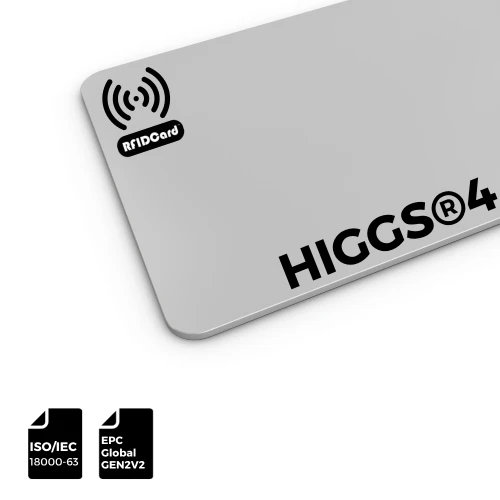
RFID Card EPC Class 1 Gen 2 UHF IC Higgs® 4

Blank or customized printing RFID card with choice of dimensions available. Higgs® 4 conforms to the EPCglobal Class 1 Gen 2 specifications and is one of highest market performing RFID IC.