In today’s fast-evolving retail landscape, technology is redefining how people shop and how businesses operate. Among the most transformative innovations is RFID smart retail, a system that combines Radio Frequency Identification (RFID) technology with data-driven retail intelligence. This approach allows retailers to track products, optimize store operations, and deliver personalized, seamless shopping experiences. As consumers increasingly demand speed, convenience, and accuracy, RFID smart retail has become a cornerstone of modern commerce—bridging the gap between the digital and physical worlds. It is not merely a technological upgrade; it represents a complete reimagination of how retail functions in the era of connectivity and automation.
1. What Is RFID Smart Retail?

At its core, RFID smart retail leverages Radio Frequency Identification (RFID) technology to identify and track items instantly and accurately. Unlike traditional barcode systems, which require a line-of-sight scan for each item, RFID uses radio waves to communicate with small, inexpensive tags attached to merchandise. The system consists of four main components: the tag (containing a microchip and antenna), the reader (which emits radio waves), the antenna (which facilitates communication), and the data system (which processes the collected information).
The “smart” component comes from the integration of this powerful data collection mechanism with advanced retail systems, including data analytics, cloud computing, and the Internet of Things (IoT). This integration allows for real-time applications that were previously impossible. For instance, RFID is the backbone of automatic checkouts, where a customer’s entire basket can be tallied in seconds. It provides instantaneous inventory updates, eliminating the lag inherent in manual counting. Furthermore, it powers innovative customer experiences like smart fitting rooms, which can recognize the items brought in and offer size alternatives or complementary product recommendations on a digital mirror.
2. The Evolution of Retail Technology
The journey of retail technology is a story of continuous pursuit of efficiency. It began with traditional, manual retail processes, where inventory was counted by hand and transactions were laboriously recorded. The first major leap came with the widespread adoption of barcode systems in the 1970s. Barcodes standardized product identification and significantly improved checkout speed and inventory tracking. However, barcodes are inherently limited; they require a clear line-of-sight for scanning, can only identify an item by its product type (not its unique instance), and still rely heavily on manual labor for scanning and stock-taking.
The transition to RFID smart retail represents the next, more profound evolution. RFID overcomes the fundamental limitations of barcodes by enabling non-line-of-sight reading and the simultaneous scanning of hundreds of items. This capability transforms inventory management from a periodic, labor-intensive chore into a continuous, automated process. The post-pandemic shift further accelerated this digital adoption, as retailers scrambled to implement low-touch, high-efficiency solutions to meet safety concerns and handle the surge in omnichannel operations. RFID is now seen not just as an efficiency tool, but as a critical infrastructure component for resilient, modern retail.
3. Enhancing the In-Store Shopping Experience
Perhaps the most visible impact of RFID smart retail is how it transforms the shopping experience inside physical stores.
3.1 Frictionless Checkout
The most celebrated application is frictionless checkout. By simply placing items in a designated area, the embedded RFID tags are read instantly, generating a total bill without the need for an employee to scan each item individually. This drastically reduces waiting times, especially during peak hours, transforming the most common point of customer frustration into a moment of convenience.
3.2 Smart Fitting Rooms
RFID tags allow for the creation of smart fitting rooms. When a customer enters, the RFID reader identifies the items they are carrying. A digital mirror or screen can then display information about the products, suggest alternative sizes or colors available in the store, and even recommend coordinating accessories. This personalized, interactive experience elevates the fitting room from a functional space to a powerful sales tool.
3.3 Real-Time Product Availability
A major pain point for customers is inaccurate stock information. RFID smart retail provides near-perfect real-time product availability. By conducting frequent, automated inventory scans, the system ensures that the stock count visible to the customer—whether on a store app or an in-store kiosk—is highly accurate. This capability is vital for “Buy Online, Pick Up In Store” (BOPIS) models, ensuring a reliable and positive customer fulfillment experience.
4. Improving Retail Operations Behind the Scenes
Beyond improving the customer experience, RFID smart retail revolutionizes how businesses operate behind the scenes.

4.1 Real-Time Inventory Accuracy
Inventory management is the foundation of retail profitability. Traditional inventory methods often result in accuracy rates as low as 65-75%. By contrast, RFID systems can achieve accuracy rates exceeding 98%. This real-time inventory accuracy drastically reduces “ghost inventory” (items recorded as present but missing) and prevents costly out-of-stock (OOS) situations, which are a major driver of lost sales and customer dissatisfaction. Automated cycle counting replaces disruptive manual counts, freeing up staff time for customer-facing activities.
4.2 Supply Chain Efficiency
RFID provides an unprecedented level of visibility throughout the supply chain. Products can be tracked from the moment they leave the factory, through distribution centers, and onto the store shelf. This transparency ensures accountability, helps identify bottlenecks, and is crucial for reducing shrinkage and waste. Furthermore, in the context of high-value or regulated goods, RFID can aid in authenticity verification, combating counterfeiting by providing an unbroken digital trail for every item.
4.3 Data-Driven Insights
The continuous stream of data from RFID readers—detailing product movement, dwell time, and interaction frequency—provides retailers with sophisticated data-driven insights. Retailers can analyze the popularity of display locations, understand which items are frequently paired together, and measure the effectiveness of promotional placements. This granular level of data allows for optimal store layout design, merchandising strategies, and demand forecasting, moving decision-making from guesswork to precision.
5. Real-World Examples of RFID Smart Retail
Several leading global retailers have already demonstrated the power of RFID smart retail in practice.
- Decathlon: The sports retail giant Decathlon has tagged nearly every product with RFID, enabling customers to check out all their items simultaneously. The result: faster transactions, reduced labor, and greater accuracy in inventory counts.
- Uniqlo: The Japanese apparel brand uses RFID smart retail systems to support self-checkout kiosks, where shoppers can complete purchases by simply placing their items in a basket—no scanning required.
These examples illustrate how RFID smart retail delivers measurable improvements in efficiency, customer satisfaction, and brand loyalty.
6. Benefits for Customers and Retailers
The value proposition of RFID smart retail is a powerful, mutually beneficial relationship: a win-win for both the customer and the retailer.
For shoppers, the benefits include:
- Shorter checkout times and reduced waiting.
- Better product information and availability.
- Personalized service and recommendations.
- Greater trust through transparent, real-time updates.
For retailers, RFID brings:
- Improved operational efficiency and labor productivity.
- Enhanced sales through accurate demand forecasting.
- Reduced losses and waste through precise inventory control.
- Stronger customer loyalty through consistent experiences across channels.
7. Conclusion
RFID smart retail has moved beyond being a technological novelty; it is now a critical enabler of modern shopping. By connecting every product, process, and customer interaction, RFID brings unparalleled transparency and efficiency to the retail industry. For shoppers, it means faster service, personalized experiences, and greater convenience. For retailers, it offers precise control over inventory, stronger customer insights, and a pathway to sustainable growth.
Recommended Product
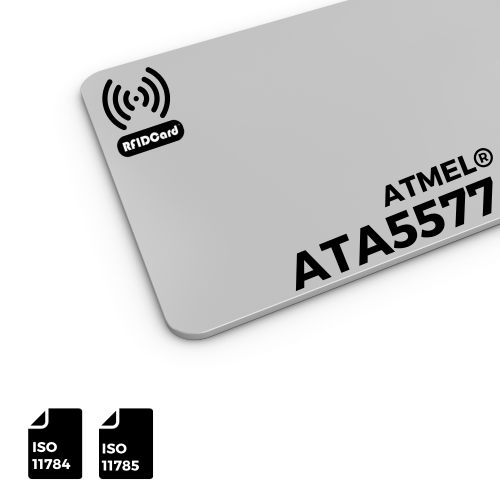
RFID Card Atmel® ATA5577

The ATA5577 RFID cards are made with Photo quality standard PVC sheets in the size of CR80, which are suitable for use with most direct thermal or thermal transfer card printers.. Atmel® ATA5577 is a contactless read/write identification transponder (IDIC®) for applications in the 125kHz frequency band. The total memory on-chip is 363-bit EEPROM (11 blocks with 33 bits each) where 7 × 32 Bits are user memory including 32-bit password memory.