In the era of digital access and contactless systems, RFID (Radio Frequency Identification) cards have become indispensable across multiple sectors — from hotel room keys and office ID badges to transportation passes and warehouse logistics. However, when it comes to manufacturing or importing RFID products into the United States, FCC compliance is not optional. Every device that emits or receives radio waves must meet strict regulatory standards set by the Federal Communications Commission (FCC) to ensure safe and interference-free operation. This article provides a detailed guide on how to ensure your RFID cards fully comply with FCC rules — from understanding the regulations and testing requirements to labeling, documentation, and import procedures.
1. Understanding FCC and Part 15 Regulations
The Federal Communications Commission (FCC) governs all electronic products that emit radio frequency energy in the United States. The key section relevant to RFID technology is Part 15 of the FCC Rules.
Part 15 regulates “unlicensed” radio frequency devices — meaning products that do not require individual user licenses but must still meet strict emission and interference limits. This category includes most RFID systems, Wi-Fi modules, Bluetooth devices, and other short-range communication technologies.
Under Part 15, RFID systems are considered intentional or unintentional radiators depending on their design:
- RFID readers and antennas are intentional radiators because they actively emit radio signals.
- RFID cards or tags are usually passive devices that reflect or modulate a signal, but their operation still falls under FCC oversight when integrated into a system.
Complying with Part 15 means your RFID device must:
- Operate within designated frequency bands.
- Stay below defined power emission limits.
- Not cause harmful interference to other authorized communications.
2. RFID Frequency Bands and Power Limits in the U.S.

RFID technology operates in several distinct frequency ranges. Each band has specific FCC regulations regarding maximum transmission power, bandwidth, and application suitability.
| Frequency Band | Range | Typical Applications | FCC Notes |
| LF (Low Frequency) | 125–134 kHz | Access control, animal ID | Low data rate, short range, minimal interference risk. |
| HF (High Frequency) | 13.56 MHz | Smart cards, NFC, library systems | Widely used for proximity cards; must comply with Part 15.225. |
| UHF (Ultra-High Frequency) | 902–928 MHz | Supply chain, logistics, inventory tracking | Highest range; governed by Part 15.247 for spread-spectrum devices. |
It’s essential to verify that your RFID cards and readers operate strictly within these approved frequencies and under the corresponding power limits. Exceeding emission thresholds can lead to interference complaints or immediate enforcement actions from the FCC.
3. The FCC Testing and Certification Process
Navigating the FCC testing and certification process is a critical step for bringing RFID products to market in the U.S. There are two primary routes to demonstrate compliance, depending on the nature of the device:
3.1 Supplier’s Declaration of Conformity (SDoC)
This route is typically used for devices that are less likely to cause harmful interference. Under SDoC, the responsible party (usually the manufacturer or importer) ensures that the product complies with the applicable technical standards and provides a declaration of conformity. While no FCC approval is required, the responsible party must have test reports and other documentation available to demonstrate compliance if requested.
3.2 FCC Certification with an FCC ID
This is a more rigorous process required for devices that have a higher potential to cause interference. It involves submitting an application to the FCC, which includes test reports from an FCC-recognized accredited testing laboratory, technical descriptions, and photographs of the device. Upon successful review, the FCC issues an FCC ID, which must be affixed to the product.
The step-by-step breakdown of the certification process generally includes:
- Pre-compliance evaluation – internal or preliminary testing to check emission levels.
- Testing in an FCC-accredited lab – measuring radiated and conducted emissions according to the applicable Part 15 standards.
- Filing with a Telecommunication Certification Body (TCB) – submission of test reports, schematics, and photos for review.
- Issuance of an FCC ID – a unique identifier that must be displayed on the product label.
4. Labeling and Documentation Requirements
Once certification is complete, RFID products must carry appropriate labeling and documentation to remain FCC compliant.
4.1 Labeling Rules
All certified or SDoC-compliant RFID devices must bear specific labels. For devices requiring FCC Certification, this includes the FCC ID. The label must be permanently affixed to the device in a conspicuous location. Additionally, a compliance statement, typically indicating that the device complies with Part 15 of the FCC Rules and that its operation is subject to certain conditions (e.g., not causing harmful interference), must be included in the product’s user manual. The exact wording and placement of these labels are detailed in the FCC rules.
4.2 Documentation Retention Requirements
Manufacturers and responsible parties are obligated to maintain comprehensive technical documentation for their RFID products. This includes test reports, design specifications, schematics, and any other information related to the device’s compliance. These technical files must be kept for a minimum of 10 years from the date the product was first marketed or imported into the U.S. This long retention period ensures that the FCC can verify compliance at any point during the product’s lifecycle. Proper documentation is a critical, yet often overlooked, aspect of FCC compliance.
5. Staying FCC-Compliant When Importing RFID Cards to the U.S.
Even if the RFID cards are manufactured overseas, they must meet U.S. standards before entering the American market. U.S. Customs and Border Protection (CBP) may request proof of FCC compliance during inspection, especially for electronic products.

5.1 Tips for Importers and Distributors
Verify FCC certification with the manufacturer before shipment. You can look up the FCC ID in the FCC Equipment Authorization Database.
Keep all documentation (SDoC, test reports, labeling photos) ready for customs review.
Work with trusted suppliers who understand U.S. compliance requirements.
Monitor FCC rule updates, as frequency allocations and testing requirements may change over time.
6. Conclusion
Achieving FCC compliance is not merely a bureaucratic step — it’s a commitment to product quality, reliability, and market integrity. In the competitive RFID industry, companies that demonstrate compliance are more likely to win the confidence of partners, system integrators, and customers in the U.S. market. From design and testing to labeling and importation, every stage of the product lifecycle should integrate FCC requirements as a core part of quality assurance. By doing so, businesses not only meet regulatory expectations but also build a strong reputation for professionalism and safety.
FAQs
Do RFID cards need FCC certification?
Passive RFID cards typically do not require individual certification, but the system (reader + tag) must still comply with Part 15 standards.
What’s the difference between FCC and CE compliance?
FCC compliance applies to the U.S. market, focusing on radio emissions. CE certification applies to the European Union under the RED Directive, covering safety, EMC, and health standards.
What happens if an RFID product fails FCC testing?
It must be redesigned or adjusted to reduce emissions, then retested. Selling non-compliant devices in the U.S. can result in fines and product recalls.
Recommended Product
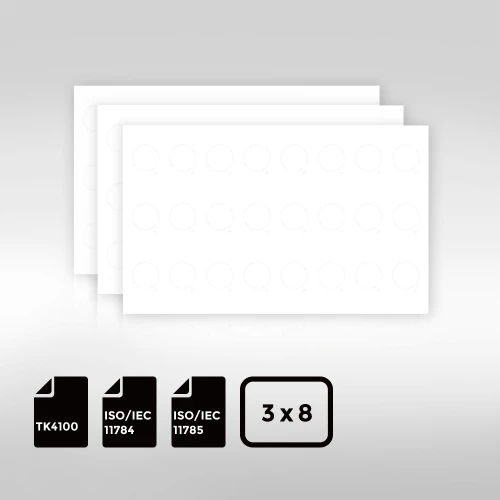
BioPoly™ Vinyl RFID Inlay Sheet TK4100

The TK4100 BioPoly™ Vinyl RFID Inlay Sheet combines eco-friendly BioPoly™ Vinyl material with the reliable TK4100 chip operating at 125 kHz. Featuring a 40-bit unique, read-only ID compliant with ISO/IEC 11784, ISO/IEC11785, it ensures secure identification. Available in customizable sizes and thicknesses, this lightweight, durable inlay is ideal for sustainable RFID applications seeking both performance and environmental responsibility.