
Introduction
In modern access control systems, radio frequency identification (RFID) technology has been widely adopted. From hotel room keys to corporate employee passes, RFID cards have significantly enhanced daily operational efficiency through their convenience. However, a core question remains: Is your RFID card number unique? The answer to this question directly impacts the security level and reliability of your access control system. This article provides a professional analysis of the composition of RFID card numbers, the true meaning of uniqueness, and how selecting the right RFID technology and security measures ensures your assets and personnel receive the highest level of protection in access control and security.
1. RFID Card Numbers: The Dialectic of Uniqueness and “Pseudo-Uniqueness”

What is a UID (Unique Identifier)?
Every RFID card, regardless of its technical standard, contains a numeric string known as a UID (Unique Identifier). This UID is typically burned into the chip during the manufacturing process by the manufacturer and is theoretically globally unique.
UID Generation: For common Mifare Classic cards, the UID is usually a 4-byte (32-bit) or 7-byte (56-bit) number.
UID Function: In access control systems, the reader first reads this UID. The system checks whether this UID is on the authorized list to determine whether to grant access.
Why “Unique” Doesn’t Equate to “Secure”?
Although UIDs are unique at the factory, this does not guarantee absolute security for your access control system. The critical factors are:
UID Publicity: For many low-security cards (e.g., ID cards), UIDs are unencrypted and can be read by anyone using simple devices.
UID replicability: Special chips known as “UID cards” or “CUID cards” exist on the market. These cards allow users to modify their UID to match any original card’s UID exactly.
Passive voice example: Access control systems typically authenticate based on a card’s UID, but this verification method can be easily bypassed by replicable cards.
The true core of uniqueness: Encryption and authentication
For high-security applications like financial payments or premium access control, relying solely on UIDs is insufficient. True security hinges on encrypted storage and mutual authentication.
Encrypted Storage: Internal storage areas (e.g., sectors in Mifare Classic) can be protected by keys. Even if the UID is copied, data within the card remains unreadable or unmodifiable without the correct key.
Mutual Authentication: A complex “handshake” process occurs between the reader and the card. Data exchange is only permitted once both the card and reader have verified each other’s identity (via shared keys).
2. The Core of Access Control: Selection and Comparison of Technical Standards
Selecting the appropriate RFID technology standard is the first step in building a secure access control system. Different frequencies and protocols determine a card’s security level, read range, and cost.
Common RFID Technology Standards Comparison Table
To assist you in making an informed decision, the table below compares three RFID card types most commonly used for access control and their key characteristics:
| Features | ID Card (Low Frequency 125KHz) | Mifare Classic (High Frequency 13.56MHz) | Mifare DESFire (High Frequency 13.56MHz) |
| Card Number Uniqueness | Manufacturer guarantees UID uniqueness | Manufacturer guarantees UID uniqueness | Manufacturer guarantees UID uniqueness |
| Replicability | Extremely easy to replicate (UID open) | Easily Clonable (UID exposed, data area crackable) | Extremely Difficult to Clone (UID protected, data area highly encrypted) |
| Data Storage | No storage or minimal storage | 1KB/4KB, partitionable storage | 4KB/8KB, supports multi-application |
| Encryption Level | No encryption | Weak encryption (Crypto-1) | Advanced encryption (DES/3DES/AES) |
| Typical Applications | Simple access control, attendance systems | Hotel room keys, corporate access control, micro-payments | Transportation cards, e-passports, high-security access control |
| Security Assurance | Lowest: Relies solely on UID | Medium: Relies on key protection | Highest: Relies on hardware and algorithms |
Why are High-Frequency (HF) Cards More Valued?
High-frequency cards (such as the Mifare series) are highly valued in access control due to their data storage and encryption capabilities.
Versatility: A single card can serve multiple applications. For example, the same employee card can be used for access control, cafeteria purchases, and attendance tracking.
Dynamic Security: Data within the card can be dynamically updated. For instance, access permissions can be securely rewritten when user privileges change.
3. The Core of Security Assurance: From Physical Cards to System Management

A secure access control system relies not only on the card itself but constitutes an integrated whole comprising hardware, software, and management processes.
Security Measures at the Hardware Level
Secure Card Readers: Modern card readers are designed to communicate exclusively with authenticated cards. They typically incorporate built-in security modules for storing encryption keys, preventing external access to these keys.
Secure Element (SE): In advanced applications, a secure element chip is embedded within the card or reader to perform cryptographic operations and key management, providing hardware-level protection.
Passive Voice Example: Communication between the reader and card must be protected by predefined encryption protocols to prevent data eavesdropping.
Software and Management Security Measures
“One Card, One Key” Policy: This is one of the most effective methods to prevent bulk card duplication. Each issued card is assigned a unique encryption key instead of using a factory-default universal key.
Real-Time Monitoring and Access Control: Access control system software must include real-time monitoring capabilities to log every card swipe attempt. Cards should be immediately deactivated within the system upon loss or theft.
Key Management: All encryption keys must be securely stored and managed to prevent unauthorized access.
Preventive Measures Against Potential Threats
The table below lists common threats faced by RFID access control systems and corresponding countermeasures:
| Potential Threat (Threat) | Description (Description) | Recommended Prevention Strategy (Prevention Strategy) |
| Card Cloning | Cloning original card numbers using cards capable of modifying UIDs, or replicating data after cracking the data area key. | Adopt advanced encryption cards like DESFire; implement a “one card, one key” strategy. |
| Data Sniffing | Attackers intercept radio signals during card-reader communication to obtain data. | Employ mutual authentication and strong encryption algorithms (e.g., AES) to secure communications. |
| Replay Attacks | Attackers record valid communication signals and replay them later to gain access. | Incorporate timestamps or random numbers (challenge-response mechanism) into communication protocols. |
| Internal Leakage | Insiders or system administrators abuse privileges or disclose keys. | Implement strict hierarchical access control; store keys in hardware security modules. |
Conclusion
Is your RFID card number unique? The answer is: The UID is unique when the chip leaves the factory. However, uniqueness does not equate to security. Access control security is a multi-layered system engineering project. It requires: Selecting the correct “identity credentials”: Abandon low-security cards that are easy to duplicate and transition to cards with advanced encryption and authentication capabilities (such as DESFire).
Implementing strict “security protocols”: Ensure mutual authentication between readers and cards, and adopt strategies like “one card, one key.”
Establish robust “management mechanisms”: Monitor systems in real time and respond swiftly to incidents like card loss or permission changes.
RFIDCard stands ready to be your reliable partner, offering one-stop services from high-quality hardware to professional security consulting. With our expert products and technical support, your access control system will receive the most solid security assurance.
Recommended Product
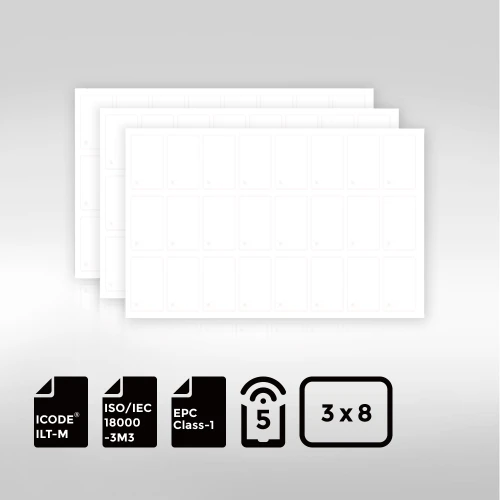
BioPoly™ Vinyl RFID Inlay Sheet NXP® ICODE® ILT-M

The NXP® ICODE® ILT-M BioPoly™ Vinyl RFID Inlay Sheet combines cutting-edge high-frequency RFID performance with a commitment to sustainability. Featuring the advanced ICODE® ILT-M chip and compliant with ISO/IEC 18000-3 Mode 3, it delivers ultra-fast data transfer, high memory capacity, and superior reading distances, making it ideal for applications such as supply chain management, asset tracking, logistics, and industrial automation.
Made from eco-friendly BioPoly™ vinyl, this inlay sheet helps your business reduce its environmental footprint while maintaining exceptional durability and printability. Whether used in custom labels, smart packaging, or intelligent inventory systems, the ILT-M BioPoly™ enables your brand to achieve operational efficiency, environmental responsibility, and a stronger connection with customers—all in one smart solution.