As contactless technologies continue to shape modern interactions—from mobile payments to automated inventory systems—terms like NFC and RFID are often used interchangeably. Yet the two operate in different ways, especially when it comes to communication distance. One of the most common questions businesses and users ask is: Why is NFC range so short compared with RFID range? Understanding this difference is essential when deciding which technology fits a specific application. In this blog, we explore what determines NFC range, how it compares with RFID range, and what these differences mean for real-world use cases.
1. What Is Near Field Communication (NFC)?
Near Field Communication (NFC) is a specialized, short-range wireless communication technology that enables data exchange between devices when they are brought within a few centimeters of each other. Built upon existing RFID protocols, NFC is essentially a subset of High-Frequency (HF) RFID.
NFC operates at a single, globally available frequency: 13.56 MHz. This frequency is part of the HF band and is crucial to understanding its operational constraints. The technology allows for two-way communication, meaning an NFC-enabled device (like a smartphone) can act as both a reader and a tag, facilitating a peer-to-peer exchange of information.
The applications of NFC are focused on secure, user-initiated interactions:
- Mobile Payment: Services like Apple Pay and Google Wallet rely on NFC for secure, tap-to-pay transactions.
- Access Control: Using a phone or card to unlock doors in offices or hotels.
- Consumer Electronics: Quick pairing of Bluetooth devices or transferring small amounts of data, such as digital business cards.
2. What Is Radio Frequency Identification (RFID)?
Radio Frequency Identification (RFID) is a non-contact, automatic identification technology that uses radio waves to transfer data from a tag attached to an object for the purpose of identification and tracking. Unlike NFC, RFID is an umbrella term covering a wide spectrum of frequencies and, consequently, a vast array of operating ranges.

RFID systems are categorized primarily by the radio frequency they use, which directly determines their read range and application suitability:
| RFID Frequency Band | Operating Frequency | Typical Read Range | Primary Applications |
| Low Frequency (LF) | 125–134 kHz | Up to ~10 cm (4 inches) | Animal tracking, car key fobs, access control |
| High Frequency (HF) | 13.56 MHz | Up to ~1 meter (3 feet) | Library book tracking, smart posters, NFC-compatible applications, access control |
| Ultra-High Frequency (UHF) | 860–960 MHz | Up to 10+ meters (30+ feet) | Supply chain management, inventory tracking, toll collection |
3. NFC Range vs. RFID Range: Key Technical Differences
The dramatic difference in operational distance between NFC and the various RFID types stems from three core technical distinctions: frequency, communication mode, and the underlying purpose of the technology.
3.1 Frequency and Wavelength
While NFC is a subset of HF RFID, the broader RFID category encompasses LF and UHF, which operate on entirely different parts of the radio spectrum.
- NFC/HF RFID (13.56 MHz): This lower frequency has a longer wavelength, which is less susceptible to interference from water and human bodies but is inherently limited in its ability to propagate over long distances for power transfer and data communication.
- UHF RFID (860–960 MHz): These higher frequencies have shorter wavelengths, allowing for the use of smaller antennas and enabling the transmission of radio waves over much greater distances. This is the primary reason UHF RFID can achieve a read range of 10 meters or more, a feat impossible for NFC.
3.2 Purpose and Security Needs
The final difference is not technical but philosophical: the intended use case.
- NFC: Designed for intentional, secure, and user-driven interactions. When you tap your phone to pay, you intend to pay. The ultra-short range acts as a physical security layer, ensuring that only the intended device is communicating and that no accidental transactions occur.
- RFID: Designed for quick, hands-off, and automated scanning. In a warehouse, the goal is to scan hundreds of items simultaneously and quickly without human intervention. Long range is a feature, not a bug, enabling efficiency in logistics and inventory management.
4. Why NFC Range Is Intentionally Short

The limited NFC range is perhaps the most misunderstood aspect of the technology. It is not a technological failure but a core feature that underpins its utility in sensitive applications. The 0–4 cm distance is a deliberate design choice for four critical reasons:
4.1 Prevents Accidental Transactions
Imagine walking through a crowded store with a mobile payment app active. If the range were 1 meter, your phone could accidentally trigger a payment at every terminal you passed. The short range ensures that a transaction only occurs when the user physically brings the device into contact with the reader, confirming their intent. This “touch to pay” model is a key part of the user experience and security.
4.2 Ensures User Control and Trust
The need for physical proximity gives the user a sense of control. They know exactly when and where the communication is happening. This physical security layer builds trust in the system, especially for high-value or sensitive operations like financial transactions and unlocking secure areas.
4.3 Physical Security Layer (Proximity = Trust)
In the world of NFC, proximity is a proxy for trust. The system assumes that if two devices are close enough to communicate, the user has authorized the interaction. This simplifies the security protocol compared to long-range systems, which must rely on more complex cryptographic methods to authenticate devices that are far apart.
5. How to Choose Between NFC and RFID
Choosing the right technology is a matter of aligning the application’s needs with the technology’s inherent capabilities, particularly its operational range.
Choose NFC when:
- Security and Intentionality are paramount: The application involves financial transactions, sensitive data exchange, or personal identification.
- Short-range interaction is desired: The user is expected to physically interact with the reader (e.g., tapping a phone to a poster).
- Small data payloads are sufficient: NFC is optimized for quick, small data transfers.
Choose RFID (specifically UHF) when:
- Long-distance reading is required: The application involves tracking assets over large areas (e.g., logistics, warehousing).
- Bulk reading is necessary: The need is to read many tags simultaneously and quickly.
- Hands-off automation is the goal: The system needs to identify items without human intervention (e.g., tolling, automated checkpoints).
Factors beyond range, such as tag cost, hardware complexity, environmental resilience, and data requirements, also play a role, but the fundamental decision often comes down to whether the application requires the security of a short NFC range or the efficiency of a long RFID range.
6. Conclusion
Although NFC and RFID are related technologies, their communication distances—and therefore their use cases—are fundamentally different. NFC range is intentionally limited to just a few centimeters to ensure security, user control, and reliability. RFID, on the other hand, offers flexible ranges depending on frequency, enabling everything from short-range access cards to long-distance inventory tracking. Understanding these differences helps businesses choose the right tool for the right task. Whether you need secure tap-to-pay interactions or efficient long-range asset tracking, selecting between NFC and RFID starts with a clear understanding of your range requirements.
FAQs
1. Why can UHF RFID read from meters away but NFC cannot?
UHF RFID can read from meters away because it uses radio waves that travel long distances and has larger antennas to catch these signals. NFC, on the other hand, uses magnetic fields that only work when the device and tag are very close—usually just a few centimeters. This short range is also safer, making sure actions like payments or access only happen when you intentionally tap your device.
2. Can NFC Range Be Extended?
No, NFC range cannot be significantly extended. NFC works using magnetic fields, which only work when the device and tag are very close—usually within a few centimeters. Even with stronger antennas or special designs, the distance stays very short. This is intentional: a short NFC range keeps interactions secure and controlled, like when you tap to pay or unlock a door.
Recommended Product
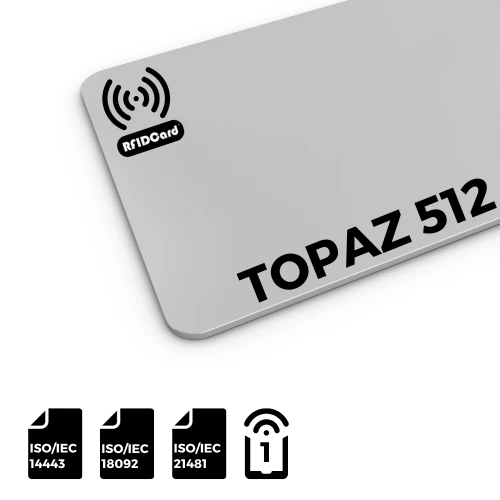
NFC Card Topaz512 | NFC Tag Type 1

The Topaz512 IC fully comply to NFC Forum Type 1 Tag and ISO/IEC 14443A specifications., the Topaz512 NFC card is uniquely identified by a 7 bytes UID with 454 bytes of user memory.