As the global gaming industry rapidly transforms, the concept of a smart casino is moving from a futuristic idea to an operational reality. Today, casinos worldwide are adopting smart technologies that enhance security, improve efficiency, and elevate the gaming experience. Among these innovations, RFID playing cards have emerged as one of the most influential technologies shaping modern table games. They are no longer optional upgrades but essential components in the evolution of smart casino operations. From anti-cheating protection to real-time data analytics, RFID-enabled cards are redefining how casinos manage risk, optimize tables, and maintain fairness. This article explores the key smart casino trends and why RFID playing cards sit at the center of these advancements.
1. The Evolution of Smart Casino Technology
The journey toward the modern smart casino began decades ago with simple security measures. Early technological integrations focused on surveillance cameras to monitor the floor and digital chips to track wagers and payouts. However, the true revolution has been the integration of sophisticated, AI-driven analytics. While slot machines and electronic games were relatively easy to digitize and connect to a central system, the chaotic, human-centric nature of live table games—such as Blackjack, Baccarat, and Poker—presented a significant challenge.
For years, table games remained a technological blind spot. Data collection was manual, slow, and prone to human error, relying on pit bosses and supervisors to record game outcomes and player actions. This lack of real-time, granular data meant that casinos were operating a significant portion of their business with limited visibility. The introduction of RFID technology has finally bridged this gap, providing the necessary innovation to bring table games fully into the digital age and complete the vision of a truly intelligent gaming floor.
2. Why Casinos Are Upgrading to Smart Systems

The push for casinos to upgrade their infrastructure to a smart casino model is driven by a confluence of powerful economic and operational factors:
2.1 Increasing Security and Anti-Cheating Requirements
The stakes in high-roller games are immense, and the methods used by sophisticated cheaters are constantly evolving. Traditional security measures are often reactive. Smart systems, particularly those utilizing RFID, offer a proactive, real-time defense against card switching, colluding, and other forms of fraud, protecting the casino’s bottom line and reputation.
2.2 Labor Shortages and Demand for Automation
The gaming industry, like many others, faces persistent challenges in recruiting and retaining skilled staff, especially dealers and pit supervisors. Automation is no longer a luxury but a strategic imperative. Smart tables and RFID systems automate the tedious, error-prone tasks of tracking hands, calculating payouts, and logging data, allowing human staff to focus on customer service and security.
2.3 Data-Driven Decision-Making
In the highly competitive casino environment, every percentage point of efficiency matters. Smart systems provide the granular data needed for true revenue optimization. This includes understanding the profitability of individual tables, the optimal game mix, and the most efficient table opening and closing times. This level of insight is impossible to achieve with manual tracking.
2.4 Integrated Digital Experience Expected by Modern Players
Today’s casino patrons, especially younger demographics, expect a seamless, integrated digital experience in every aspect of their lives. A smart casino offers this by linking player loyalty programs directly to table play, enabling faster, more accurate comps, and providing a modern, transparent gaming environment that enhances player satisfaction.
3. The Role of RFID Playing Cards in Smart Casinos
RFID playing cards are the linchpin of the smart table game ecosystem. Each card is embedded with a tiny, passive RFID chip that contains a unique digital identifier corresponding to the card’s rank and suit. When a card is dealt or placed on the table, it passes over an antenna embedded in the felt or the dealing shoe. This antenna emits a radio frequency signal that energizes the passive chip, causing it to transmit its unique ID back to the reader. This data is instantly captured, logged, and sent to the casino’s backend management system. This process is instantaneous and invisible to the player, ensuring the flow of the game is not interrupted.
Traditional cards are anonymous, requiring human verification for every action. RFID cards, conversely, are traceable from the moment they are introduced to the game until they are retired. This provides an unprecedented level of security and data integrity. Furthermore, RFID cards are designed for durability and a longer lifespan, as the chip is securely embedded and protected from wear and tear. Their seamless integration with smart tables, antennas, and backend systems creates a closed-loop data environment that is both highly secure and incredibly efficient.
4. Key Trends Driving RFID Playing Card Adoption

The widespread adoption of RFID playing cards is being fueled by five critical trends that are reshaping the table game landscape:
4.1 Advanced Anti-Cheating Technology
The most immediate and compelling benefit of RFID is its superior security. The system enables real-time card tracking, allowing the casino to know the exact location of every card at all times. This makes card switching, palming, and other forms of cheating virtually impossible. If a card is introduced that the system does not recognize, or if a card is detected in an unauthorized location, an immediate alert is triggered. The tamper-proof nature of the card identification ensures that the integrity of the deck is maintained throughout the game.
4.2 Real-Time Game Data & Analytics
For the first time, casinos can capture live card distribution monitoring data with 100% accuracy. This data feeds directly into sophisticated analytics platforms, providing deep insights into player behavior. Casinos can now identify subtle patterns in betting, game pace, and player interaction that were previously invisible. Furthermore, the system allows for precise dealer performance tracking, identifying dealers who are consistently slow, prone to errors, or potentially colluding, thereby ensuring operational excellence.
4.3 Automated Table Game Management
RFID cards enable a high degree of automation, streamlining operations and reducing the potential for human error. The system facilitates automatic game recording, logging every hand, every bet, and every outcome without manual input. This leads to faster dispute resolution, as supervisors can instantly review the digital record of a hand rather than relying on subjective human accounts or grainy video footage. By automating data entry and calculation, the system significantly reduces dealer mistakes and ensures accurate payouts.
4.4 Enhanced Player Trust & Casino Transparency
In an industry where trust is paramount, RFID technology offers tangible proof of fair-play assurance. Players can be confident that the cards are legitimate and that the game is being conducted according to the rules, as the system is constantly verifying the deck’s integrity. This improved customer experience and the resulting higher credibility for regulated casinos are invaluable assets in attracting and retaining a loyal customer base.
4.5 Integration with AI and Smart Table Ecosystems
The data generated by RFID cards is the fuel for the next generation of casino management. This data enables predictive analytics, allowing the casino to forecast demand, player churn, and potential security risks. It facilitates dynamic table optimization, where the system can recommend changes to minimum bets, game types, or table staffing in real-time based on current floor conditions. Finally, the system provides automatic reporting for compliance, simplifying the complex regulatory requirements faced by modern casinos.
5. What Casinos Should Look For When Choosing RFID Playing Cards
For casinos ready to make the transition, selecting the right RFID playing card supplier is a critical decision. Several key factors must be considered to ensure a successful and future-proof implementation:
- Chip Quality: The embedded chip must be of the highest quality, ensuring consistent and reliable data transmission.
- Read Range Accuracy: The system must be able to accurately read the card’s ID regardless of its precise position on the table or in the shoe. High read range accuracy is essential for maintaining the speed and flow of the game.
- Compatibility with Table Systems: The cards must be fully compatible with the casino’s existing or planned smart table hardware, antennas, and backend management software.
- Durability and Printing Quality: The physical card must withstand the rigorous environment of a casino floor. High durability ensures a longer service life, while superior printing quality maintains the aesthetic appeal and prevents the cards from being visually distinguishable to players.
6. Conclusion
The smart casino movement is accelerating rapidly, reshaping the way table games are played, monitored, and managed. RFID playing cards are at the heart of this transformation, enabling casinos to improve security, optimize operations, gain real-time insights, and build trust with players. As more casinos embrace digital systems and AI-driven analytics, RFID cards will continue to lead the future of modern gaming floors. Ready to bring your gaming floor into the smart casino era? Contact us to get high-quality RFID playing cards designed for maximum durability, accuracy, and security.
FAQs
1. How long do RFID playing cards last?
RFID playing cards are made with durable materials and sealed chips designed to withstand frequent handling. Their lifespan typically exceeds that of standard cards, especially when used with automated shufflers and maintained properly.
2. Are RFID playing cards compatible with all smart table systems?
Most RFID playing cards are compatible with the majority of smart table platforms, but casinos should confirm chip type, frequency, and system requirements with supplier.
Recommended Product
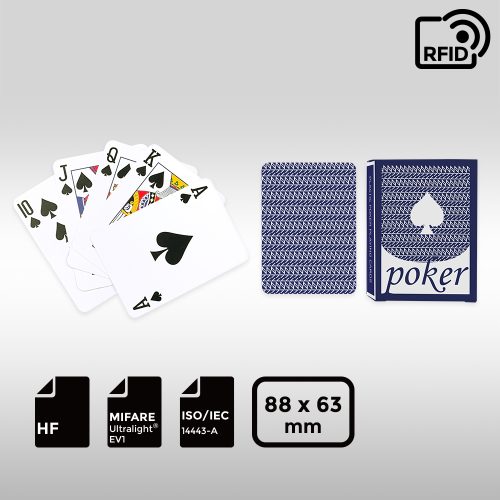
MIFARE Ultralight® EV1 PVC RFID Playing Cards

RFID playing cards are special cards based on regular playing cards, with additional RFID chips embedded. This type of playing card is suitable for scenarios with higher quality and requirements, such as casinos, magic shows, or collectors who enjoy collecting special playing cards.