

In today’s connected world, RFID cards have become indispensable. They open hotel doors, enable seamless access to offices, serve as ski passes, manage transportation systems, and even support contactless payments. Yet behind their convenience lies a growing environmental concern. Billions of plastic RFID cards are produced each year, many of which end up in landfills after only a few years of use. To address this challenge, governments and industries are turning to stronger environmental standards. Among them, the WEEE Directive stands out as a cornerstone of the European Union’s circular economy strategy. Designed to minimize electronic waste and promote responsible recycling, the WEEE Directive also has implications for the RFID industry.
1. Understanding the WEEE Directive and Its Relevance to RFID
The WEEE Directive (2012/19/EU) aims to reduce the environmental impact of electronic waste by promoting collection, recycling, and recovery of electronic equipment. It applies to a wide range of products—from household appliances to IT equipment—and includes any device that depends on electric currents or electromagnetic fields to function. Although small and lightweight, RFID cards fall within this scope because they contain electronic components such as chips and antennas. Under the WEEE Directive, manufacturers, importers, and distributors are responsible for ensuring that these products are properly labeled, collected, and recycled at the end of their life cycle.
Every compliant RFID card sold within the EU must carry the crossed-out wheeled bin symbol, indicating that it cannot be discarded with regular waste. Producers must also register in national WEEE databases, report the number of units placed on the market, and contribute to recycling schemes that recover materials safely and efficiently. By aligning with the WEEE Directive, RFIDCard demonstrate not only legal compliance but also a commitment to sustainability and corporate responsibility.
2. Sustainable Materials and Eco-Friendly Innovations

To meet environmental and WEEE Directive goals, RFID card manufacturers are exploring eco-friendly materials and innovative production methods:
- ABS (Acrylonitrile Butadiene Styrene): Known for its toughness and stability, ABS provides excellent mechanical strength and is less harmful during production and disposal compared to PVC.
- Recycled PET: Made from post-consumer waste such as water bottles, helping reduce overall plastic use.
- Paper-based and wood-based RFID cards: These options minimize plastic content and can integrate thin chip layers without compromising performance.
3. Aligning RFID Card Production with WEEE and Circular Economy Principles
Sustainability is not only about materials—it’s about rethinking the entire production and disposal process. By following WEEE Directive principles, RFID manufacturers can embed environmental responsibility at every stage:
- Design for Disassembly: Simplifying card construction to allow easier separation of electronic components.
- Reduced Hazardous Substances: Avoiding harmful materials that complicate recycling or pose environmental risks.
- Producer Responsibility Programs: Implementing collection and take-back systems for expired or replaced cards.
- Eco-Design Practices: Creating cards that use fewer resources, generate less waste, and support reuse or recycling.
These practices align closely with the circular economy model, where products and materials are kept in use for as long as possible. For RFID cards, this means turning linear production (make–use–discard) into a closed-loop system (make–use–recycle–remake).
4. The Business Value of Going Green
While compliance with the WEEE directive is a non-negotiable legal requirement for market access in the EU, the move towards sustainable RFID cards offers substantial business value that extends far beyond regulatory adherence. Sustainability has evolved from a niche concern to a core competitive advantage.

4.1 Enhanced Brand Image and Market Access
In an era of heightened environmental awareness, consumers and corporate clients alike are increasingly scrutinizing the sustainability credentials of their suppliers. Companies that proactively offer eco-friendly, WEEE-compliant RFID solutions can significantly enhance their brand image, positioning themselves as industry leaders in corporate social responsibility (CSR). This is particularly true when dealing with EU partners, who often require proof of WEEE compliance as a standard part of their procurement process. Meeting this demand opens up lucrative European markets and strengthens global partnerships.
4.2 Alignment with ESG Goals
Environmental, Social, and Governance (ESG) criteria are now central to investment decisions and corporate reporting. By adopting sustainable materials and implementing closed-loop recycling, RFID manufacturers and users can directly contribute to their environmental ESG metrics, attracting socially responsible investors and improving their overall corporate valuation.
4.3 Long-Term Cost Reduction
While the initial cost of new, sustainable materials might be higher, the long-term financial benefits are compelling. Effective eco-design reduces the complexity and cost of end-of-life management, which is a direct financial liability under EPR schemes. Furthermore, securing a supply of recycled materials through take-back programs can stabilize raw material costs and reduce exposure to volatile commodity markets. The efficiency gains from streamlined, sustainable production processes ultimately translate into a more resilient and profitable business model.
5. Conclusion
The journey toward sustainable RFID cards is a collective effort—one that bridges technology, responsibility, and innovation. By aligning with the WEEE Directive, manufacturers can ensure that their products contribute to a cleaner, safer, and more circular economy. From adopting recyclable materials to designing take-back systems and reducing waste, every step brings the RFID industry closer to true sustainability. Ready to make your RFID systems more sustainable? Contact us to learn more about our eco-friendly RFID card solutions designed in full compliance with the WEEE Directive and European environmental standards.
FAQs
1. Are eco-friendly RFID cards as durable as traditional ones?
Yes—many sustainable materials such as PET and ABS provide equal or even superior durability compared to PVC. Wooden RFID cards are also highly robust when properly sealed or laminated.
2. How can companies ensure their RFID cards are WEEE-compliant?
Companies can achieve compliance by registering their products under national WEEE systems, marking each card with the crossed-out wheeled bin symbol, and participating in approved collection and recycling programs.
Recommended Product
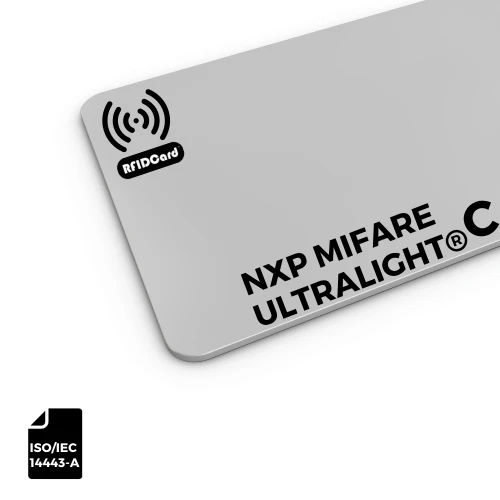
RFID Card NXP MIFARE Ultralight® C ISO14443-A CR80

The NXP MIFARE Ultralight® C blank RFID cards fully comply with ISO/IEC 14443-A. The RFID cards are made with photo-quality standard PVC/PET in the size of CR80, which are suitable for use with most direct thermal or thermal transfer card printers.