In the age of ubiquitous connectivity and automated systems, Radio Frequency Identification (RFID) technology has become an invisible, yet indispensable, part of our daily lives. From tracking inventory in sprawling warehouses to enabling contactless payments, RFID chips facilitate seamless interaction between the physical and digital worlds. However, a critical question often arises for businesses and enthusiasts alike: what is the true capability of an RFID chip range? Understanding the maximum distance at which an RFID system can reliably operate is not just a technical detail; it is the foundation upon which successful RFID deployment is built.
1. What Is RFID Chip Range?
At its core, the RFID chip range is defined as the maximum physical distance between an RFID reader (or interrogator) and an RFID tag (or transponder) at which successful, consistent communication can be established and maintained. This communication involves the reader powering the tag (in the case of passive RFID) and then receiving the data stored on the tag’s microchip.
It is crucial to understand that the range is not solely a function of the chip itself. Instead, it is a property of the entire RFID system. This system includes:
- The RFID Chip/Tag: The microchip stores the data, and the tag’s antenna captures energy and transmits the response.
- The Reader/Interrogator: The device that emits the radio frequency energy and receives the tag’s response.
- The Environment: Physical surroundings, including materials, interference, and obstacles, all play a significant role.
Therefore, optimizing the RFID chip range requires a holistic approach, considering every component and the context of its deployment.
2. The Science Behind RFID Range

RFID technology operates on the principles of electromagnetic fields and radio waves. When a reader is activated, its antenna generates an electromagnetic field. This field is essentially a form of radio wave. When a passive RFID tag enters this field, the tag’s antenna captures the energy, which is then rectified and used to power the microchip. Once powered, the chip modulates the field—a process known as backscatter—to transmit its unique identifier and other data back to the reader.
The range is fundamentally determined by two physical phenomena:
- Power Transfer: For passive tags, the distance is limited by the strength of the electromagnetic field required to sufficiently power the tag’s microchip. The power available to the tag decreases exponentially with distance from the reader.
- Signal Reflection (Backscatter): The reader must be able to detect the minuscule amount of energy reflected back by the tag. This return signal weakens significantly over distance, and the reader’s sensitivity to this faint signal sets the ultimate limit on the read range.
3. Types of RFID and Their Typical Ranges
RFID systems are classified by frequency, which significantly affects their performance and range. Below is an overview:
| Frequency Band | RFID Type | Typical Range | Common Uses | Key Characteristics |
| LF (Low Frequency) | 125–134 kHz | < 10 cm (Short) | Animal identification, car immobilizers, access control. | Excellent penetration of non-metallic materials, highly resistant to interference, but very short range and slow data transfer. |
| HF (High Frequency) | 13.56 MHz | < 30 cm (Near-Field) | Access cards, contactless payment (NFC), library books, ticketing. | Global standard, moderate data rates, and relatively stable performance near liquids and metals compared to UHF. |
| UHF (Ultra-High Frequency) | 860–960 MHz | 1–12 m (Long) | Logistics, inventory management, asset tracking, supply chain. | Longest passive read range, fast data transfer, but highly sensitive to environmental factors like metal and water. |
The differences in RFID chip range between these types are significant. For instance, UHF RFID chips are the workhorse of modern supply chains, enabling a reader to scan hundreds of items on a pallet from several meters away, a capability essential for warehouse systems requiring several meters of read distance. In contrast, Low-Frequency (LF) tags, while offering robust performance when placed directly on metal or submerged in water, are limited to a few centimeters, making them suitable only for close-proximity applications like microchipping pets.
4. Key Factors That Affect RFID Chip Range
The RFID chip range is not fixed — it varies depending on multiple design and environmental factors. Let’s look at the main ones:
4.1 Frequency Band
As established, the frequency band is the primary determinant of the potential range. UHF offers the longest range for passive systems, while LF and HF are limited to near-field communication. The choice of frequency must align with the required read distance and the operating environment.
4.2 Tag Type (Passive, Semi-Passive, Active)
- Passive Tags: Rely entirely on the reader’s energy field for power. Their range is limited by the power transfer mechanism, typically up to 12 meters for high-performance UHF tags.
- Semi-Passive (or Battery-Assisted Passive – BAP) Tags: Contain a small battery to power the microchip, but still use the reader’s field to initiate communication and backscatter the data. This battery power allows the chip to operate with a much weaker incoming signal, significantly extending the read range and improving reliability, often reaching 30 meters or more.
- Active Tags: Contain a battery to power both the chip and a transmitter, allowing them to broadcast their signal independently. Their range can exceed 100 meters, making them ideal for large-scale asset tracking and RTLS applications.
4.3 Antenna Design and Configuration
Both the reader and tag antennas are critical.
- Reader Antenna: The size, gain, and polarization of the reader antenna determine the shape and reach of the interrogation zone. High-gain antennas focus the energy into a narrower beam, increasing range in a specific direction.
- Tag Antenna: The design and orientation of both tag and reader antennas affect signal strength. Directional, high-gain antennas focus energy efficiently, while circularly polarized antennas allow flexible tag orientation. Mismatched or poorly aligned antennas can dramatically reduce range.
4.4 Environment and Materials
RFID signals are affected by obstacles such as metal surfaces, water, and other electronic devices. Metallic environments cause reflection and detuning, while water absorbs RF energy. Testing tags in real-world conditions is the only reliable way to determine true RFID chip range.
4.5 Chip Sensitivity
Modern RFID chips, such as NXP’s UCODE 8 or Impinj Monza R6-P, are engineered with high sensitivity and low power requirements. Improved chip design allows tags to be read from farther away using the same reader power — a major factor driving the evolution of RFID chip range in recent years.
5. Conclusion
The RFID chip range is not a one-size-fits-all metric. It varies widely based on frequency, environment, and system design. Understanding how these factors interact helps you choose the right RFID technology for your application — whether you need a few centimeters for secure access or several meters for automated logistics. By selecting suitable frequencies, optimizing antennas, and leveraging modern high-sensitivity chips, businesses can achieve reliable and efficient RFID performance. As technology evolves, we can expect even more extended and stable ranges that will further expand the possibilities of wireless identification and smart automation.
Recommended Product
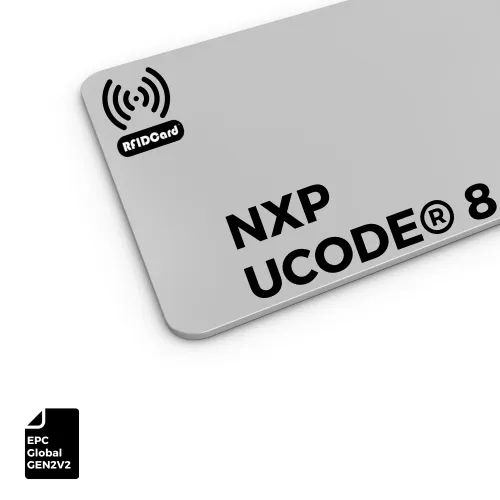
UHF RFID Card NXP UCODE® 8

The UHF RFID cards are made with Photo quality standard PVC sheets in the size of CR80, suitable for use with most direct thermal or thermal transfer card printers. UCODE® 8 optimized for serializing items for Retail management, Supply chain management and shipping service, etc.