In modern life, smart cards have become inseparable from our daily routines — from access cards and transportation cards to bank cards and ID cards. One of the key technologies powering these cards is Radio Frequency Identification (RFID). RFID enables contactless data communication through radio waves, greatly enhancing both convenience and security in our lives. However, while we effortlessly tap a card to open a door or make a payment, few people stop to think about how this small piece of plastic transforms from raw material into a sophisticated “intelligent identity.” This article takes you behind the scenes of RFID card production, revealing the intricate and precise process that turns design concepts into high-quality finished products.
1. The Art of Precision Printing and Color
The manufacturing of an RFID card begins with printing, the first step in giving the card its visual identity and branding. A card’s appearance directly influences its professionalism and user experience.

1.1 The Combination of Silk-Screen and Offset Printing
In the production line, two main printing techniques are used: silk-screen printing and Heidelberg 5-color offset printing.
| Printing Method | Function and Characteristics |
| Heidelberg 5-color offset printing | Ideal for producing high-resolution images and smooth gradients with an additional fifth color unit for spot colors, metallic effects, or protective coatings, ensuring precise, consistent, and vibrant results. |
| Silk-screen printing | Ideal for printing text, lines, large color blocks, and special effects such as metallic tones, matte finishes, or UV varnish. It creates a thicker ink layer, resulting in richer and more vivid colors. |
By combining these two techniques, the card achieves a refined, vibrant appearance and a strong foundation for later customization.
1.2 Surface Finishing for Durability
Following the printing stage, the card surface undergoes anti-scratch and anti-abrasion treatments. This protective layer is vital, as it ensures that the printed graphics and information remain intact despite frequent, daily use, such as being carried in a wallet or repeatedly swiped/tapped. This focus on durability is a hallmark of high-quality card manufacturing, directly contributing to the card’s long service life.
2. The Core Integration — Embedding the Antenna and Chip
The printed material is merely the “shell.” To become a true RFID card, it must be implanted with its “brain” (chip) and “nervous system” (antenna). This stage represents the most technologically intensive part of the manufacturing process.
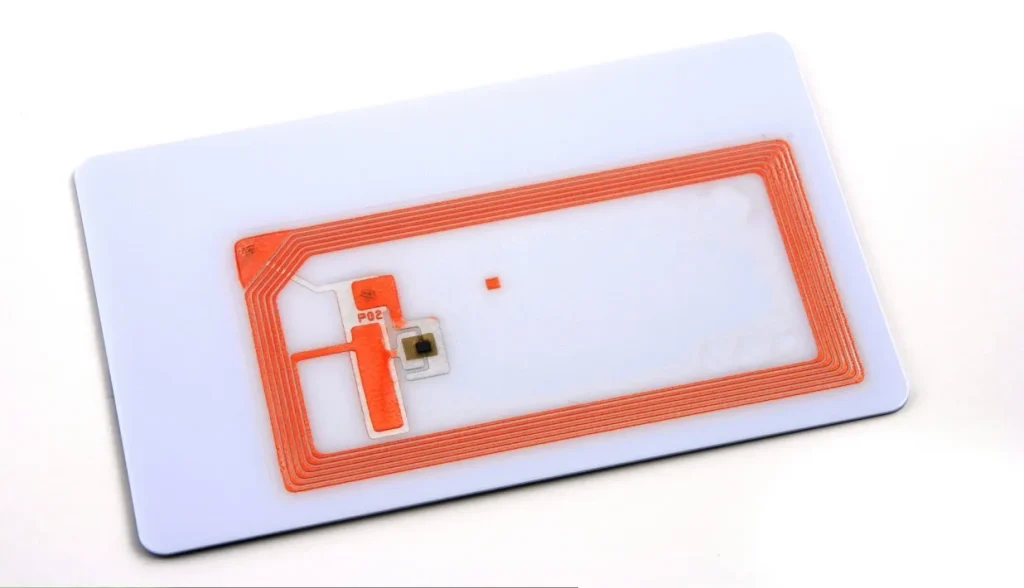
The RFID card’s antenna is typically formed either by winding fine copper wire or by an etching process on a substrate material like PET or PVC. The antenna’s function is twofold: to capture the radio frequency signal emitted by the reader and to harvest the necessary energy to power the chip. The precision of the antenna’s geometry is paramount, as it directly determines the card’s reading distance and operational stability. Any imperfection can lead to a significant drop in performance.
The chip, usually a tiny integrated circuit module, is precisely connected to the antenna. This process, known as Inlay Assembly, requires highly automated and specialized equipment to ensure a reliable and robust connection. In non-contact cards, the chip and antenna are encapsulated together to form the “Inlay,” which is the functional core of the RFID device.
3. Lamination and Curing
After the core components are implanted, the card undergoes Lamination. This is the process of permanently bonding multiple layers of material—the printed layers, the Inlay layer, and the protective overlays—into a single, cohesive unit.
3.1 Fusion Under High Heat and Pressure
The lamination process is conducted under controlled conditions of high temperature and pressure. This fuses all the materials tightly together, creating a sturdy and durable card substrate. This step is critical not only for protecting the internal chip and antenna but also for giving the card its standard thickness and rigidity. The quality of lamination is a direct determinant of the card’s flatness and longevity, and it is the key defense against delamination (the separation of layers) over time.
3.2 Strict Quality Control in Lamination
Precise control over temperature and pressure is essential during lamination. Even minor deviations can lead to internal defects such as air bubbles or material stress, which can compromise the card’s performance and lifespan. Modern production lines utilize sophisticated parameter control systems to ensure every batch meets consistently high standards, a testament to the manufacturing precision required in RFIDCard.
4. Fine Cutting and Personalization
After lamination, the material exists as a large sheet that must be die-cut and customized before becoming finished cards ready for delivery.
4.1 High-Speed Die Cutting
Die-cutting trims the laminated sheets into standard ISO/IEC 7810 ID-1 size (85.60 mm × 53.98 mm) cards. Automated machinery can achieve cutting speeds of up to 20,000 cards per hour, showcasing the efficiency of industrial-scale production.
4.2 Rich Personalization Options
Personalization gives each card its unique identity. Common techniques include:
| Customization Technique | Effect Description | Application Scenario |
| Laser Engraving | Permanently etches text or numbers into the surface — clear and tamper-resistant. | Serial numbers, expiry dates, personal ID details |
| Flat Printing | Inkjet or thermal transfer printed text or numbers. | Batch numbers, general serial codes |
| Embossed Printing | Creates raised characters, commonly used on bank cards. | Bank card numbers, membership cards |
| Gold/Silver Foiling | Adds metallic shine for premium visual appeal. | VIP cards, gift cards, brand logos |
| UV Effects | Adds selective gloss for visual contrast and highlights. | Emphasizing logos or key design areas |
These customization methods enhance both the aesthetic appeal and functional versatility of RFID cards, meeting diverse industry requirements for security and branding.
5. Rigorous Testing and Packaging
The production journey of an RFID card doesn’t end after cutting — quality testing serves as the final and most critical checkpoint to ensure reliability.

5.1 100% Functional Testing
Every finished card must pass strict tests to verify that its internal chip and antenna function flawlessly. Testing includes:
- RF performance test: Ensures accurate reading within standard distance.
- Data integrity test: Verifies that data stored in the chip is error-free.
- Physical durability test: Assesses resistance to bending, twisting, and impact.
Only cards that pass all these checks are certified as qualified products — a reflection of the manufacturer’s commitment to excellence.
5.2 Custom Packaging for Clients
Approved cards are packaged according to client requirements. Packaging serves not only to protect the cards during shipping but also as an extension of brand presentation. Whether bulk-stacked or individually wrapped, every detail reflects our professionalism and attention to customer needs.
6. Conclusion
A single RFID card represents a remarkable convergence of optics, electronics, materials science, and precision manufacturing. From Heidelberg 5-color offset printing to chip embedding, high-speed die-cutting, and meticulous testing, every step embodies the relentless pursuit of accuracy, efficiency, and reliability that defines the RFID card manufacturing process.
FAQs
1. What is the fundamental difference between an RFID card and a traditional magnetic stripe card?
The fundamental difference between an RFID card and a magnetic stripe card lies in their data communication and technology structure.
A magnetic stripe card stores data on a magnetic strip that must be physically swiped through a reader to transfer information. The communication is contact-based, and the data is relatively easy to copy or wear out over time. In contrast, an RFID card uses radio frequency identification technology to enable contactless communication. It contains an embedded chip and antenna that transmit data wirelessly when near a reader. RFID cards are faster, more durable, and more secure, offering greater resistance to physical wear and data tampering.
2. What does “personalization” in RFID cards include?
Personalization is the process of adding unique information and visual effects to an RFID card according to customer requirements. It includes:
- Data personalization: Writing unique information such as serial numbers, user IDs, or access credentials into the chip.
- Visual personalization: Applying techniques such as laser engraving, flat printing, or embossing to add text or numbers; as well as gold/silver foiling and UV effects to enhance the card’s appearance and brand value.
Recommended Product
Hotel Key Card

Our ColorEdge™ card is designed to deliver a premium experience beyond traditional white PVC cards. Made with advanced ColorEdge™ material, it provides reliable room access while enhancing the visual appeal with a refined, stylish finish. Combining functionality, durability, and elegant design, this card helps hotels create a more memorable guest experience while reflecting a modern and sophisticated brand image.