
In a world where NFC technology is becoming essential for marketing, access control, product authentication, and smart experiences, choosing the right NFC chip is crucial. It ensures reliable performance and user-friendly interaction. Among the many NFC chip options available today, NTAG 216 stands out as one of the most capable and versatile. It is especially suitable for applications that require larger data storage. As businesses move toward digital business cards, interactive product labels, IoT configuration tags, and immersive customer engagement tools, the need for high-memory NFC chips is growing quickly. NTAG 216 meets this demand with an excellent balance of capacity, compatibility, and performance. This makes it one of the most popular choices for professional-grade NFC deployments.
1. Overview of the NTAG 216 Specification
NXP Semiconductors manufactures the NTAG 216 as a premium NFC chip designed for applications that require maximum memory and strong performance. Understanding its basic specifications is crucial to appreciating its utility:
| Specification | Detail | Significance |
| User Memory | 888 bytes | The largest capacity in the NTAG21x series, enabling complex data storage. |
| NFC Type | NFC Forum Type 2 Tag | Ensures broad compatibility with all NFC-enabled devices and readers. |
| Operating Frequency | 13.56 MHz | Standard high-frequency (HF) band for NFC, guaranteeing global interoperability. |
| Compatibility | Universal | Works with virtually all modern smartphones (Android and iOS) and NFC readers. |
2. The Key Advantage: High User Memory
Many NFC beginners overlook memory size, but it significantly influences usability, user experience, and the overall flexibility of an NFC project.
2.1 How Much Data Can 888 Bytes Store?
To put the 888-byte capacity of the NTAG 216 into perspective, consider the following data types that can be stored directly on the chip:
- Extended URLs with Tracking Parameters (UTM Tags): A simple URL is often insufficient for sophisticated marketing campaigns. Marketers need to embed detailed tracking information (e.g., source, medium, campaign, content) directly into the URL. A fully-loaded URL with extensive UTM parameters can easily exceed 200 bytes. The NTAG 216 provides ample room for these long, data-rich links, ensuring granular campaign analytics.
- Digital Business Card Information: A standard digital business card format includes name, phone, and email. A rich digital business card, however, includes multiple phone numbers, physical addresses, company details, job title, social media links, a short biography, and even a company logo URL. This complex data structure can easily consume 500-700 bytes, making the NTAG 216 the viable choice for a truly comprehensive digital business card experience.
- Offline Configuration Files: In environments with limited or no connectivity, the tag can store critical configuration data for a device or sensor, allowing for quick, local setup and troubleshooting without needing to connect to a server.
2.2 Why Memory Size Matters for the User Experience
The significance of high memory capacity extends beyond mere data storage; it fundamentally impacts the user experience and the reliability of the application:
- Enhanced Offline Functionality: The ability to store more data directly on the tag means the application is less reliant on external server lookups. If a user scans a tag in an area with poor connectivity, the tag can still deliver a rich, meaningful payload (like a full vCard or detailed product information) instantly, without a network connection. This is critical for improving reliability and user satisfaction.
- Superior User Experience (UX): When a tag can store a complete data set, the response time is near-instantaneous. There is no delay while the phone resolves a short URL, connects to a server, and then loads the final content. This immediate feedback loop creates a smoother, more professional user experience, particularly in high-traffic or time-sensitive scenarios.
- Critical for Interactive Marketing Campaigns: In marketing, every millisecond counts. By storing the full, long URL with all tracking parameters, the tag ensures that the user is directed to the correct, fully-tracked destination immediately, maximizing the effectiveness and measurability of the campaign.
3. Common Use Cases That Benefit from NTAG 216’s Capacity
The expanded memory of the NTAG 216 makes it the preferred choice for several high-value applications where data richness is paramount.

3.1 Smart Business Cards: The Ultimate Digital Handshake
The digital business card is one of the most popular applications for NFC. While smaller chips can store a basic contact record, the NTAG 216 allows for the creation of the ultimate digital handshake.
- Complex vCard Fields: Store not just a name and number, but also multiple office and mobile numbers, a detailed company address, a headshot URL, a short professional bio, and links to LinkedIn, Twitter, and a personal website.
- Integrated Tracking: The tag can store a URL that first redirects through a tracking service before landing on the user’s digital profile, allowing the card owner to track how many times their card has been scanned and where.
- Multi-Language Support: For international professionals, the tag can store multiple versions of the vCard in different languages, allowing the reading application to select the most appropriate one based on the user’s device settings.
3.2 Advanced NFC Marketing Campaigns
For marketing professionals, the NTAG 216 is a game-changer, moving beyond simple “tap to visit website” functionality.
- Long URLs with Granular Campaign Tracking: As mentioned, the ability to embed long, complex URLs with detailed UTM tags is essential for accurate campaign attribution. This capacity ensures that every tap is correctly logged and analyzed.
- Storing Promo Text or Coupon Codes: Instead of linking to a coupon page, the tag can store the actual, unique coupon code or a short promotional message directly. This allows for instant redemption at a point-of-sale system, even if the network is down, or for a unique, one-time-use code to be stored and delivered instantly.
- A/B Testing and Dynamic Content: The extra memory can be used to store a small JSON payload that dictates which version of a landing page (A or B) the user should be directed to, or to store a set of rules for dynamic content delivery.
4. Security and Data Protection Features
Beyond its impressive memory, the NTAG 216 incorporates essential security and data protection features that are crucial for commercial deployment:
- Password Protection (PWP): The chip can be protected with a 32-bit password, preventing unauthorized users from reading or rewriting the tag content. This is vital for protecting sensitive configuration data or ensuring the integrity of marketing campaigns.
- Read/Write Lock Features: The memory can be permanently or temporarily locked. A permanent lock is often applied after the initial data is written (e.g., a final URL), ensuring the data can never be altered. Temporary locks can be used in scenarios where the data needs to be updated periodically by an authorized party.
- Originality Signature: Like all NTAG chips, the NTAG 216 includes a unique 32-bit signature generated by NXP, which can be used by applications to verify the authenticity of the chip, helping to prevent cloning and counterfeiting.
5. Universal Compatibility Advantages
A powerful chip is useless if it cannot be read by the devices in the hands of consumers. The NTAG 216 excels in this area, adhering strictly to the NFC Forum Type 2 Tag specification.
- Broad Smartphone Support: It works flawlessly with all modern NFC-enabled devices, including the latest Android phones and iPhones. This universal compatibility is essential for consumer-facing deployments, ensuring a high success rate for user interaction.
- No Special Hardware Required: Unlike proprietary solutions, the NTAG 216 requires no special reading hardware; any standard NFC reader or smartphone can interact with it. This makes deployment simple, scalable, and cost-effective.
6. Conclusion
NTAG 216 continues to rank among the most versatile, reliable, and high-capacity NFC chips available today. Its 888-byte memory gives it enough capacity to support rich digital content and detailed product information. It can also store full vCard business profiles, structured data formats, and modern marketing content. All of this is possible without affecting compatibility or user experience. If your project requires more than just the basics, NTAG 216 is the best NFC chip to choose. We offer premium NTAG 216 cards made with reliable materials. Each card is fully tested for performance and can be customized with your branding. Contact us today to get a quote.
Recommended Product
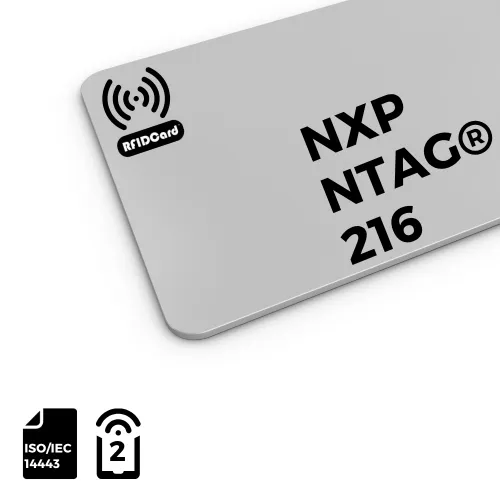
NFC Card NXP NTAG® 216 NFC Type 2

The NTAG® 216 RFID card is made with Photo quality standard PVC sheets into size of CR80, it programmed 7-byte UID with 888 bytes of user memory available (222 pages). The NTAG® 216 NFC ICs fully comply to NFC Forum Type 2 Tag and ISO/IEC14443 Type A specifications.