Introduction
In today’s rapidly evolving business landscape, operational efficiency, data accuracy, and asset security are regarded as critical success factors. As global supply chains grow increasingly complex and digital transformation deepens, traditional management models face significant challenges. Against this backdrop, the adoption of Radio Frequency Identification (RFID) technology has become a key strategy for enterprises to enhance competitiveness and ensure operational fluidity.
RFID technology is not merely an efficiency-enhancing tool; it is increasingly recognized as a vital component within an enterprise’s digital perimeter security framework. By tightly linking physical assets with digital identities, RFID and security systems deliver unprecedented visibility and control.
1. RFID Technology: The Cornerstone for Reshaping Operational Workflows

Traditional asset identification and tracking methods, such as barcodes, increasingly reveal their limitations when applied to large-scale, high-turnover commercial scenarios. The advent of RFID technology has fundamentally transformed this landscape.
Say Goodbye to Traditional Headaches: How RFID Reshapes Operational Workflows
The core advantage of RFID lies in its contactless identification capability. A complete RFID system comprises tags, readers, and antennas. Tags contain embedded microchips and antennas that store data and receive radio frequency signals from readers. When a tag enters the reader’s magnetic field range, its information is automatically and rapidly retrieved.
This technical feature ensures real-time data collection and exceptional accuracy. In inventory management, tasks that once required hours of manual counting can now be completed in seconds, significantly reducing human error and providing businesses with instant, accurate inventory visibility.
Application Scenarios Expand Widely:
Retail and Inventory Management: Major brand retailers and distributors (e.g., Walmart, Costco) attach RFID tags to every item, enabling end-to-end tracking from warehouse to shelf. Improved inventory accuracy effectively reduces the risk of stockouts and overstocking, directly boosting sales and customer satisfaction. RFID tags enable rapid, precise identification and counting of tens of thousands of items—an advantage unmatched by traditional barcode scanning.
Hotels and Access Control Systems: Hotel key cards and access cards streamline guest check-in while providing secure access management. These cards typically employ high-frequency (HF) or ultra-high-frequency (UHF) technology, ensuring stable and secure data transmission. Customized hotel key cards can incorporate brand designs to enhance the guest experience.
Apparel Brands and Supply Chains: International fashion brands (such as Uniqlo, Zara, Nike, Adidas, etc.) utilize customized RFID tags for item-level supply chain tracking and anti-counterfeiting. From raw material procurement to finished goods shipment and retail sales, every movement is precisely recorded. This effectively combats counterfeiting while providing brands with valuable consumer behavior data.
Public Transportation and Payments: Subway operators employ RFID cards or key fobs for payments and access control, significantly improving passenger flow efficiency. This contactless payment method not only speeds up transactions but also reduces the complexity of cash handling.
| Feature | Traditional Barcode | Radio Frequency Identification | Key Advantage |
| Identification Method | Requires line-of-sight,single read | Non-contact, bulk reading possible | Bulk Efficiency |
| Reading Speed | Slow | Fast, bulk inventory in seconds | Operational Acceleration |
| Data Capacity | Low, limited characters | High, more data storage | Information Richness |
| Environmental Requirement | Requires clean, flat surface | Resistant to dirt/damage, penetrates non-metal | Adaptability |
| Security | Easy to duplicate | Encryptable, higher security | Data Protection |
2. The Digital Boundaries of Enterprises: The Security Protection Role of RFID

While enhancing operational efficiency, RFID technology also plays a crucial role in enterprise security protection. A company’s digital perimeter extends beyond cyberspace to encompass the management of physical assets and access privileges.
The Invisible Guardian: Core Value of RFID in Enterprise Security
RFID systems serve as the “invisible guardian” that integrates physical security with information security.
Access Control and Permission Management: Access cards, RFID cards, and RFID wristbands are used to precisely regulate personnel entry into designated zones. By uniquely encoding and authenticating each tag, only authorized individuals or items gain passage, effectively blocking unauthorized access. In highly sensitive areas like data centers or R&D laboratories, RFID access systems serve as an indispensable first line of defense.
Deepening Supply Chain Anti-Counterfeiting and Traceability: For high-value goods or strictly regulated products like apparel, pharmaceuticals, or electronic components, customized RFID tags deliver robust anti-counterfeiting capabilities. The tags’ unique IDs and encryption make cloning difficult. Product authenticity can be traced and verified at every stage from factory to end consumer. This safeguards brand reputation while protecting consumer rights.
Asset Protection and Real-Time Monitoring: In factories and data centers, RFID tags track and inventory IT equipment, tools, and critical documents. This not only streamlines asset management but also crucially provides real-time monitoring to prevent loss or theft. For instance, the system triggers immediate alerts when tagged assets pass through unauthorized exits.
Data Management and Addressing Security Challenges: The Necessity of Proactive Defense
While RFID technology offers significant convenience, its wireless communication nature introduces specific security challenges that must be professionally addressed to ensure data integrity and privacy. Key potential risks include tag cloning, data eavesdropping, and unauthorized reading.
Proactive defense strategies are implemented:
Encryption and Authentication: Data transmitted between tags and readers is encrypted using Advanced Encryption Standard (AES) or equivalent protocols. Simultaneously, strict mutual authentication between readers and tags verifies the legitimacy of communication parties, effectively preventing eavesdropping or forgery.
Physical Security Design: To mitigate unauthorized reading risks, shielding technologies or tags with “sleep” functions can be employed. For instance, RFID wristbands may incorporate metal shielding layers that permit reading only at specific angles or upon contact with the reader, thereby safeguarding personal privacy.
Customized Security Protocols: Tailored RFID tags can be designed for specific application scenarios, integrating proprietary security protocols. For example, RFID cards in financial payment systems must comply with stringent EMV standards to ensure transaction security and non-repudiation.
| Security Challenge | Potential Risk | Countermeasure |
| Tag Cloning | Counterfeit products enter the market, and systems face unauthorized access. | Implement encrypted chips with unique serial numbers to prevent data replication. |
| Eavesdropping | Sensitive information (e.g., inventory, personal identification) being intercepted. | Implement Advanced Encryption Standard (AES) for data transmission encryption and authentication. |
| Unauthorized Reading | Privacy breaches, such as personal tracking. | Employ shielding technology or access passwords to restrict reading range. |
| Denial of Service (DoS) | Interference disrupting RFID system operations, causing service interruptions. | Optimize reader protocols and implement anti-interference design to ensure system stability. |
Conclusion
RFID technology is no longer a future trend but an essential component of modern business operations. By delivering unparalleled efficiency, accuracy, and security, it helps enterprises safeguard their digital boundaries and maintain a competitive edge in the marketplace.
We understand the critical importance of quality and reliability for our global clients. If you’re seeking to enhance inventory management efficiency, strengthen access control security, or require any customized RFID solutions, don’t hesitate—contact RFIDCard today.
Recommended Product
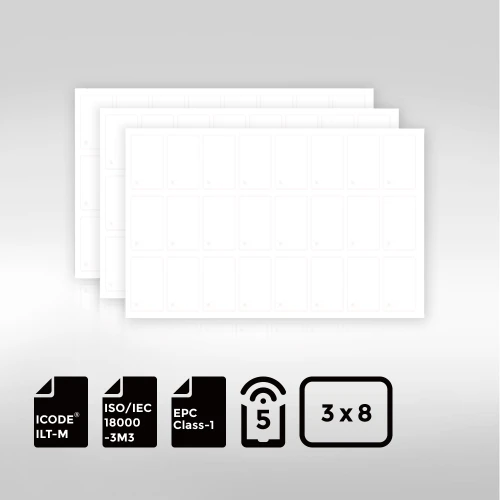
BioPoly™ Vinyl RFID Inlay Sheet NXP® ICODE® ILT-M

The NXP® ICODE® ILT-M BioPoly™ Vinyl RFID Inlay Sheet combines cutting-edge high-frequency RFID performance with a commitment to sustainability. Featuring the advanced ICODE® ILT-M chip and compliant with ISO/IEC 18000-3 Mode 3, it delivers ultra-fast data transfer, high memory capacity, and superior reading distances, making it ideal for applications such as supply chain management, asset tracking, logistics, and industrial automation.
Made from eco-friendly BioPoly™ vinyl, this inlay sheet helps your business reduce its environmental footprint while maintaining exceptional durability and printability. Whether used in custom labels, smart packaging, or intelligent inventory systems, the ILT-M BioPoly™ enables your brand to achieve operational efficiency, environmental responsibility, and a stronger connection with customers—all in one smart solution.