Introduction
In today’s rapidly evolving digital world, radio frequency identification (RFID) technology has become a critical tool for enhancing efficiency and optimizing management across diverse industries. From retail inventory management to supply chain tracking, access control systems, and asset monitoring, RFID applications are ubiquitous. Among various RFID technologies, ultra-high frequency (UHF) RFID stands out for its exceptional performance. However, to fully unlock the potential of UHF RFID, Electronic Product Code (EPC) tags play an indispensable core role. This article will delve into UHF RFID technology and its close connection with Tag RFID EPC, explaining why EPC tags are the core technology of UHF RFID and how they jointly drive progress in modern commerce.
1. What is an Electronic Product Code (EPC)?

The Electronic Product Code (EPC) is a globally unified coding standard developed and managed by the GS1 organization. It aims to provide a unique digital identity for every physical item within the supply chain. It can be understood as an item’s “digital fingerprint,” offering finer identification granularity than traditional barcodes. EPC is not RFID technology itself, but rather a specific data format stored on RFID tags. This enables RFID systems to identify and distinguish each individual item, thereby achieving true “item-level” management.
A typical EPC usually contains the following key information, which collectively forms a globally unique identifier, ensuring uniqueness and traceability:
EPC Manager: This is a unique code assigned by GS1 to a company or organization, identifying the entity to which the EPC code is allocated and ensuring global uniqueness. Similar to a company’s registered ID, it serves as the “company prefix” within the EPC system, guaranteeing coding independence between different enterprises and preventing code conflicts. This information forms the foundation of the EPC, guaranteeing global coding uniqueness. It provides the basis for collaborative global supply chain operations, enabling partners across countries and regions to seamlessly exchange and understand item information, thereby facilitating international trade. For example, Walmart requires all its global suppliers to use the EPC Manager to identify their products, ensuring unified management of the global supply chain.
Object Class: This code identifies an item’s type, similar to the traditional product code (GTIN) in barcodes, but with greater flexibility to accommodate broader product classifications. It defines product categories such as “men’s shirts” or “specific electronic models,” enabling systems to categorize and manage different product types. This facilitates data statistics and analysis, providing deeper insights into product structures and sales trends. This facilitates more granular inventory classification and sales analysis for businesses, optimizing product portfolios and market strategies to enhance competitiveness. For instance, object classes enable rapid identification of best-selling versus slow-moving items, allowing timely adjustments to production and sales strategies based on market demand.
Serial Number: This is the most critical component of the EPC, providing a unique identifier for each item within the same object class. This means that even two identical products can be uniquely distinguished by EPC if their serial numbers differ. This has revolutionary implications for achieving granular management and tracking. For instance, it enables the identification of every item produced in the same batch, facilitating precise recalls or anti-counterfeiting measures. The introduction of serial numbers gives each individual item a unique “identity card,” significantly enhancing traceability and providing a solid foundation for product lifecycle management. For instance, apparel brands like Uniqlo, Zara, Nike, and Adidas can use EPC to track each garment’s production, transportation, and sales journey. This enables more precise inventory management and anti-counterfeiting measures, effectively combating fake products and safeguarding brand reputation. In healthcare, serial numbers can trace every vaccine dose or drug batch, ensuring clear accountability for their origin and destination.
The introduction of EPC grants every product, every package, and even every individual item a globally unique identity, revolutionizing precision management and tracking. It empowers businesses with unprecedented capabilities to trace items throughout their entire lifecycle from production to sale, thereby enhancing supply chain transparency and efficiency. Through EPC, companies can upgrade from “batch management” to “item-level management”—a significant advancement across many industries. This provides a richer, more accurate foundation for data analysis and business decisions, helping organizations better understand and optimize their operations for lean management. This level of precision management is also crucial for enhancing customer satisfaction and brand loyalty. Particularly in product recalls and after-sales service, EPC provides reliable data support, enabling businesses to respond swiftly and resolve issues, thereby safeguarding corporate reputation and consumer trust.
2. Synergy Between EPC and UHF RFID: The Core Element

Achieving item-level unique identification: UHF RFID readers enable long-range, bulk reading of EPC tags, quickly capturing the unique EPC information for each item. This means businesses can accurately identify and track every single item within the supply chain, rather than merely product batches. For instance, retailers can pinpoint the exact location and status of every shirt in their warehouse, rather than just knowing the total quantity—a capability critical for precise inventory management and loss reduction. This level of granular management far surpasses traditional barcodes, providing unprecedented inventory visibility. It optimizes inventory turnover, reduces stockpiling, and significantly boosts operational efficiency. For large distributors and retailers, this translates to lower inventory costs and higher sales, enhancing market competitiveness and profitability. This item-level precision enables businesses to better control inventory, minimize waste, and elevate customer service quality, ultimately boosting overall operational efficiency.
Ensuring Global Standardization and Interoperability: The EPC standard, maintained by the GS1 organization, guarantees global interoperability of RFID data. This ensures that an item’s EPC information can be recognized and understood by RFID systems worldwide, regardless of where it is produced, transported, or sold. This global uniformity significantly simplifies international trade and logistics management, facilitates data exchange between diverse systems and enterprises, and lays the foundation for seamless global supply chain operations. Businesses no longer need to worry about data format incompatibilities across countries or regions, thereby reducing the complexity of international collaboration and enhancing the efficiency and transparency of global supply chains.
Seamless Data Integration and Automation: Through EPC, RFID systems can easily integrate with backend systems such as Enterprise Resource Planning (ERP), Warehouse Management Systems (WMS), and Manufacturing Execution Systems (MES). When an item is identified by a UHF RFID reader, its EPC information can be instantly uploaded to databases, automatically updating inventory status, tracking logistics routes, monitoring production progress, and even triggering automated replenishment or shipping processes. This significantly reduces manual intervention and data entry errors, enhances data accuracy and operational efficiency, and enables true “data-driven” management. Consequently, it optimizes entire business processes and boosts corporate competitiveness. This automation capability is pivotal for achieving Industry 4.0 and smart manufacturing, delivering substantial competitive advantages and higher productivity. It empowers enterprises to respond more flexibly to market shifts and swiftly address customer demands, thereby maximizing production efficiency.
Significantly Enhanced Supply Chain Visibility and Transparency: By combining UHF RFID’s long-range reading capability with EPC’s unique identification, enterprises gain unprecedented supply chain visibility. From raw material procurement to manufacturing, through warehousing and distribution to final sales, every stage of an item’s journey can be monitored and traced in real time. This end-to-end visibility empowers businesses to swiftly adapt to market shifts, optimize inventory levels, reduce theft and losses, and enhance customer satisfaction—ultimately boosting market competitiveness. For instance, the food industry can precisely trace product origins and distribution paths, ensuring food safety, meeting consumer transparency demands, and building brand trust. This strengthens corporate social responsibility and enhances market reputation. For any enterprise requiring precise tracking and management of goods—such as pharmaceutical companies or high-tech manufacturers—this visibility is indispensable. It also serves as a critical means of meeting regulatory requirements, helping businesses build a strong reputation and market position, thereby enhancing overall corporate value.
Enhanced Anti-Counterfeiting and Traceability Capabilities: The uniqueness of EPCs makes product anti-counterfeiting and traceability more reliable. Consumers or businesses can scan EPC tags to verify product authenticity and trace its complete production and distribution history—particularly vital for food safety, pharmaceutical regulation, and luxury goods anti-counterfeiting. This provides robust technical support for brand protection and consumer trust, effectively combating counterfeit goods, maintaining market order, safeguarding consumer rights, and ultimately elevating brand value and credibility.
3. Widespread Application Cases of UHF RFID and EPC Tags

Retail Industry: For renowned hotel chains, distributors, and retailers such as Walmart and Costco, as well as apparel brands utilizing RFID tags like Uniqlo, Zara, Nike, and Adidas, UHF EPC tags serve as a powerful tool for achieving precise inventory management and enhancing the shopping experience. By attaching UHF EPC tags to each item, retailers can conduct real-time inventory counts in stores, raising inventory accuracy to over 95% and significantly reducing stockouts and overstock. This not only optimizes inventory turnover but also minimizes sales losses caused by inaccurate inventory. Simultaneously, UHF RFID technology accelerates checkout processes, elevates customer shopping experiences, and supports omnichannel retail models like “Buy Online, Pickup In-Store” (BOPIS), “Click & Collect,” and “In-Store Returns,” catering to modern consumers’ diverse shopping needs.
Logistics and Supply Chain Management: In large warehouses and distribution centers, UHF RFID systems rapidly identify pallets, cartons, and individual packages during goods movement, automatically recording item details. This substantially boosts efficiency in receiving, shipping, sorting, and cross-docking operations while reducing human errors and operational costs. For instance, a pallet containing hundreds of items can be fully scanned within seconds, dramatically accelerating goods turnover, increasing logistics throughput, and ensuring smooth supply chain operations. This enhances the responsiveness and reliability of the entire logistics network. This is crucial for distributors and logistics companies managing large volumes of goods efficiently, significantly reducing operational costs and improving customer satisfaction. Its value is particularly pronounced in global supply chains, facilitating worldwide cargo tracking and management. RFID enables real-time monitoring of shipments, allowing timely detection and resolution of transport anomalies to ensure on-time delivery.
Manufacturing: In complex manufacturing processes like automotive and electronics, UHF EPC tags track semi-finished goods and component production progress, monitor quality control points to ensure compliance with standards, and provide complete production traceability. This optimizes production workflows, reduces scrap rates, enables lean manufacturing, and enhances product quality and efficiency. For instance, on automotive assembly lines, each component can be precisely tracked to ensure correct installation, thereby enhancing final product reliability and meeting stringent industry standards.
Asset Management: Enterprises can affix UHF EPC tags to fixed assets (such as IT equipment, tools, medical devices, and document archives). Regular or real-time inventory checks via RFID readers enable precise asset location, efficient management, and theft prevention. This is particularly crucial for large enterprises, hospitals, and data centers, effectively preventing asset loss, improving utilization rates, simplifying audit processes, and ensuring asset security and compliance. For example, in hospitals, medical equipment can be quickly located, improving equipment utilization and maintenance efficiency. This saves valuable time and resources while ensuring the availability of critical equipment, delivering significant economic benefits and management convenience to the enterprise. RFID enables real-time monitoring of high-value assets, preventing theft or unauthorized movement and enhancing asset security.
Healthcare: UHF RFID tags can be used to track medical devices, pharmaceuticals, blood samples, and patient wristbands, ensuring the correct medications and treatment protocols are administered to the right patients. This enhances medical safety and efficiency. Simultaneously, it streamlines inventory management and maintenance of medical assets, reduces human error, and improves the quality of patient care, delivering safer and more efficient healthcare services. For instance, RFID wristbands enable rapid and accurate patient identification, preventing medication errors and safeguarding patient lives. They also optimize internal hospital workflow management, elevating overall healthcare service standards to improve institutional operational efficiency and patient satisfaction. RFID further facilitates surgical instrument management, ensuring complete sterilization and usage records to enhance surgical safety.
Airline Baggage Tracking: The global aviation industry is actively deploying UHF RFID technology to track passenger luggage, reducing lost or misrouted bags, improving passenger satisfaction, and optimizing airport operational efficiency. The International Air Transport Association (IATA) has promoted RFID adoption among member airlines for baggage tracking, aiming for global implementation within the coming years. This will significantly enhance the air travel experience, reduce delays and complaints caused by baggage issues, thereby elevating airline service quality and brand image.
Access Control & Security: UHF RFID cards and tags enable efficient, secure access systems for rapid identification and management of personnel and vehicle movement. For instance, in large corporate campuses, parking facilities, or event venues, UHF RFID facilitates long-range automatic identification, boosting access efficiency and security while recording detailed entry/exit data for security management and incident tracing. This is particularly critical for high-security, high-traffic areas like major event entrances and sensitive zones.
Public Transportation: Public transit systems like subway companies can utilize RFID cards or key fobs for payment and access. UHF RFID technology enables fast, convenient card-swiping experiences, improving passenger throughput and reducing queue times. It can also be applied to vehicle management and scheduling, optimizing operational efficiency.
Conclusion
In summary, RFID EPC tags are undoubtedly the core of UHF RFID technology. UHF RFID delivers robust physical identification capabilities, enabling long-range, rapid, and bulk reading, while EPC tags assign a globally unique digital identity to each item and provide a standardized data structure. The combination of the two empowers enterprises to achieve unprecedented precision in item tracking, management efficiency, and supply chain visibility. This is not merely a technological superposition but a revolutionary transformation for modern business operations, fundamentally enhancing the efficiency and accuracy of data management.
For enterprises seeking to maintain competitiveness in the digital era, investing in UHF RFID and EPC tag solutions represents a critical step toward boosting operational efficiency, reducing costs, and optimizing customer experiences. Whether optimizing inventory management, boosting logistics efficiency, achieving precise asset location, or enhancing product traceability and anti-counterfeiting capabilities, UHF EPC RFID delivers robust support. Contact RFIDCard today to explore customized services and unlock the limitless potential of RFID technology, propelling your business forward. We look forward to partnering with you to pioneer new frontiers in RFID applications, providing solid technical support for your growth, and embracing the intelligent future together.
Recommended Product
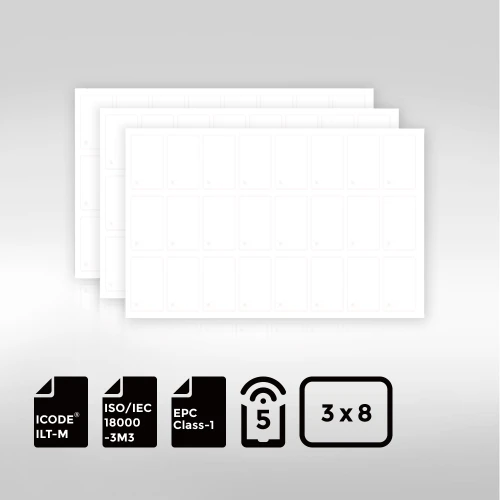
BioPoly™ Vinyl RFID Inlay Sheet NXP® ICODE® ILT-M

The NXP® ICODE® ILT-M BioPoly™ Vinyl RFID Inlay Sheet combines cutting-edge high-frequency RFID performance with a commitment to sustainability. Featuring the advanced ICODE® ILT-M chip and compliant with ISO/IEC 18000-3 Mode 3, it delivers ultra-fast data transfer, high memory capacity, and superior reading distances, making it ideal for applications such as supply chain management, asset tracking, logistics, and industrial automation.
Made from eco-friendly BioPoly™ vinyl, this inlay sheet helps your business reduce its environmental footprint while maintaining exceptional durability and printability. Whether used in custom labels, smart packaging, or intelligent inventory systems, the ILT-M BioPoly™ enables your brand to achieve operational efficiency, environmental responsibility, and a stronger connection with customers—all in one smart solution.