Introduction
In today’s rapidly evolving digital age, the evolution of payment methods shows no signs of stopping. From cash transactions to card payments, and now to “tap-and-go” payments, each technological innovation aims to enhance efficiency and security. Among these, the application of Radio Frequency Identification (RFID) technology in the credit card sector is spearheading a payment revolution. This article will delve into how credit cards RFID function, their significant advantages in speed and security, and compare them with traditional payment methods to provide valuable insights for your business decisions.
1. Core Principles of RFID Technology

RFID is a contactless automatic identification technology that uses radio frequency signals to automatically identify target objects and retrieve relevant data. It enables seamless data reading and transmission without physical contact, facilitating a smooth payment process. The core components of an RFID system include:
RFID Tag: In credit cards, this typically manifests as an embedded microchip and antenna. These tags store unique identification information and respond when receiving radio frequency signals.
RFID Reader: A device that transmits radio frequency signals and receives tag responses. In payment scenarios, it corresponds to the induction area on common POS terminals.
Backend System: Responsible for processing data collected by the reader, performing verification, authorization, and recording transactions.
When an RFID-enabled credit card is brought near the reader, the reader emits electromagnetic waves to energize the passive RFID tag within the card. Once activated, the tag transmits encrypted transaction data back to the reader via its built-in antenna as radio waves. This data is then sent to the banking system for rapid verification and authorization, typically completing within seconds. It is worth noting that the RFID technology used in credit cards is often closely integrated with Near Field Communication (NFC) technology. NFC, a subset of RFID technology, is specifically designed for short-range, high-security communication, ensuring the accuracy and safety of payments.
2. Speed: A Significant Enhancement to the Payment Experience
The application of RFID technology in credit cards has significantly enhanced payment speed and convenience, which is crucial for modern business environments that prioritize efficiency.
Instant Transactions, No More Waiting
Traditional credit card payments require inserting the card, waiting for chip recognition, and entering a PIN or signature—a time-consuming process. RFID credit cards streamline this procedure. Users simply tap or wave their card over the reader, and the transaction completes instantly. For small payments, no PIN is even required, further reducing transaction time. This “tap-and-go” experience makes payments as natural and seamless as breathing, significantly cutting customer wait times at checkout counters.
Optimizing Operations, Boosting Throughput
In high-traffic environments like retail, dining, and public transit, transaction speed directly impacts customer satisfaction and operational efficiency. The rapid payment capability of RFID credit cards enables more transactions per unit of time. For instance, during peak hours at coffee shops or supermarkets, swift contactless payments significantly reduce queue lengths and enhance the customer shopping experience. For subway and bus systems, passengers simply tap their cards to enter and exit stations, greatly accelerating passenger flow and improving overall operational efficiency. This efficiency boost not only enhances customer satisfaction for businesses but also directly translates into higher sales and more optimal resource allocation.
Seamless Integration, Diverse Applications
RFID technology extends beyond traditional credit card payments. It can be integrated into various carriers like RFID wristbands or key fobs. At theme parks, large events, or corporate facilities, employees and visitors wearing RFID wristbands gain swift entry, in-park purchases, and access control management. This seamless integration enables innovative business models and customer service approaches, further enhancing transaction convenience and speed.
3. Security: Multiple layers of protection safeguard your wealth

Security is a core concern in financial transactions. RFID credit cards incorporate robust security measures from the outset, employing multiple advanced technologies to provide a solid safeguard for users’ funds.
Encryption Technology: Guardian of Data Transmission
RFID credit cards utilize advanced encryption technology during data transmission. This means all data transmitted from the card to the reader undergoes complex encoding, making it difficult for unauthorized third parties to intercept and decipher valid information. Even if criminals attempt to steal transmitted data through technical means, they cannot succeed without the decryption key. This encryption mechanism safeguards transaction confidentiality at its source, effectively countering the risk of data eavesdropping.
Tokenization: One-Time Passwords, Eliminating Reuse
Unlike traditional magnetic stripe cards that transmit static card numbers directly, RFID credit cards widely employ dynamic code technology (Tokenization). For each transaction, the system generates a unique, one-time “token” representing the actual card number. This means that even if this dynamic code is intercepted by criminals during the transaction, it can only be used for the current transaction and cannot be reused or applied to other transactions. The actual bank card information remains securely stored within the banking system and is never directly exposed. This “one-time password” mechanism significantly reduces the risk of card information being copied or stolen, effectively preventing counterfeit card fraud.
Short-Range Communication: A Physical Security Barrier
The NFC technology relied upon by RFID credit cards typically operates at extremely short distances, generally within 1-2 inches (a few centimeters). This inherent short-range communication characteristic forms a physical security barrier. For illicit actors to steal card information, they must place a reader device extremely close to your credit card—a feat difficult to achieve in public settings and easily detectable. In contrast, magnetic stripe cards are more vulnerable to skimming devices when swiped.
Anti-Cloning and Anti-Duplication: Establishing Technical Barriers
Thanks to encryption and dynamic code technology, RFID credit card information is difficult to simply copy or clone. This stands in stark contrast to the vulnerability of traditional magnetic stripe cards to duplication. Fraudsters cannot easily replicate card information using simple devices to create counterfeit cards, significantly raising the threshold and difficulty of fraud. This provides enhanced security for banks, merchants, and consumers alike.
User Authentication and Additional Safeguards
While contactless payments are enabled for small transactions, RFID credit card systems typically require users to enter a PIN or provide signature verification for larger purchases. This adds an extra security layer for high-risk transactions, ensuring enhanced fund protection. Furthermore, many banks and payment networks offer fraud monitoring and zero-liability policies, providing consumers with additional safeguards.
4. Comparative Analysis of Traditional Magnetic Stripe Cards and RFID Credit Cards
To better understand the advantages of RFID credit cards, the following table compares key features between traditional magnetic stripe cards and RFID credit cards:
| Features | Traditional Magnetic Stripe Card | RFID Credit Card (Contactless/NFC Card) | Advantage |
| Payment Method | Swipe card, requires physical contact with reader | Tap or wave, no physical contact with reader required | RFID Credit Card |
| Transaction Speed | Slower, requires swiping, waiting for chip readout (EMV chip card), entering PIN or signature | Extremely fast, typically completed within seconds; contactless payments for small transactions may be PIN-free | RFID Credit Card |
| Data Transmission | Static data, card number information directly exposed | Encrypted data, generates a one-time dynamic token for each transaction | RFID Credit Card |
| Security | Vulnerable to duplication/cloning, susceptible to skimming, lacks dynamic encryption | Employs advanced encryption and dynamic codes, difficult to replicate, short-range communication limits theft | RFID Credit Card |
| Convenience | Requires physical contact with device, may need multiple swipes, cumbersome operation | No physical contact needed, simple and fast operation, enhances user experience | RFID Credit Card |
| Fraud Risk | Higher risk, prone to counterfeit card fraud and skimming | Lower risk; information theft and counterfeiting are difficult; dynamic codes prevent reuse | RFID Credit Card |
| Application Scenarios | Traditional POS terminals (gradually phased out) | Compatible with traditional POS terminals (chip insertion), better suited for contactless readers, supports mobile payments | RFID Credit Card |
| Technology Trends | Gradually replaced by more secure chip cards and contactless payments | Mainstream in modern payments, integrated with mobile payments (e.g., Apple Pay, Google Pay) | RFID Credit Card |
As shown in the comparison above, RFID credit cards demonstrate overwhelming advantages in payment speed, convenience, and security. They not only enhance the consumer payment experience but also deliver higher operational efficiency and lower fraud risks for merchants.
Conclusion
The “tap-and-go” payment method represents not merely a technological advancement but a profound response to the demands of modern life and security needs. With its exceptional speed and multi-layered security, the RFID credit card is reshaping our payment habits and revolutionizing commercial operations. For businesses seeking to enhance customer experience, optimize operational efficiency, and strengthen data security, adopting and promoting RFID technology is undoubtedly a wise choice.
At RFIDCard, we are committed to being your most trusted partner, providing high-quality, customizable RFID cards and solutions to empower your business success in the digital wave. If you have any requirements for RFID cards or other RFID solutions, we sincerely invite you to contact us. Together, we can explore how to integrate this cutting-edge technology into your business, unlocking a more efficient and secure future.
Recommended Product
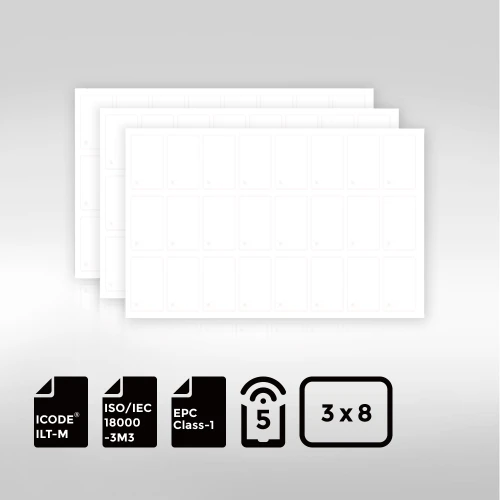
BioPoly™ Vinyl RFID Inlay Sheet NXP® ICODE® ILT-M

The NXP® ICODE® ILT-M BioPoly™ Vinyl RFID Inlay Sheet combines cutting-edge high-frequency RFID performance with a commitment to sustainability. Featuring the advanced ICODE® ILT-M chip and compliant with ISO/IEC 18000-3 Mode 3, it delivers ultra-fast data transfer, high memory capacity, and superior reading distances, making it ideal for applications such as supply chain management, asset tracking, logistics, and industrial automation.
Made from eco-friendly BioPoly™ vinyl, this inlay sheet helps your business reduce its environmental footprint while maintaining exceptional durability and printability. Whether used in custom labels, smart packaging, or intelligent inventory systems, the ILT-M BioPoly™ enables your brand to achieve operational efficiency, environmental responsibility, and a stronger connection with customers—all in one smart solution.