Introduction
In modern office environments, security and convenience are two indispensable elements for business operations. Every day, millions of employees swipe access cards to enter offices, conference rooms, or restricted areas. Have you ever wondered what technology lies behind these seemingly ordinary access cards? The answer likely points to radio frequency identification (RFID) technology. With its unique advantages, RFID chip card has become the mainstream choice for office access control systems, providing enterprises with efficient and secure management solutions.
1. What is RFID technology?

RFID is a technology that uses radio waves for contactless data communication. It identifies specific targets and reads/writes related data via radio signals without requiring mechanical or optical contact between the identification system and the target. A typical RFID system usually consists of the following components:
RFID tag (or chip card): Contains a microchip and an antenna for storing data and receiving/transmitting radio signals.
RFID reader/writer: Emits radio frequency energy and receives signals from tags to read stored data.
Antenna: Connected to the reader/writer, it transmits and receives radio waves.
Backend system: Processes data received from the reader/writer for authentication, record management, and other operations.
When an RFID tag enters the reader’s operational range, the radio frequency energy emitted by the reader activates the tag. The tag then transmits its stored data back to the reader, completing an identification process. This contactless communication method is one of the core advantages of RFID technology.
2. Why Do Office Access Cards Favor RFID?

The widespread adoption of RFID technology in office access control systems is no coincidence. Compared to traditional access control methods, RFID access cards offer numerous significant advantages, making them the preferred choice for modern enterprise access management.
Exceptional Convenience
RFID access cards deliver unparalleled convenience. Employees can swiftly gain entry by simply holding their card near the reader—no need to remove it. This contactless operation significantly boosts access efficiency, effectively preventing congestion during peak hours. Furthermore, RFID cards can be easily integrated into employee ID badges, key fobs, or even mobile devices, further streamlining the daily experience for staff.
Enhanced Security
Security is a core consideration for access control systems. RFID access systems enhance security through the following features:
Unique Identification Codes: Each RFID card possesses a unique identification code that is difficult to replicate, reducing the risk of unauthorized card duplication.
Encryption Capabilities: Some RFID cards support encryption to ensure secure data transmission, preventing information theft or tampering.
Real-Time Monitoring and Logging: RFID systems capture all access events in real time, including timestamps, personnel, and locations, providing comprehensive data support for security audits and incident tracing.
Multi-Factor Authentication: RFID technology integrates with other security measures (e.g., biometrics, passwords) to enable multi-factor authentication, further strengthening access security.
Efficient Management Capabilities
For enterprises, RFID access control systems deliver powerful management tools:
Flexible Permission Management: Administrators can easily set and adjust access permissions for different zones based on employee roles, departments, or project requirements. When employees leave or permissions change, card access can be swiftly disabled or modified without replacing physical locks.
Cost-Effectiveness: RFID cards are typically more cost-effective than other access options and can be reprogrammed and reconfigured, reducing additional expenses from lost cards or permission changes.
Integration Capabilities: RFID access systems seamlessly integrate with other enterprise management systems like attendance tracking and video surveillance, enabling data sharing and collaborative management to enhance overall operational efficiency.
Durability and Adaptability
RFID cards are typically constructed from durable materials with waterproof and dustproof properties, making them suitable for diverse environments. Their contactless reading mechanism minimizes card wear, extending service life. Additionally, RFID technology operates independently of line-of-sight constraints, enabling card reading even when stored in wallets or backpacks, thereby enhancing user convenience.
3. Comparison of RFID Access Control and Traditional Access Control Systems
To better understand the advantages of RFID access control systems, the following table compares the features of RFID access control with several common traditional access control systems:
| Features | RFID Access Control System | Magnetic Stripe Card Access Control System | Keypad Access Control System | Key-Based Access Control System |
| Identification Method | Radio Frequency Identification (Contactless) | Contact Card Swiping | Manual Password Entry | Physical Key Insertion into Lock Cylinder |
| Convenience Level | Very High (No card removal required, rapid access) | Moderate (Requires swiping, potential wear issues) | Moderate (Requires memorizing codes, potential leakage risk) | Low (Requires carrying keys, prone to loss, inconvenient management) |
| Security | High (Unique ID, encryptable, real-time logging) | Moderate (Easily duplicated, magnetic stripe demagnetization, no real-time logging) | Moderate (Passwords prone to leakage, no personal identification, no real-time logging) | Low (keys easily duplicated/lost, no records, poor security) |
| Management Cost | Moderate (cards reprogrammable, flexible access adjustments) | High (cards prone to damage, access changes require reissuing cards) | Low (no cards needed, but complex password management) | High (lost keys require lock replacement, complex management) |
| Data Logging | Detailed (Entry/exit times, personnel, locations) | Limited (Typically records events only, no detailed personnel info) | None (Cannot log individual access information) | None (Cannot log access information) |
| Integration Capability | Strong (Integrates with attendance, surveillance, etc.) | Weak (Typically standalone operation) | Weak (Typically standalone operation) | None |
| Durability | High (Contactless, waterproof/dustproof) | Moderate (Magnetic stripe wears easily, susceptible to moisture) | High (No physical wear) | Moderate (Keys wear easily, lock cylinders prone to damage) |
4. Application Frequency and Types of RFID Access Cards
RFID cards are suited for different applications based on their operating frequencies. In office access control systems, the most common RFID card frequencies are primarily the following two:
125 kHz (Low Frequency LF): These cards are typically used for short-range identification, such as employee access cards and attendance systems. They are relatively low-cost but have a shorter read range and slower data transmission speeds.
13.56 MHz (High Frequency, HF): These cards offer enhanced security and are commonly used in applications requiring stronger encryption and faster data transmission, such as payment cards, public transit cards, and more secure office access systems. They support more complex protocols and larger data storage capacities.
5. Market Trends and Future Outlook
The RFID access control system market is experiencing sustained growth. According to market research reports, the global RFID market size is projected to expand from $15.49 billion in 2024 to $37.71 billion by 2032, achieving a compound annual growth rate (CAGR) of 11.9%. Within this, the RFID locks market (including the access card segment) is projected to exceed $43.4 billion by 2037, with the key card segment holding a significant 50.2% share between 2025 and 2037. This growth is primarily driven by increasing demand for contactless access in hotels, hospitals, offices, and residential areas.
Looking ahead, RFID access control systems will evolve toward greater integration, intelligence, and security. Through convergence with Internet of Things (IoT) and artificial intelligence (AI) technologies, these systems will deliver more granular access management, smarter visitor management, and enhanced data analytics capabilities. This evolution will create safer, more efficient work environments for enterprises.
Conclusion
In summary, your office access card is most likely an RFID chip card, and this is no coincidence. RFID technology has become the ideal choice for modern office access systems due to its significant advantages in convenience, security, management efficiency, and durability. It not only simplifies daily access for employees but also provides robust security safeguards and flexible management tools for businesses. As technology advances and market demand grows, RFID access systems will continue to play a pivotal role in building intelligent, secure, and efficient office environments. For organizations seeking to enhance corporate security and operational efficiency, investing in RFID access solutions is undoubtedly a wise decision.
If you’re interested in learning more, we invite you to visit our official RFIDCard website for further information.
Recommended Product
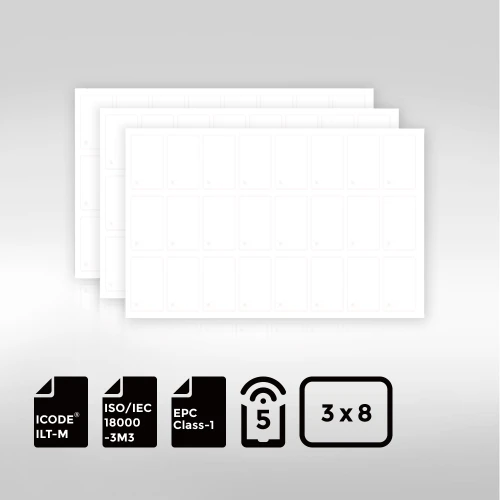
BioPoly™ Vinyl RFID Inlay Sheet NXP® ICODE® ILT-M

The NXP® ICODE® ILT-M BioPoly™ Vinyl RFID Inlay Sheet combines cutting-edge high-frequency RFID performance with a commitment to sustainability. Featuring the advanced ICODE® ILT-M chip and compliant with ISO/IEC 18000-3 Mode 3, it delivers ultra-fast data transfer, high memory capacity, and superior reading distances, making it ideal for applications such as supply chain management, asset tracking, logistics, and industrial automation.
Made from eco-friendly BioPoly™ vinyl, this inlay sheet helps your business reduce its environmental footprint while maintaining exceptional durability and printability. Whether used in custom labels, smart packaging, or intelligent inventory systems, the ILT-M BioPoly™ enables your brand to achieve operational efficiency, environmental responsibility, and a stronger connection with customers—all in one smart solution.