The global rise of contactless payments, including the RFID credit card, has brought convenience but also sparked fears of “RFID theft.” Viral videos and media claims suggest criminals can steal data wirelessly. This article addresses the core question: Is this a genuine threat or an overblown myth? We will clarify the technology, examine real risks versus exaggerated claims, and help you assess your need for protection.
1. What Is an RFID Credit Card and How Does It Work?
Most contactless payment cards use high-frequency (HF) radio at 13.56 MHz and follow ISO/IEC 14443 for short-range communication. Inside the plastic card is a tiny antenna coil and chip. When you bring the card within a few centimeters of a payment terminal, the terminal’s field powers the chip and initiates a secure exchange.

Under the hood, contactless cards implement the EMV contactless specifications maintained by EMVCo. Each transaction generates dynamic cryptographic data (often called a cryptogram). This means the information produced for one tap is not reusable for another. The design goal is convenience and security at very short range.
Key properties by design:
- Very short read distance (typically a few centimeters)
- Mutual protocol expectations between card and certified terminal
- Dynamic, per-transaction data rather than static secrets
- Back-end fraud detection by banks and networks
2. What Is RFID Skimming?
“RFID skimming” describes a scenario where a rogue reader tries to interrogate cards through clothing or bags in crowded places. The concept is plausible at a physics level: HF readers can energize nearby tags. The concern is whether meaningful data can be extracted from an RFID credit card without the owner noticing.

Two important distinctions:
2.1 Skimming vs. traditional card fraud
Traditional fraud often comes from data breaches, phishing, malware, or card-not-present attacks online. These vectors expose full card details or credentials. RFID skimming, in contrast, attempts to pull limited data over the air at very short range.
2.2 Perception vs. practical payoff
Even if a reader communicates with a card, what it can obtain is constrained by the EMV contactless design and by what the card is willing to reveal without a legitimate transaction context.
3. Can Someone Really Steal Money from Your RFID Credit Card?
When evaluating the threat of digital pickpocketing, we must examine what data can and cannot be read from a contactless card. If a scanner successfully interrogates an RFID credit card, it can typically only retrieve the card number and the expiration date. It cannot access the cardholder’s name, billing address, or the three-digit CVV security code printed on the back of the card.

Why are the CVV, PIN, and full track data not exposed? The EMV (Europay, Mastercard, and Visa) standard ensures that the most sensitive information required for online or card-not-present transactions is never transmitted wirelessly. Without the CVV or the billing address, it is exceedingly difficult for a criminal to use the intercepted card number for online shopping, as almost all reputable e-commerce platforms require these verification details.
Moreover, the financial industry employs tokenization and transaction limits to further mitigate risk. Tokenization replaces the primary account number with a unique digital identifier, or token, during the transaction process. Additionally, banks impose strict transaction limits on contactless payments. If a purchase exceeds a certain threshold, the terminal will prompt the user to insert the card and enter a PIN.
A realistic assessment of the actual risk reveals that documented cases of real-world RFID skimming are virtually nonexistent. Security experts and law enforcement agencies consistently report that criminals prefer traditional skimming or large-scale data breaches, which are far more lucrative and easier to execute than attempting to wirelessly pickpocket individuals one by one.
4. Why Banks Continue to Use RFID Technology Despite the Concerns
Banks and networks have spent years refining contactless security because the usability benefits are enormous: faster lines, less wear on terminals, and better hygiene. They would not deploy this at global scale if the risk model were unacceptable.

Layers of protection include:
- EMV contactless cryptography and certified terminals
- Real-time fraud analytics on issuer systems
- Transaction limits for tap-to-pay without PIN
- Tokenization when cards are added to mobile wallets
Statistically, fraud is far more prevalent in card-not-present e-commerce and phishing scenarios than in contactless tap-to-pay.
5. Do You Actually Need RFID Protection?

With the market flooded with RFID-blocking wallets and sleeves, consumers are left wondering if these products are necessary. There are certainly situations where protection may give peace of mind. If you frequently travel to densely populated tourist destinations or simply suffer from anxiety regarding digital privacy, investing in an RFID-blocking wallet can alleviate those concerns. These products act as a Faraday cage, effectively blocking the 13.56 MHz radio waves required to activate the card.
However, there are many instances when RFID blocking is unnecessary. If your wallet is thick, filled with multiple cards, coins, and receipts, the physical clutter alone can interfere with a scanner’s ability to isolate and read a specific RFID credit card. Additionally, if you carry multiple contactless cards (such as a transit pass, a building access card, and a credit card) next to each other, they will often cause “card clash.” When a scanner attempts to read them, the competing signals confuse the reader, resulting in an error rather than a successful data extraction.
6. Consumer RFID Protection vs. Enterprise-Grade RFID Security
It is helpful to distinguish between the consumer market for RFID protection and the enterprise-grade security measures implemented by financial institutions. The consumer approach primarily focuses on the difference between blocking signals and securing data. An RFID-blocking wallet does not make the data on your card any more secure; it simply prevents the radio frequency signal from reaching the microchip. It is a physical barrier against a wireless connection.
In contrast, enterprise-grade security focuses on rendering the data useless even if the signal is intercepted. Advanced RFID chips use complex encryption and dynamic authentication to protect the integrity of the transaction. The banking infrastructure assumes that interception is possible and designs the system so that captured data cannot be monetized.
7. Conclusion
In summary, while the theoretical concept of wireless theft sounds alarming, the reality is that your RFID credit card is highly secure. The combination of short read ranges, dynamic encryption, and robust bank fraud monitoring makes real-world skimming incredibly rare and impractical for criminals.
Partner with RFIDCard for secure, custom RFID card solutions tailored to your project needs.
Recommended Product
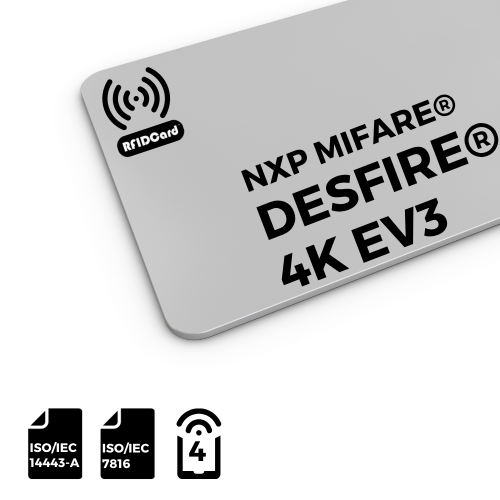
RFID Card NXP MIFARE® DESFire® EV3 4K

Blank or customized printing RFID cards with a choice of dimensions are available. The MIFARE® DESFire® EV3 4K is Common Criteria EAL5+ security certified for smart card IC products. The MIFARE® DESFire® EV3 4K ICs fully comply with NFC Forum Type 4 Tag.