
With the ongoing development of digitalization and automation, RFID (radio frequency identification technology) technology has become an indispensable tool in modern business. It rapidly identifies and tracks items using radio waves, greatly enhancing the efficiency of supply chain management, inventory control, and customer experience. As market demand continues to grow, the application of RFID technology has expanded across various industries like retail, logistics, and manufacturing, becoming a crucial driving force in the digital transformation of enterprises.
Among these advancements, the NXP UCODE®8 UHF RFID technology, recognized as the leading RFID tag solution in the industry, is steadily transforming operational methods across different sectors with its outstanding performance and versatile features. This article will delve into how NXP UCODE®8 RFID technology can help businesses stand out in a fiercely competitive market by improving inventory management efficiency, optimizing customer experience, and reducing operating costs.

NXP UCODE®8 UHF RFID Technology Overview
The NXP UCODE®8 is the latest generation of UHF RFID tag chips launched by NXP Semiconductors, part of the UCODE series. This series is designed for high-demand RFID applications, especially in industries requiring precision and reliability. With its excellent RFID performance, the UCODE®8 chip has become an ideal choice for retail, fashion, logistics, and more, helping companies operate more efficiently and manage assets more accurately.
Application Areas of NXP UCODE®8
NXP UCODE®8 RFID technology is widely used across various industries, particularly in the following areas:
Retail Industry: UCODE®8 offers efficient inventory management and rapid checkout processes in retail environments, enabling retailers to achieve accurate product tracking and inventory control while enhancing customer experience.
Fashion Industry: For fashion apparel and other goods, RFID tags play a crucial role in inventory counting, product tracking, and theft and counterfeiting prevention.
Logistics and Supply Chain Management: UCODE®8 helps companies improve supply chain transparency, minimize loss and error risks, and ensure timely delivery through accurate cargo tracking.
The core advantage of UCODE®8 lies in its powerful long read range and fast inventory management capabilities, allowing it to perform excellently even in high-density tag environments. Moreover, its global compatibility makes it an ideal choice for multinational companies managing global supply chains, adapting to RFID regulations across different countries and regions.
Technical Advantages of UCODE®8
NXP UCODE®8 boasts a series of outstanding technical features tailored to meet diverse demanding application needs. Below are its main advantages:
High Read and Write Sensitivity
Read Sensitivity: -23 dBm, meaning tags can be read efficiently over long distances, ensuring quick and accurate information retrieval even in complex environments.
Write Sensitivity: -18 dBm, supporting efficient writing in most scenarios and providing stable support for various RFID operations.
Innovative Features
Self Adjust: This function automatically optimizes tag performance to ensure optimal reading and writing capabilities in different working environments.
Memory Safeguard: Built-in error detection and correction ensures data integrity in RFID tags, preventing information loss or corruption.
Brand Identifier: Used for product authentication to verify the authenticity of a product’s origin and brand, thereby enhancing consumer trust and preventing counterfeiting issues.
Untraceable: This feature protects personal privacy, ensuring that RFID tags do not disclose sensitive information when it’s not needed.
Wide Adaptability
Single-Slit Antenna Support: Compatible with most RFID readers and writers on the market, simplifying hardware deployment.
EPC Gen2v2 Standard Support: Compliant with the latest EPC global standards, ensuring smooth worldwide use and meeting regulatory requirements in various countries.
Durability and Safety
Temperature Adaptability Range: -40°C to +85°C: UCODE®8 can function normally under extreme temperature conditions, adapting to various outdoor or storage environments.
100k Write Endurance: It has very high durability, capable of withstanding up to 100,000 write operations, ensuring reliability in long-term use.
32-Bit Password Function: A built-in 32-bit password protection feature provides data security and prevents unauthorized access and tampering.

Functions and Benefits of NXP UCODE®8
As RFID technology keeps evolving, the NXP UCODE®8 has become a crucial tool for various industries to boost operational efficiency, cut costs, and ensure data security with its innovative features and robust technical advantages.
Main Function Breakdown
Self-Adjustment: The self-adjustment feature of NXP UCODE®8 can automatically optimize the performance of RFID tags based on the working environment. This function guarantees that the reading performance of tags remains top-notch, even in complex situations (like environments with a lot of tags packed closely together).
Memory Safeguard: The memory safeguard function can automatically detect and fix errors, ensuring that the data stored in the RFID tag is always intact and accurate. Whether in high-speed scanning or tough environments, memory safeguard cleverly avoids data loss or corruption through automatic error correction processes.
Brand Identifier: The built-in brand identifier feature of UCODE®8 allows each tag to support product authentication, preventing counterfeit and substandard products from hitting the market. Brand identifiers help guarantee the source and authenticity of products, making them especially suitable for high-value items and industries sensitive to brand integrity such as luxury goods and electronics.
Untraceable: UCODE®8 supports an untraceable function, providing users with better privacy protection. With this untraceable feature, the data from the RFID tag is read under specific conditions only, avoiding any leakage of sensitive information and eliminating privacy breach issues that could arise from unauthorized access. This feature is particularly significant as consumer privacy protection gains more focus, particularly in tracking applications for electronics and consumer goods.
Pre-serialization: NXP UCODE®8 supports a pre-serialization function that can pre-encode the 96-bit EPC (Electronic Product Code) during manufacturing. This means that each RFID tag is assigned a unique serial number when it leaves the factory, greatly simplifying tag management and deployment. This feature not only boosts the efficiency of large-scale RFID tag deployment but also ensures the uniqueness and traceability of the tags.
EPC Gen2v2 and Compatibility
Support for EPC Gen2v2 protocol: NXP UCODE®8 fully adheres to the EPC Gen2v2 protocol, the latest version of the RFID technology standard. Utilizing this protocol ensures high performance of RFID tags and allows UCODE®8 to be widely used globally to meet various RFID regulatory demands across countries and regions. This global compatibility offers multinational companies greater flexibility and simplifies the integration of RFID systems in different markets.
Highly compatible with existing equipment: NXP UCODE®8 is designed to be compatible with existing RFID equipment and infrastructures. This means you can easily integrate UCODE®8 technology into your current RFID systems without needing extensive hardware upgrades, greatly reducing system implementation costs. Plus, UCODE®8’s compatibility with a range of RFID readers and antennas ensures that system deployment remains convenient and efficient.

How NXP UCODE®8 Can Help Your Business
As the demand for efficient management and optimized operations grows among enterprises, NXP UCODE®8 UHF RFID technology offers a groundbreaking solution across various industries. Whether it’s inventory management, checkout processes, theft prevention, brand protection, or after-sales service, NXP UCODE®8 can dramatically boost efficiency, cut costs, and enhance the customer experience.
Boost Inventory Management and Logistics Efficiency
Accurate Inventory Counts: NXP UCODE®8 excels in high-density label environments with outstanding read performance. This means companies can quickly take stock of large quantities of goods, even in complex inventory scenarios. By minimizing manual intervention and enhancing inventory accuracy, NXP UCODE®8 can significantly cut down inventory management time and improve operational efficiency.
Enhance Supply Chain Transparency: NXP UCODE®8 RFID technology enables real-time tracking of goods flow, ensuring every step from the production source to the final retail store is clearly recorded and traceable. With RFID tags, supply chain management becomes not only more transparent but also allows companies to predict potential issues in advance, preventing goods from being lost, delayed, or misallocated.
Minimize Inventory Errors: Thanks to UCODE®8’s robust read sensitivity and high-precision features, RFID tags can be read swiftly and accurately, ensuring data integrity even in busy settings. This dramatically reduces possible errors during manual inventory, ensures accurate inventory data, and avoids issues like stockouts or excess inventory.
Speed Up Checkout Processes and Enhance Customer Experience
High-Speed Checkout: Implementing NXP UCODE®8 RFID tags in retail stores can significantly accelerate the checkout process. Customers can make quick payments through self-checkout systems without waiting in long lines. This efficient checkout not only enhances the shopping experience for customers but also helps retailers save on labor costs and serve more customers.
Accurate Product Positioning: Utilizing UCODE®8 RFID tags allows customers to quickly locate the products they need. In large retail environments, RFID technology can pinpoint products accurately, improving shopping efficiency. This precise positioning not only enhances the customer experience but also helps retailers optimize their inventory layout, reducing product misplacement and duplicate purchases.
Strengthen Theft Prevention and Brand Protection
Electronic Article Surveillance (EAS) Function: The NXP UCODE®8 RFID tag comes with a built-in electronic article surveillance feature, functioning as an anti-theft tag. With an integrated Product Status Flag (PSF), the tag can prevent items from being illegally removed from the store in real time, without requiring additional back-end database support. This greatly enhances store security and reduces theft incidents.
Anti-Counterfeiting and Brand Protection: UCODE®8 supports brand identifier functions, providing unique identity verification for each product, effectively preventing counterfeit and substandard products from entering the market. For high-value commodities like luxury goods and electronics, brand identifiers help consumers verify product authenticity, boost brand credibility, and shield brands from infringement issues.
Optimize After-Sales Service Management
After-Sales Process Management: NXP UCODE®8 RFID technology assists businesses in achieving more efficient management throughout the after-sales service process. For instance, product returns, warranty tracking, repair history, and more can all be recorded and managed via RFID tags. This enables companies to respond to customer needs more swiftly, enhancing after-sales service efficiency and customer satisfaction.
Real-Time Data Tracking: Through RFID technology, companies can track the after-sales status of each item in real time, including returns, repairs, warranties, and other processes. This real-time tracking capability aids businesses in understanding the after-sales situation of their products promptly, reducing customer wait times while optimizing the after-sales service process. For consumers, this translates to faster service and greater satisfaction.

Industry Application Cases of NXP UCODE®8
NXP UCODE®8 UHF RFID technology plays a crucial role across various industries with its powerful performance and adaptability, providing enterprises with efficient and accurate management solutions. Whether in retail, logistics, aviation, laundry, or express delivery, UCODE®8 proves to be transformative.
Retail Industry
Store Management
Efficient Inventory Management: The implementation of NXP UCODE®8 RFID tags in retail stores significantly improves inventory management efficiency. With RFID tags, retailers can perform fast and accurate inventory counts, reduce manual errors, and ensure real-time updates of product data. By continuously monitoring stock levels, businesses can adjust inventory in a timely manner to avoid stockouts or overstock situations.
Fast Checkout: By integrating NXP UCODE®8 RFID tags into the checkout system, retailers can offer a more convenient checkout experience. Customers can quickly complete payment through self-service checkout machines, reducing waiting time. This not only enhances the shopping experience but also helps retailers improve checkout efficiency and decrease labor costs.
Enhanced Customer Experience: RFID technology enables retailers to deliver a personalized and intelligent shopping experience. For instance, RFID tags can be utilized to accurately locate products, allowing customers to swiftly find what they need, thus improving shopping efficiency and satisfaction.
Omnichannel Retail
Online and Offline Inventory Synchronization: NXP UCODE®8 RFID technology seamlessly connects the inventory information of physical stores with online platforms, achieving omnichannel inventory synchronization. This function enhances the supply chain’s flexibility, enabling retailers to predict product demand more accurately and minimize sales losses due to inconsistent inventory. At the same time, customers enjoy a more convenient purchasing experience and can check inventory status any time.
Improved Supply Chain Flexibility: Through the real-time tracking capabilities of RFID tags, retailers can monitor inventory across the entire supply chain and optimize the distribution and replenishment process. This not only enhances logistics efficiency but also reduces inventory backlogs and unsold risks, boosting retailers’ competitiveness in the market.
Logistics and Supply Chain Management
Supply Chain Tracking
End-to-End Tracking: The application of NXP UCODE®8 RFID technology in the supply chain enables complete tracking from suppliers to warehouses to retailers. Each RFID tag marks the flow path of goods, ensuring that they can be tracked and monitored in real time at every stage. This transparent logistics management allows companies to understand the state of each link in real time, optimizing supply chain operations and reducing uncertainties in transportation and inventory.
Ensured Logistics Transparency: Using RFID tags, logistics companies can obtain real-time status updates of goods during transit, adjust transportation plans on the fly, and prevent goods from getting delayed due to traffic issues or other problems. Furthermore, customers and partners can query the latest status of goods using the system, enhancing the transparency of the supply chain.
Airline Baggage Tracking
Improved Baggage Handling Efficiency: Airlines can significantly enhance baggage handling efficiency by utilizing NXP UCODE®8 RFID tags to identify and track each bag. RFID technology enables real-time monitoring of luggage through multiple stages, ensuring that every piece of luggage arrives at its destination on time and on the right flight.
Reduced Risk of Loss: The precise tracking capabilities of RFID technology effectively reduce the risk of lost luggage. With real-time data transmission, airlines and passengers can check the exact location of luggage at any time, providing assurance that it will arrive safely at its destination.
Other Industry Applications
Laundry Services
Efficient Laundry Management: The laundry industry also benefits from NXP UCODE®8 RFID technology. By attaching RFID tags to each piece of clothing, laundries can accurately track the status of items, including whether they have been washed or repaired. This not only improves the efficiency of laundry services but also mitigates the risk of customer items being lost, ensuring proper management.
Customer Item Tracking: With RFID tags, customers can check the processing status of their items at any time and easily confirm their items when picking up clothes, thus improving service transparency and customer satisfaction.
Postal and Express Delivery
Parcel Tracking: In the postal and express delivery industries, companies widely use RFID technology for real-time package tracking. They fit each parcel with an RFID tag, which they continuously monitor during transit to ensure accurate and timely delivery. This technology allows express delivery companies to enhance parcel management efficiency and reduce loss or delays.
Timely and Accurate Delivery: RFID technology collects and tracks real-time data during the distribution process, ensuring on-time delivery of every package. With this technology, express delivery companies can accurately allocate resources, enhance overall delivery efficiency, and ultimately boost customer satisfaction.

How to Implement the Deployment of NXP UCODE®8 RFID Technology
Successful deployment of NXP UCODE®8 RFID technology relies not only on the selection of suitable tags and hardware but also on meticulous planning of implementation steps and subsequent maintenance. A well-executed deployment can significantly enhance operational efficiency, reduce costs, and ensure the long-term stability of RFID technology.
Preparation Before Deployment
Determine Business Needs and Goals
Choose Appropriate RFID Tags Based on Industry Characteristics: Different industries have varying requirements, so companies must clarify their business goals before deploying RFID technology. For the retail industry, the focus may be more on inventory management and fast checkout; for logistics, it may lean towards supply chain tracking and package management. Select the appropriate NXP UCODE®8 RFID tag according to specific needs to ensure its technical characteristics (such as high reading sensitivity, long reading distance, etc.) meet application requirements.
Evaluate the Business Goals of the RFID System: Before deployment, companies should analyze the core issues that RFID technology can resolve, such as improving inventory accuracy, reducing losses, and optimizing supply chains. Set specific goals (e.g., improving inventory counting efficiency by 30%). This helps in subsequently assessing system effectiveness and fine-tuning deployment plans.
Choose the Right RFID Reading and Writing Devices
Ensure Compatibility with Existing Systems: While NXP UCODE®8 supports a wide range of device compatibility, it is still essential to ensure the selected RFID reader is compatible with the enterprise’s existing IT systems, databases, and hardware during deployment. Choosing a reading and writing device that supports the EPC Gen2v2 protocol ensures seamless integration with UCODE®8 tags. Especially in environments with existing RFID infrastructure, you need to confirm that new equipment integrates smoothly with existing systems to minimize additional investment and time costs.
Consider Future Scalability: When selecting read-and-write devices, you also need to think about future scalability. For example, if a business plans to expand RFID applications across more areas or departments, ensure that the equipment supports future expansion and upgrades to adapt to business development needs.
Implementation Steps
Plan the Deployment Process
Attachment of RFID Tags: Proper attachment of RFID tags is crucial for ensuring smooth system operation. Based on business needs, companies need to decide where to attach tags (e.g., product outer packaging, storage shelves, etc.). Ensure accurate tag placement to prevent incorrect placements that lead to inaccurate readings. In the retail sector, attach tags to merchandise or packaging; in logistics, place them on shipping containers or freight documents.
System Integration: Besides tagging, system integration is another vital step in deployment. Companies need to integrate RFID reading and writing devices with enterprise resource planning (ERP) systems, warehouse management systems (WMS), or other related business systems to ensure smooth data transfer and sharing. For example, data captured by RFID tags must connect with the inventory management system to achieve real-time inventory updating.
Train Employees to Operate RFID Devices
Enhance Technology Usage Efficiency: To ensure the effective operation of RFID systems, employee training is key. The training content should cover the identification and use of RFID tags, operation of RFID reading and writing devices, data entry, and processing procedures. Especially in inventory management and logistics tracking scenarios, employees need to master the correct operation of RFID equipment, timely acquisition and processing of data, and ensure system stability and accuracy.
Continuous Training and Support: The deployment of RFID technology is not an overnight affair. Companies should organize regular technical training to help employees familiarize themselves with new functions and systems and improve operational skills. When necessary, a technical support team can provide on-site guidance to resolve issues employees encounter during actual operations promptly.
Later Maintenance and Optimization
Regularly Check the Operating Status of the RFID System
Monitor System Performance: The deployed RFID system requires regular inspection and monitoring to ensure normal operation of the equipment. Regularly check RFID readers, tags, and systems to avoid performance degradation caused by equipment failures, damaged tags, or system errors. Particularly in large retail stores or logistics warehouses, efficient system operation is crucial for improving overall operational efficiency.
Timely Optimize and Adjust: As business needs evolve, the RFID system might need optimization and adjustments. For instance, it may become necessary to expand the reading area, add additional tags or equipment, or adjust tag attachment positions. Regularly evaluating system performance, identifying potential problems, and making adjustments can ensure ongoing stable and efficient operation of the system.
Continuously Expand the Scope of RFID Applications Based on Business Development
Expanded Application Scenarios: As enterprise operations expand and digital transformation deepens, the application scope of RFID technology should gradually broaden. From initial inventory management to subsequent supply chain tracking, enhancing customer experience, and optimizing after-sales service, companies can progressively expand RFID technology applications as needed to ensure that the technology keeps pace with business development.
Technology Upgrade and Innovation: With the continual advancement of RFID technology, enterprises need to stay sensitive to new technologies and introduce new functions and equipment as needed. Regularly upgrading existing systems and equipment can enhance business efficiency and ensure the company maintains a technological edge.

Conclusion
NXP UCODE®8 UHF RFID technology has emerged as a crucial tool for enhancing operational efficiency, cutting costs, and improving customer experiences for modern enterprises, thanks to its outstanding performance and innovative features. With its high reading sensitivity, long reading distances, and global compatibility, UCODE®8 RFID technology not only boasts significant advantages in inventory management and supply chain optimization but also effectively boosts product tracking transparency, reduces human error, and increases operational accuracy and efficiency. Furthermore, the technology’s capabilities in brand protection, anti-counterfeiting, and electronic product theft prevention further bolster the competitiveness and market position of enterprises.
As the demand for digital transformation and automated management rises across industries like retail, logistics, and aviation, NXP UCODE®8 RFID technology offers companies unprecedented opportunities to gain a competitive edge in a fiercely competitive market. Through intelligent RFID deployment, businesses can not only enhance the efficiency of daily operations but also foster customer loyalty and promote growth by optimizing customer experiences. Whether it’s improving inventory accuracy, speeding up the checkout process, or optimizing supply chain management, NXP UCODE®8 can deliver substantial benefits.
Thus, enterprises should seize the opportunities presented by RFID technology to drive business transformation and achieve intelligent, digital development. Doing so will help companies improve operational efficiency, reduce costs, maintain technological leadership in a rapidly evolving market, and establish future competitive advantages.

FAQs
What are the advantages of NXP UCODE®8 RFID technology over traditional barcode technology?
NXP UCODE®8 RFID technology has several advantages compared to traditional barcodes. First, RFID tags allow quick scanning of multiple items without unpacking, as they don’t require direct contact or line-of-sight reading. Second, RFID tags offer a longer read range, making them ideal for high-density environments. Additionally, RFID technology provides higher accuracy and faster processing speeds, reducing human errors and enhancing inventory management and logistics efficiency.
How does NXP UCODE®8 RFID technology help improve supply chain transparency?
NXP UCODE®8 RFID technology enhances supply chain transparency by assigning a unique RFID tag to each item, enabling real-time tracking at every step of the supply chain. Whether it’s in production, transportation, or storage, RFID tags can accurately record the flow of items, ensuring data transparency. This allows companies to monitor the location, status, and inventory levels of goods in real time, helping them better coordinate supply chain activities, mitigate inventory risks, respond more quickly, and prevent loss or damage to products.
How does NXP UCODE®8 RFID technology improve customer experience in the retail industry?
NXP UCODE®8 RFID technology significantly enhances customer experience by speeding up inventory management and checkout processes. First, RFID technology enables retailers to update inventory information in real-time, ensuring product availability and preventing customer disappointment due to stockouts. Second, RFID tags expedite the checkout process, allowing customers to swiftly complete their purchases through self-service checkout stations without waiting in long lines. Moreover, RFID technology can also assist in item location, helping customers quickly find what they need and thus boosting shopping efficiency.
How can NXP UCODE®8 RFID technology enhance efficiency in the logistics industry?
NXP UCODE®8 RFID technology improves logistics efficiency by providing real-time tracking of goods within the supply chain. An RFID tag tracks each item to ensure accurate records at every stage, from shipping and transportation to final delivery. This allows logistics companies to obtain real-time status updates, identify problems early, and make quick adjustments to avoid delays. RFID technology also reduces manual intervention, speeds up goods processing, and guarantees the efficiency and accuracy of the logistics operation.
Is NXP UCODE®8 RFID technology suitable for large-scale inventory management?
Absolutely, NXP UCODE®8 RFID technology is well-suited for large-scale inventory management. Its high read sensitivity and long read distances allow for fast and accurate inventory counts, even in high-density tagging environments. Compared to traditional barcode scanning, RFID technology can quickly read multiple tags without needing to touch the items, greatly enhancing inventory management efficiency. Additionally, RFID systems can update inventory information in real time, helping businesses better forecast demand, optimize inventory, and reduce backlogs or out-of-stock situations.
Recommended Product
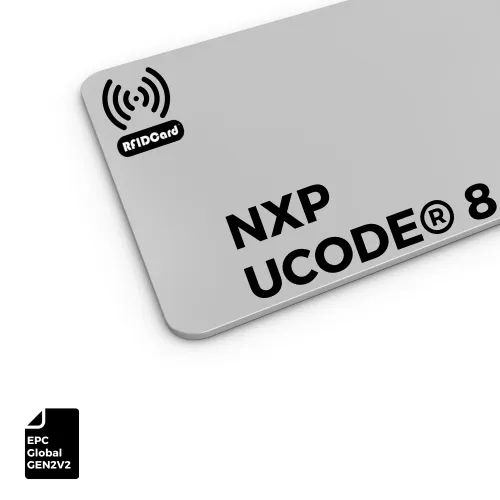
UHF RFID Card NXP UCODE® 8

The UHF RFID cards are made with Photo quality standard PVC sheets in the size of CR80, suitable for use with most direct thermal or thermal transfer card printers. UCODE® 8 optimized for serializing items for Retail management, Supply chain management and shipping service, etc.