

In the age of digital access and contactless convenience, RFID card production has become a cornerstone of modern identification and security systems. Manufacturers produce billions of RFID cards each year—from hotel key cards and employee badges to transit passes and membership cards—to enable seamless communication between people and smart infrastructure. Yet, behind every simple plastic card lies a complex series of precise engineering steps — combining electronics, materials science, and advanced automation. This article takes you inside the entire process of RFID card production, showing how chips, antennas, and design come together to create reliable, durable, and secure smart cards.
1. Understanding the Core Components of an RFID Card
To understand how an RFID card is made, it’s essential to know what it’s made of. An RFID card consists of three primary components:
- Antenna Coil: enables communication with the reader via electromagnetic fields.
- RFID Chip (Integrated Circuit – IC): stores and transmits data.
- Substrate Layers or card body: typically made from PVC, PET, or ABS, protecting the electronic parts.
The chip and antenna together form what is known as the RFID inlay, which is embedded within the card body. Material selection directly affects card performance. For instance, PET offers better heat resistance, while PVC is cost-effective and widely used. These components must work perfectly together for the RFID system to achieve reliable read range, stability, and lifespan.
2. Antenna Manufacturing
The antenna is the conduit for communication between the RFID card and the reader. Its manufacturing is a critical step in RFID card production, demanding high precision to ensure optimal performance. There are two primary methods for creating the antenna:
- Etching or Printing on Copper/Aluminum Foil: This method involves etching or printing the antenna pattern onto thin sheets of conductive materials like copper or aluminum. This technique allows for highly detailed and consistent antenna geometries, which are crucial for precise frequency tuning.
- Wire Embedding using Copper or Aluminum Wire: In this method, manufacturers precisely embed fine copper or aluminum wires into the substrate material to form the antenna coil. They often use this technique for its robustness and ability to create antennas with specific performance characteristics.
The precise design of the antenna is paramount for tuning it to the correct operating frequency (e.g., 13.56 MHz for High-Frequency (HF) RFID cards, or 860-960 MHz for Ultra-High Frequency (UHF) RFID cards). Automated machinery plays a pivotal role in ensuring consistent antenna geometry and quality across large production batches, thereby guaranteeing reliable communication capabilities for every card.
3. Chip Embedding and Inlay Formation
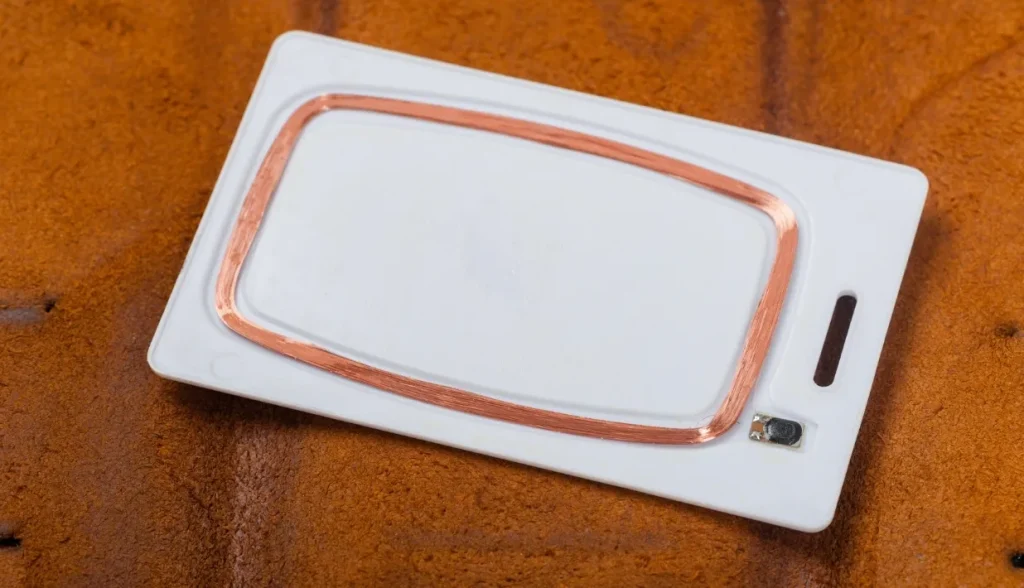
Once manufacturers produce the antenna, they move to the next critical stage in RFID card production—the chip embedding process—which results in the creation of the RFID inlay. This involves securely placing or bonding the tiny RFID chip onto the antenna substrate. Various sophisticated techniques are employed:
- Flip-Chip Bonding: This method involves directly attaching the bare RFID chip to the antenna contacts using conductive adhesive or solder bumps. It allows for a compact and robust connection.
- Wire Bonding: In this technique, fine wires are used to connect the chip’s contact pads to the antenna’s terminals. This is a highly precise process, ensuring a strong electrical connection.
The accuracy of chip and antenna alignment is absolutely crucial. Even a slight misalignment can severely compromise the card’s performance, leading to reduced reading distance or complete communication failure. Following the embedding process, rigorous testing is conducted to verify the chip’s response and ensure that the inlay functions correctly before proceeding to the next manufacturing stage. This early testing helps identify and rectify defects, preventing further processing of faulty components.
4. Lamination — Turning Inlays into Cards
Lamination is the process that transforms the delicate RFID inlay into a durable, functional card. This stage of RFID card production involves stacking multiple layers and bonding them together under controlled conditions. The typical stack-up includes:
- RFID Inlay: The core component containing the chip and antenna.
- Overlay Films: Protective layers, often made of clear PVC or PET, that encapsulate the inlay and provide a smooth, printable surface.
- Printed Sheets: These are the top and bottom layers of the card, pre-printed with graphics, logos, and any other visual information.
Technicians carefully stack these layers and then subject them to high heat and pressure in a laminating press. They precisely control the temperature and timing of this process to ensure a strong, uniform bond between all layers while preventing deformation, bubbling, or delamination. Proper lamination gives the RFID cards their characteristic rigidity, durability, and waterproof sealing, protecting the internal electronics from environmental damage and wear and tear during their operational life.
5. Cutting, Punching, and Finishing
After lamination, the large laminated sheets, which typically contain multiple RFID cards, are processed further. This stage involves transforming the sheet into individual, usable cards:
- High-Precision Punching: Automated punching machines are used to cut the laminated sheets into individual cards with precise dimensions. These machines are calibrated to ensure consistent card size and shape, adhering to industry standards (e.g., CR80 size).
- Edge Polishing or Trimming: After punching, the edges of the cards may be polished or trimmed to ensure smoothness and remove any sharp burrs, enhancing user comfort and card aesthetics.
Additional finishing processes may include applying magnetic stripes, embossing characters, hot stamping, or adding signature panels, depending on the specific requirements of the RFID card.
6. Quality Inspection and Testing
Quality control is an indispensable part of RFID card production, ensuring that every card meets stringent performance and durability standards. A multi-step quality inspection process is employed throughout and at the end of the manufacturing line:
- Electrical Tests: These tests verify the functionality of the RFID chip and antenna. This includes checking the chip’s ability to store and retrieve data, as well as measuring the card’s reading distance and signal strength to ensure it communicates effectively with RFID readers.
- Visual Inspection: Trained personnel and automated optical inspection systems meticulously examine each card for cosmetic defects such as bubbles, scratches, misalignments of printed elements, or any imperfections in the lamination. This ensures a professional appearance and structural integrity.
- Durability Tests: To assess the card’s resilience, testers perform various stress tests, including bending, heat resistance, and water resistance tests. These simulations ensure the card can withstand typical usage conditions and environmental exposure without compromising its functionality or physical integrity.
7. Conclusion
In conclusion, the manufacturing of RFID cards is a highly sophisticated process that seamlessly integrates electronics, materials science, and precision engineering. At first glance, what appears to be a simple plastic card is, in reality, a product of multiple intricate design and manufacturing steps, each playing a crucial role in ensuring its functionality and durability. Moreover, high-quality RFID card production is not just about assembling components; rather, it is about ensuring that each card provides secure, reliable, and long-lasting smart access solutions for a wide range of applications.
Recommended Product
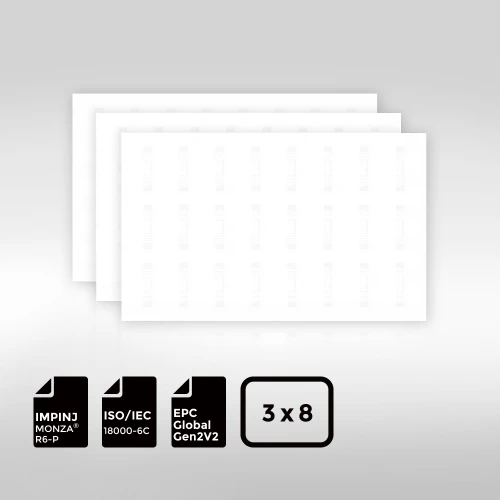
BioPoly™ Vinyl RFID Inlay Sheet Impinj® Monza® R6-P

The Impinj® Monza® R6-P BioPoly™ Vinyl RFID Inlay features the high-performance Monza® R6-P chip, known for its exceptional read range, reliability, and accuracy. This chip optimizes inventory and asset tracking, ensuring fast and efficient data capture in various applications. While offering cutting-edge RFID technology, the inlay also utilizes eco-friendly BioPoly™ Vinyl, a biodegradable PVC made with renewable materials that degrades within three years, reducing environmental impact without compromising performance. The combination of the Monza® R6-P chip and sustainable BioPoly™ Vinyl makes this inlay a powerful, environmentally responsible solution for modern RFID needs.