In the fast-evolving world of contactless technology, NFC tag types play a crucial role in connecting the physical and digital worlds. From mobile payments to product authentication, NFC (Near Field Communication) enables seamless wireless communication between devices within a few centimeters. Choosing the right NFC tag type ensures that your project performs reliably, efficiently, and securely. Whether you’re developing a smart product, managing assets, or launching an interactive marketing campaign, understanding the differences among NFC tag types can help you make an informed decision and achieve better results.
1. What Are NFC Tag Types?
To ensure global interoperability and a consistent user experience, the NFC Forum, a non-profit industry association, established a set of technical specifications that define how NFC devices and tags communicate. These specifications categorize passive NFC tags into distinct types, known officially as NFC tag type standards. These standards are not arbitrary; they are deeply rooted in existing international standards for contactless smart cards, primarily ISO/IEC 14443 (for proximity cards) and ISO/IEC 15693 (for vicinity cards).
The NFC Forum’s classification system ensures that any NFC-enabled device, such as a modern smartphone, can reliably read and write data to a tag, regardless of the tag’s manufacturer. The types define essential parameters, including:
- Communication Protocol: The underlying method used for data transfer.
- Memory Structure: How data is organized and accessed on the chip.
- Data Rate: The speed at which information can be exchanged.
- Security Features: The level of protection against unauthorized access or cloning.
- Read/Write Behavior: Whether the tag is read-only, rewritable, or write-once.
By adhering to these standardized types, the NFC ecosystem maintains a high degree of compatibility, which is essential for mass-market adoption.
2. Overview of the Five NFC Tag Types

The NFC Forum currently defines five primary NFC tag type specifications, each optimized for different use cases. While Type 1 through 4 are based on the ISO 14443 standard, Type 5 is based on ISO 15693, which allows for a greater reading distance. The following table provides a high-level comparison, followed by a detailed breakdown of each type.
| NFC Tag Type | ISO Standard Basis | Memory Capacity (Typical) | Data Rate (Relative) | Key Feature | Common Applications |
| Type 1 | ISO 14443A | Up to 2 KB | Low | Simple, Low-Cost | Basic URL redirection, event tickets |
| Type 2 | ISO 14443A | Up to 2 KB (e.g., NTAG) | Medium | Most Popular, Versatile | Smart business cards, product authentication |
| Type 3 | ISO 18092 (FeliCa) | Up to 1 MB | High | High-Speed, Large Data | Transit systems, complex loyalty programs |
| Type 4 | ISO 14443A/B | Up to 32 KB+ | Medium/High | Secure, Professional | Secure access control, digital ID cards |
| Type 5 | ISO 15693 | Up to 8 KB | Medium | Long-Range, Industrial | Asset tracking, library management |
Type 1: Simple and Low-Cost
Type 1 tags are typically based on technologies like Topaz and operate under the ISO 14443A standard. They are characterized by their simplicity and affordability.
- Memory and Performance: They offer a relatively small memory capacity, generally up to 2 KB. They are rewritable, meaning the data stored on them can be changed after initial programming. Their communication speed is generally the lowest among the types.
- Advantages: The primary benefit is their low cost, making them ideal for high-volume, disposable applications. They are also easy to integrate and program.
- Applications: Simple marketing campaigns (e.g., smart posters), basic event ticketing, and single-use applications where cost is the main driver.
Type 2: The Most Popular and Versatile
Type 2 tags are the workhorse of the NFC world, representing the most common NFC tag type in use today. They are based on chips like the NXP® MIFARE® Ultralight or the widely adopted NTAG series, also operating under ISO 14443A.
- Memory and Performance: They offer a good balance of cost and performance, with memory capacities typically up to 2 KB, though higher-capacity versions exist. They are rewritable and offer a faster data rate than Type 1.
- Advantages: Exceptional compatibility with virtually all modern NFC-enabled smartphones and readers. They strike the best balance between affordability, storage, and reliability.
- Applications: Smart business cards, product authentication and anti-counterfeiting, loyalty programs, and general consumer interaction.
Type 3: High-Speed and Large Memory
Type 3 tags are based on the Sony FeliCa technology and adhere to the ISO 18092 standard. They are designed for applications requiring high performance and large data storage.
- Memory and Performance: They boast a significantly faster data rate and can support much larger memory capacities, sometimes up to 1 MB. They are configured as read-only or can be rewritten in blocks, depending on the application.
- Advantages: High performance and reliability make them suitable for time-sensitive transactions. Their large memory allows for complex data structures.
- Applications: Public transit systems (e.g., Suica, Octopus cards), electronic money, and complex NFC loyalty or membership cards
Type 4: Secure and Professional
Type 4 tags are the premium option, designed for applications where security and data integrity are paramount. They are based on high-end chips like NXP® DESFire or NTAG® 424 DNA and are compliant with both ISO 14443A and 14443B.
- Memory and Performance: They support larger storage (up to 32 KB and beyond) and offer high data rates. Crucially, they are designed to be fully compliant with the NFC Forum’s Tag Operation Specification, which mandates a specific communication protocol.
- Advantages: Advanced security features are their defining characteristic. They support robust encryption, mutual authentication between the tag and the reader, and secure messaging. This makes them highly resistant to cloning and eavesdropping.
- Applications: Secure access control systems, digital ID cards, e-passports, secure payment solutions, and any application requiring the highest level of data protection.
Type 5: Long-Range and Industrial
Type 5 tags stand apart as they are based on the ISO/IEC 15693 standard, often referred to as Vicinity Cards. This standard is distinct from the ISO 14443-based types and is optimized for a different physical requirement: reading distance.
- Memory and Performance: They offer a moderate memory capacity (up to 8 KB) and a medium data rate.
- Advantages: The key feature is their extended reading range, which can be up to 1 meter with specialized readers, significantly more than the few centimeters of the other types. This makes them ideal for scenarios where precise alignment is difficult or impossible.
- Applications: Industrial asset tracking, logistics and supply chain management, library book management, and Internet of Things (IoT) applications where tags are embedded in machinery or infrastructure.
3. How to Choose the Right NFC Tag Type for Your Project

Selecting the appropriate NFC tag type is a critical decision that should be guided by a systematic evaluation of project requirements. A simple marketing campaign has vastly different needs than a secure access control system. The following criteria should form the basis of your decision-making process:
3.1. Reading Distance Requirements
- Short Range (0-4 cm): If the user is expected to tap their phone directly onto the tag, Type 1, 2, 3, or 4 will suffice.
- Extended Range (Up to 1 m): If the tag needs to be read from a distance or in a challenging environment (e.g., tracking assets on a warehouse shelf), Type 5 is the only viable option.
3.2. Memory Size and Data Needs
- Minimal Data (URL, small text): Type 1 or Type 2 tags are perfectly adequate and cost-effective.
- Moderate Data (Product information, small log): Type 2 tags or Type 4 tags offer sufficient capacity.
- Large Data (Complex transaction logs, biometric data): Type 3 or Type 4 tags, with their larger memory options, are necessary.
3.3. Security and Encryption Requirements
- No Security Needed: For public-facing information like a website URL, Type 1 or Type 2 tags are fine.
- Basic Security (Password protection): Some Type 2 tags offer basic password-locking features.
- High Security (Authentication, Encryption): For sensitive applications like payments, secure access, or digital identity, Type 4 tags are mandatory due to their built-in support for advanced cryptographic protocols.
3.4. Rewritability and Expected Lifespan
- Disposable/Single-Use: Type 1 tags are the most economical choice.
- Rewritable/Long-Term Use: Type 2 tags are the standard for long-term, frequently updated applications like smart business cards or reusable product tags. Type 4 tags are also designed for long-term, secure use.
4. Conclusion
The world of Near Field Communication is built upon a foundation of standardized protocols, and the five distinct NFC tag type specifications are the pillars of this structure. From the simplicity and affordability of Type 1 to the high-speed performance of Type 3, the advanced security of Type 4, and the long-range capabilities of Type 5, each type serves a unique and vital role. The success of any NFC project hinges on the careful and informed selection of the correct tag. Ready to choose the perfect NFC tags for your project? Visit our website today to find the best NFC tag type for your business needs and turn your innovative ideas into seamless, real-world interactions.
Recommended Product
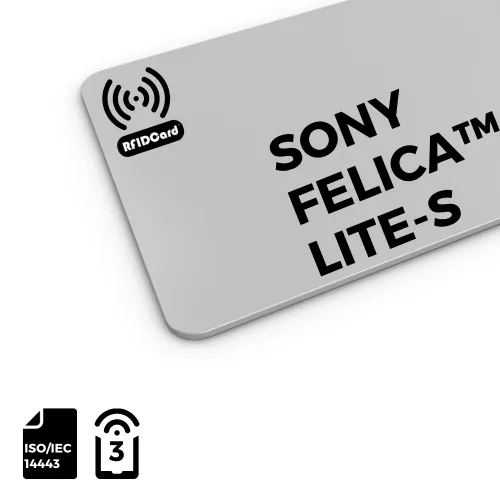
SONY Felica™ Lite-S NFC Type 3 Card CR80

The FeliCa™ Lite-S: RC-S966 product is a small-size contactless IC chip fully comply to NFC Forum Type 3 Tag and ISO/IEC 18092 specifications. The card made with photo quality standard PVC sheets into the size of CR80, that are suitable for use with most direct thermal or thermal transfer card printers.